This post on Here We Stand and Bob Waters commentary really caught my attention. I normally don't comment on a person's private choices, but Dave H. posted on his move himself at Here We Stand, inviting comments.
I don't know much about Anglicanism, although I've learned a lot in the past two years. After spending twenty years adrift in Christianity before discovering a home in confessional Lutheranism, it is incomprehensible to imagine someone leaving. Unless, as Bob suggests, he was never really a confessional Lutheran. I wish Dave H. well...I wish him a deeper understanding of how God saved him and the incredible love He has for. And how we can never, ever atone for our condition of sin. It's just already been taken care of. That's it. Anything else we do is out of deep and uttter gratitude for that gift.
Monday, February 28, 2005


Wednesday, February 23, 2005
Newsletter from my old church - a contest!
I still receive the newsletter from our former church, suburban ELCA mega-church. I have good reasons for receiving it and reading it - my parents still belong there and I do care about the souls in that church. Usually, I don't find anything more bothersome than the things that caused me to pick my teen-aged children up in my arms and carry them out of there. This week, however, I was bothered by this letter from the pastor. Of course, this church continues to do many good things, some of which are very scriptural. Can you guess my concerns? More importantly, can you guess the sentence that I found sadly hilarious and extremely ironic?
Dear Friends,
Wow! When I think of all that has happened in the last couple weeks, it is mind boggling. A couple thousand people here for Ash Wednesday. Twelve hundred for supper. One hundred and seventy people at the Family Fun Time at (a local indoor waterslide park). Since then, we've gotten to know the Syro-Phoenecian Woman at last week's Lenten service. Then, we had tons of kids here for the TEC (Teens Encounter Christ) weekend. And, now we're getting ready to hear from the Rich Young Ruler at this week's Lenten service. I get tired just thinking about all that's happening. In addition to all of the special events, we have over a hundred people involved in Alpha, hundreds of kids in (Sunday School program), people meeting for Bible studies, support groups and all of the rest. In the midst of that we had 56 people get together for an absolutely great event in (warm sunny destination), gathering some of our “snow birds” together for an update on all that's happening at (ELCA mega-church). (Last week I told you there were only 40. Sorry about that). Thank you, thank you, thank you to the countless volunteers that make all of this possible.
This weekend we have a great opportunity at (ELCA mega-church). On Saturday night at 7:00, (ELCA mega-church) is host to (an inner city program). This great ecumenical program of worship has been meeting in different churches around the city for the last several years. We've wanted to host them before, but it hasn't worked out. This Saturday night, our choir will help to host and will perform throughout the first half of the program. (Joe Singer) and his wonderful musicians will perform throughout the evening. You've been hearing many of his songs the last couple weeks, and if you were able to be in church on Sunday you got to see him in person. It's going to be a great event. Hope you can come.
After hearing from the Rich Young Ruler at Lenten services this week, the theme of this weekend's services is “All American Religion.” We'll examine the kind of faith experiences that are so common in America today but bear little resemblance to Biblical faith. I think you'll find the topic fascinating and encouraging. Have a great week. See you in church.
Your Friend and Pastor,
XXX
Dear Friends,
Wow! When I think of all that has happened in the last couple weeks, it is mind boggling. A couple thousand people here for Ash Wednesday. Twelve hundred for supper. One hundred and seventy people at the Family Fun Time at (a local indoor waterslide park). Since then, we've gotten to know the Syro-Phoenecian Woman at last week's Lenten service. Then, we had tons of kids here for the TEC (Teens Encounter Christ) weekend. And, now we're getting ready to hear from the Rich Young Ruler at this week's Lenten service. I get tired just thinking about all that's happening. In addition to all of the special events, we have over a hundred people involved in Alpha, hundreds of kids in (Sunday School program), people meeting for Bible studies, support groups and all of the rest. In the midst of that we had 56 people get together for an absolutely great event in (warm sunny destination), gathering some of our “snow birds” together for an update on all that's happening at (ELCA mega-church). (Last week I told you there were only 40. Sorry about that). Thank you, thank you, thank you to the countless volunteers that make all of this possible.
This weekend we have a great opportunity at (ELCA mega-church). On Saturday night at 7:00, (ELCA mega-church) is host to (an inner city program). This great ecumenical program of worship has been meeting in different churches around the city for the last several years. We've wanted to host them before, but it hasn't worked out. This Saturday night, our choir will help to host and will perform throughout the first half of the program. (Joe Singer) and his wonderful musicians will perform throughout the evening. You've been hearing many of his songs the last couple weeks, and if you were able to be in church on Sunday you got to see him in person. It's going to be a great event. Hope you can come.
After hearing from the Rich Young Ruler at Lenten services this week, the theme of this weekend's services is “All American Religion.” We'll examine the kind of faith experiences that are so common in America today but bear little resemblance to Biblical faith. I think you'll find the topic fascinating and encouraging. Have a great week. See you in church.
Your Friend and Pastor,
XXX
Scary test
I just took the strangest quiz. It is given by Worldview Weekend Seminars. The quiz was fairly simple, although a little long. I scored well as a Biblical Worldview Thinker, but I was disturbed by the evaluation of my individual answers. Although I was given a choice of "no opinion", "tend to agree" and "tend to disagree", selecting these answers actually count against your score. You must only mark "Strongly Disagree" or "Strongly Agree". I am all for a biblical worldview, but this group seems to give the impression that individual thought is wrong and should be punished. I recommend the Confessional Christian Worldview Seminar as a much more gospel-based educational program. Those teachers aren't afraid to let you think on your own.
Your classification is: Strong Biblical Worldview Thinker
Congratulations You Are A Strong Biblical Worldview Thinker.
Your score is: 136 points of 170 possible, 80%
Scoring/Ratings Chart
Strong Biblical Worldview Thinker
75% - 100%
Moderate Biblical Worldview Thinker
50% - 74%
Secular Humanist Worldview Thinker
25% - 49%
Socialist Worldview Thinker
0% - 24%
Communist/Marxist/Socialist/Secular Humanist Worldview Thinker
under 0%
Here's the interesting kicker:
To improve your biblical worldview or that of your teen we recommend the following things:
1. Attend a Worldview Weekend near you. www.worldviewweekend.com
2. Read these books:
Mind Seige by Dr. Tim LaHaye and Dr. David Noebel God & Government I, II, and III by Gary DeMar No Retreasts, No Reserves, No Regreats, by numerous authors Original Intent by David Barton Reasons for Believeing By Frank Harber The Battle For Truth, by David Noebel Revised and Expanded Answers Book by Ken Ham Thinking Straight in a Crooked World by Gary DeMar
3. Then retake the test and see what improvements you or your teen have made.
4. Study the following list for your "wrong" answers.
Your classification is: Strong Biblical Worldview Thinker
Congratulations You Are A Strong Biblical Worldview Thinker.
Your score is: 136 points of 170 possible, 80%
Scoring/Ratings Chart
Strong Biblical Worldview Thinker
75% - 100%
Moderate Biblical Worldview Thinker
50% - 74%
Secular Humanist Worldview Thinker
25% - 49%
Socialist Worldview Thinker
0% - 24%
Communist/Marxist/Socialist/Secular Humanist Worldview Thinker
under 0%
Here's the interesting kicker:
To improve your biblical worldview or that of your teen we recommend the following things:
1. Attend a Worldview Weekend near you. www.worldviewweekend.com
2. Read these books:
Mind Seige by Dr. Tim LaHaye and Dr. David Noebel God & Government I, II, and III by Gary DeMar No Retreasts, No Reserves, No Regreats, by numerous authors Original Intent by David Barton Reasons for Believeing By Frank Harber The Battle For Truth, by David Noebel Revised and Expanded Answers Book by Ken Ham Thinking Straight in a Crooked World by Gary DeMar
3. Then retake the test and see what improvements you or your teen have made.
4. Study the following list for your "wrong" answers.
Tuesday, February 22, 2005
Happy Baptism Anniversary!
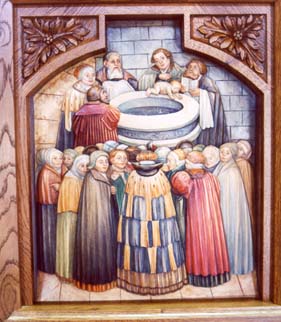
God's saving grace is available to all people.

Five years ago, on February 20th, my children were baptized. This is a day for rejoicing and I was careful to remind them of the importance of the day. On that day, Erik and Kristiana:
became disciples of Jesus Christ;
were born again of water and the Spirit;
had their sins forgiven and washed away;
were baptized into Christ, into His death and resurrection;
became new creations;
put on Christ;
were cleansed and sanctified by the washing of water with the word; and
were saved by the washing of regeneration and renewal by the Holy Spirit.
In a word, they were saved.
(This list was lovingly compiled by John H. of Confessing Evangelical in commemoration of his son's baptism recently.)
The funniest thing of all is that God accomplished all this and I didn't even fully believe it at the time. I was beginning to suspect that God had more power than I had realized, but scripture wouldn't fully convict me for a couple more years.
My kids' baptism day also has special meaning for me. It is a day of joy, certainly...but it is also a day of shame for me. It is a day that forces me to remember my sin in withholding God's power from my children. Despite their requests and admonitions from my husband, mother, mother-in-law and my pastor, I kept them from the saving waters of Holy Baptism.
I had struggled with the purpose of baptism for 20 years! Since my own weak christian training didn't teach me that we are powerless to choose faith apart from the Holy Spirit and that Jesus commanded baptism of all people without mention of age, I hesitated to baptize my own children. I rationalized that even though I was baptised, my own faith didn't mature until I was 20 years old. My wish for mature faith for my children led me to the wrong conclusion that I should have my children wait for baptism until they made their own profession of faith. Thankfully, I did not neglect teaching them God's word and soon I realized that they were Christians through the power of God's Word.
Then it became a game of "Well, when are they old enough to be baptized?". Obviously, that method never gives an answer because children are still children and their faith will never seem mature for years to come. At what point can any of us say about ourselves or our children that faith is now mature and the person is ready for baptism? In those twenty years (before and after having children) of church searching, NO pastor (ELCA, independent, Baptist, Evan. Free, Assemblies of God, Methodist, Covenant, CMA, LCMS) ever told me what the bible truly says about baptism. In fact, pastors in each of these denominations commended me for waiting until my children were ready, that baptism was merely symbolic. During our adult catechism at our new church, I was overwhelmed with my enormous sense of guilt at keeping my children from holy baptism. I did repent of my sin and asked my husband's forgiveness, but I still can't believe how misguided I was.
Now, five years later we just rejoice in the day. In fact, we rejoice in our baptisms every day. That is the true beauty and purpose of baptism, to be remembered and lived in every moment of our lives.
Saturday, February 19, 2005
Evangelism must begin in my home

Evangelism Begins at Home
Teaching God's Word Begins at Home
This means that Evangelism ~ spreading Good News about Jesus ~ begins at home! The Lord, through Moses, encourages us to teach His Truth to our children:
"Impress them on your children. Talk about them when you sit at home and when you walk along the road, when you lie down and when you get up" (Deuteronomy 6:7)
As Christian fathers and mothers do this, impressing on their children God's message of sin and grace, the Holy Spirit works through that message, and their children are blessed with repentance, faith and salvation in Christ. Yet, as Christian parents seek to instruct their children in God's Word faithfully, they face many challenges.
The Challenges
First among the challenges is our own sin and weakness. To be blunt, the sin that lives in every Christian parent's flesh, the Old Adam, hates God's Word. It does not want to hear, read or teach about Jesus. This is the basic reason all fathers and mothers fall short of impressing God's Word on their children as they should. Sin also tempts parents to allow the bustle of daily life to choke out family time spent in God's Word.
"I have a house to clean."
"I have to give the kids their baths."
"I'm just too tired."
"The children have too much homework."
The list is long.
The other challenge to evangelism in the home is the sin of our children. Sin is just as strong in them as it is in us. This is why our children frequently need to be encouraged to make use of daily devotion time and regular church attendance.
If Evangelism in the Home is Lacking
A lack of evangelism in the home is harmful, not only to our children, but also to the broader effort of the church to go into the entire world with the Good News. Christian parents can fall into the trap of getting so wrapped up in "doing evangelism" to save the world that their children, their first evangelism responsibility, are left behind. How does this affect the children? Their faith does not receive the nourishment it needs in order to mature. They can also begin to feel like leftovers. How does it affect the broader mission of the church? Let's put it this way: how sad if we Christians of the Evangelical Lutheran Synod became known for losing our own children in our zeal to evangelize the world!
The Blessings
We Christians of the ELS have been blessed to hear and learn and believe the pure Good News message of the Bible. Jesus lived a perfect life, (including a perfect life of evangelism) to fulfill everything we have left unfulfilled in our sinful lives. Jesus died an atoning death for all our sins (including the sins we have committed by failing to evangelize our children well). By Word and Baptism, the Holy Spirit has given us faith to trust in Christ. Through this faith we are clothed with Christ and receive forgiveness. This is salvation for us sinners, full and free! It is also the lifeblood to a healthy and balanced approach to evangelism. So it is essential that we Christian parents remain in God's Word and baptism day by day, so that faith grows, confidence of salvation remains firm, and love for our children increases. In this, our love and hunger for teaching them about Jesus increases! In faith and love we don't see this as something that keeps us from doing real evangelism; rather we recognize it is the starting point for all evangelism! Certainly the concern we have for those inside our homes will be evident to those we seek to reach outside our homes - in the small towns, suburbs, and cities of our country.
written by Matthew Crick, pastor of Faith Lutheran Church in San Antoinio, Texas and published in the January 2005 issue of the Lutheran Sentinel
Thursday, February 17, 2005
Manila Drive: The Semi-Pelagian Narrower Catechism
I know this is supposed to be funny, but parts of this make me sad - reminding me of a time when I believed some of these points. For example, all of these points. Manila Drive: The Semi-Pelagian Narrower Catechism
Sunday, February 13, 2005
Beggars All: Survey: Where Does Evangelicalism Come From?
I forgot to link to this! This Beggars All post, Survey: Where Does Evangelicalism Come From?was the impetus for Theology Geek's history of evangelicalism post that I linked to yesterday.
Fascinating autobiography...
For those of you who aren't already following, Hapax Legomena has posted his third installment of his spiritual autobiography. Fascinating is an understated term to use. I see that BHT has been discussing it, as well.
Saturday, February 12, 2005
Ash Wednesday and hyposcrisy?
I was frustrated, yet intrigued, earlier this week by a thread of conversation over at Bunnie's blog. Following Bunnie's post about Ash Wednesday, a frequent commenter (who happens to be Baptist) made this comment:
"Just be sure to act like a Christian while you're wearing your ashes! In elementary school, our bus was hit by a parishoner on Ash Wednesday. He walked all around his car, investigate the damage & swearing at the bus driver (it wasn't her fault). Great testimony to the driver and to all of us kids. "
Glen Piper was on the ball to add:
"Well, he certainly showed that he was a sinner, and Church was a good place for him to have been. Hopefully the realization of what he did brought home the lesson of the need for penitential mediation during Lent.
That incident sounds like a good illustration of the importance of the Ash Wednesday -> Lent -> Good Friday -> Easter progression.
And that's not a bad lesson for the kids to have learned (even if it might have only been fully learned in hindsight).
And someone else added: "Nobody is perfect."
I was intrigued by the initial comment and the following comments. I felt I could see a clear picture developing of a person who thinks that their witness is the most important thing versus what I see as a more biblical approach - recognizing your utter need for a Savior, cling to the cross as your only hope and go forward from that point. Maybe the difference seems small? I think the comments from Bunnie's post clearly illustrated that there is a difference in how you view your salvation. Here are more comments:
I added:
"Glen, Good point. That bus incident is a perfect illustration of how Satan waits to trip us up, especially when we fall into Satan's trap of thinking we can "Act like a Christian", even while wearing ashes.
"Acting" like a Christian does no good, is impossible and is offensive to God UNLESS you are acting solely of utter, deep and profound love and gratitude for being saved by grace by God from the fires of hell."
The original commenter attempts again to make her case:
"I certainly didn't mean to imply that those who practice Ash Wednesday are any more imperfect than the rest of us imperfect sinners.
All I meant was, if you are publicly identifying yourself as a Christian, ask God to help you be a good witness. This applies whether you have a John 3:16 bumper sticker, a Jesus Died for You t-shirt, verses posted in your cubicle at the office... or ashes on your forehead. Yes, we're all sinners - but it doesn't do much for the "all Christians are hypocrites" mentality of the unsaved when they don't see that Christ can make a practical difference in our lives.
The next response:
"All Christians ARE hypocrites. What I mean is, they are human. That should be the appealing characteristic, that we can be human and holy at the same time. Acting good has nothing to do with Christ and everything to do with ME. Because of Christ's love we should WANT to be better people, but we don't. The beautiful thing about christianity is that Christ died for you despite who you are or will become. That is how you should proclaim Christianity, NOT "look at me I transformed my life". Christianity is not a lifestyle, it IS life"
The commenter's third and final attempt to clarify and make her point:
Any good thing I do is not done by me, but by the Spirit that dwells within me. HOWEVER, any bad thing that I do is done by me, because I have usurped the Spirit's control in my life. It is clearly God's will that the Spirit will have 100% control in my life, 100% of the time. Obviously, I still have a sin nature, so that ain't happening.
Yes, when I sin it is an opportunity for God's grace to be shown extended to me, a pitiful sinner. But sinning should never be my goal, and it is never a good thing, even if it does demonstrate God's grace.
Romans 6:1-2 "What shall we say then? Are we to continue in sin so that grace may increase? May it never be! How shall we who died to sin still live in it?"
I found this all to be a very interesting exchange. I can't say that I disagreed with anything she said. Since both points are contained in scripture, the two must co- exist. God's word does say that we can do nothing outside of Christ, but it also says "Are we to continue in sin, so that grace may increase?" I have been taught that Romans 6:1-2 refers to deliberately sinning and claiming it doesn't matter because you are already saved. As someone recently wrote somewhere in the blogosphere, Lutherans do tend to react negatively to pietistic practices because they have tended to fall prey to the philosophy over the years.
In a related post, Focal Point by Theology Geek puts it very simply:
The focus of my theology and practice is:
(Gal 6:14 ESV)But far be it from me to boast except in the cross of our Lord Jesus Christ, by which the world has been crucified to me, and I to the world. This is it.
My mission statement, motto, slogan, etc from this point on will be,
“Adopted, Forgiven, and Loved. By Christ alone, through no works of my own”
When it all comes down to it, what else is there?
"Just be sure to act like a Christian while you're wearing your ashes! In elementary school, our bus was hit by a parishoner on Ash Wednesday. He walked all around his car, investigate the damage & swearing at the bus driver (it wasn't her fault). Great testimony to the driver and to all of us kids. "
Glen Piper was on the ball to add:
"Well, he certainly showed that he was a sinner, and Church was a good place for him to have been. Hopefully the realization of what he did brought home the lesson of the need for penitential mediation during Lent.
That incident sounds like a good illustration of the importance of the Ash Wednesday -> Lent -> Good Friday -> Easter progression.
And that's not a bad lesson for the kids to have learned (even if it might have only been fully learned in hindsight).
And someone else added: "Nobody is perfect."
I was intrigued by the initial comment and the following comments. I felt I could see a clear picture developing of a person who thinks that their witness is the most important thing versus what I see as a more biblical approach - recognizing your utter need for a Savior, cling to the cross as your only hope and go forward from that point. Maybe the difference seems small? I think the comments from Bunnie's post clearly illustrated that there is a difference in how you view your salvation. Here are more comments:
I added:
"Glen, Good point. That bus incident is a perfect illustration of how Satan waits to trip us up, especially when we fall into Satan's trap of thinking we can "Act like a Christian", even while wearing ashes.
"Acting" like a Christian does no good, is impossible and is offensive to God UNLESS you are acting solely of utter, deep and profound love and gratitude for being saved by grace by God from the fires of hell."
The original commenter attempts again to make her case:
"I certainly didn't mean to imply that those who practice Ash Wednesday are any more imperfect than the rest of us imperfect sinners.
All I meant was, if you are publicly identifying yourself as a Christian, ask God to help you be a good witness. This applies whether you have a John 3:16 bumper sticker, a Jesus Died for You t-shirt, verses posted in your cubicle at the office... or ashes on your forehead. Yes, we're all sinners - but it doesn't do much for the "all Christians are hypocrites" mentality of the unsaved when they don't see that Christ can make a practical difference in our lives.
The next response:
"All Christians ARE hypocrites. What I mean is, they are human. That should be the appealing characteristic, that we can be human and holy at the same time. Acting good has nothing to do with Christ and everything to do with ME. Because of Christ's love we should WANT to be better people, but we don't. The beautiful thing about christianity is that Christ died for you despite who you are or will become. That is how you should proclaim Christianity, NOT "look at me I transformed my life". Christianity is not a lifestyle, it IS life"
The commenter's third and final attempt to clarify and make her point:
Any good thing I do is not done by me, but by the Spirit that dwells within me. HOWEVER, any bad thing that I do is done by me, because I have usurped the Spirit's control in my life. It is clearly God's will that the Spirit will have 100% control in my life, 100% of the time. Obviously, I still have a sin nature, so that ain't happening.
Yes, when I sin it is an opportunity for God's grace to be shown extended to me, a pitiful sinner. But sinning should never be my goal, and it is never a good thing, even if it does demonstrate God's grace.
Romans 6:1-2 "What shall we say then? Are we to continue in sin so that grace may increase? May it never be! How shall we who died to sin still live in it?"
I found this all to be a very interesting exchange. I can't say that I disagreed with anything she said. Since both points are contained in scripture, the two must co- exist. God's word does say that we can do nothing outside of Christ, but it also says "Are we to continue in sin, so that grace may increase?" I have been taught that Romans 6:1-2 refers to deliberately sinning and claiming it doesn't matter because you are already saved. As someone recently wrote somewhere in the blogosphere, Lutherans do tend to react negatively to pietistic practices because they have tended to fall prey to the philosophy over the years.
In a related post, Focal Point by Theology Geek puts it very simply:
The focus of my theology and practice is:
(Gal 6:14 ESV)But far be it from me to boast except in the cross of our Lord Jesus Christ, by which the world has been crucified to me, and I to the world. This is it.
My mission statement, motto, slogan, etc from this point on will be,
“Adopted, Forgiven, and Loved. By Christ alone, through no works of my own”
When it all comes down to it, what else is there?
History of Evangelicalism
Theology Geek posted this week on a brief history of evangelicalism in America.
Thursday, February 10, 2005
Church Voices on biblical names people DON'T use for baby names
Tim Reed of Church Voices posts this funny commentary:
The scriptures are filled with such disreputable people. The kinds of people your momma warned you about. So, without further ado I present to you my favorite people your momma warned you about from scripture.
Wednesday, February 09, 2005
Cerulean Sanctum: I want to be a clone
Dan E. of Cerulean Sanctum wrote this back on 11-12-04, but it's new to me and I thought others might enjoy it, too. It certainly echos concerns I had just a couple of years ago, both in church and as I listened to Christian radio.
Dan writes:
"Is it just me or has nearly every church in this country been cloned? In the last few months, my wife and I have visited about a half-dozen different churches. Just a decade ago, the differences between those churches in their musical choices, sermon styles, liturgy choices (including no liturgy at all), and the like would have been profoundly different. Even their emphases on particular doctrinal aspects of Christianity would have been prominently on display during a worship service, and uniquely geared to the denominational beliefs of the church. Today, though, it doesn't matter if you go to a Free Methodist, Friends, Vineyard, Baptist, Pentecostal, Presbyterian, or any other denomination because what they show you on Sundays and through the week is identical. Say what you will about the worth of denominational factionalism, but if our churches are all aspiring to a lowest common denominator sameness, is that an improvement?
Now you can make a claim for ecumenism here, but I think it goes far beyond that. Evangelicalism is enmeshed in the church growth movement to such a degree that denominations are jettisoning their cores in order to embrace the flavor of the week. I continue to be astonished at the rate with which The Willow Creek Association is consuming churches, asking them to ascribe to Willow Creek's ministry models without question. But is anyone asking the pivotal question: What if Willow Creek's ministry model and philosophies are wrong? read on...
These were my same questions about two years ago. I was in an ELCA mega-church which was rapidly (and still is) throwing out Luther's reminders of what the Bible teachers for complete opposite doctrine. My point isn't to argue doctrine, but to ask the same questions. Why are we changing and what are we changing to? It was very unsettling to watch infant baptism being downplayed, formal confirmation and spiritual education programs chucked for "Wednesday Night Live", confirmation rites replaced with Affirmation of Baptism services, Lutheran curriculum thrown out for Baptist curriculum, pastors arguing over doctrine, hymns for praise choruses, liturgy for testimonies, etc... Of course, on top of that there was the whole anti-American, pro-choice, pro blessing of same-s#x marriages... I was very quickly an evangelical Lutheran without a church home. But not for too long :)
Dan writes:
"Is it just me or has nearly every church in this country been cloned? In the last few months, my wife and I have visited about a half-dozen different churches. Just a decade ago, the differences between those churches in their musical choices, sermon styles, liturgy choices (including no liturgy at all), and the like would have been profoundly different. Even their emphases on particular doctrinal aspects of Christianity would have been prominently on display during a worship service, and uniquely geared to the denominational beliefs of the church. Today, though, it doesn't matter if you go to a Free Methodist, Friends, Vineyard, Baptist, Pentecostal, Presbyterian, or any other denomination because what they show you on Sundays and through the week is identical. Say what you will about the worth of denominational factionalism, but if our churches are all aspiring to a lowest common denominator sameness, is that an improvement?
Now you can make a claim for ecumenism here, but I think it goes far beyond that. Evangelicalism is enmeshed in the church growth movement to such a degree that denominations are jettisoning their cores in order to embrace the flavor of the week. I continue to be astonished at the rate with which The Willow Creek Association is consuming churches, asking them to ascribe to Willow Creek's ministry models without question. But is anyone asking the pivotal question: What if Willow Creek's ministry model and philosophies are wrong? read on...
These were my same questions about two years ago. I was in an ELCA mega-church which was rapidly (and still is) throwing out Luther's reminders of what the Bible teachers for complete opposite doctrine. My point isn't to argue doctrine, but to ask the same questions. Why are we changing and what are we changing to? It was very unsettling to watch infant baptism being downplayed, formal confirmation and spiritual education programs chucked for "Wednesday Night Live", confirmation rites replaced with Affirmation of Baptism services, Lutheran curriculum thrown out for Baptist curriculum, pastors arguing over doctrine, hymns for praise choruses, liturgy for testimonies, etc... Of course, on top of that there was the whole anti-American, pro-choice, pro blessing of same-s#x marriages... I was very quickly an evangelical Lutheran without a church home. But not for too long :)
Old Solar now has a blog! Introducing Daylight
Old Solar Magazine now has a blog! This is very exciting news and I look forward to checking it each day!
Old Solar Magazine
Daylight blog
Old Solar Magazine
Daylight blog
Monday, February 07, 2005
What attracted you to Confessional Lutheranism?
A friend alerted me to this interesting post on Phoenix Preacher blog. Phoenix Preacher seems to be identifying problems with Calvary Chapel. I am not familiar with that movement, but I know of a couple who was involved. Phoenix Preacher has posted an interesting question: he has asked for input from former evangelicals who have turned to confessional Lutheran churches:
Pastor Michael Newnham: Questions For Our Lutheran Friend
Check out this link and comment, if you have something to say. I'd love it if you copy your comment and leave it here, too. Or I could compile comments and forward them to the pastor. As of today, there is one lengthy and interesting comment by a former evangelical turned Lutheran. That commenter is a friend of mine! He writes:
"My path from Calvary Chapel to Lutheranism occurred about 3 years ago. We were involved in a start-up Calvary for about 3-4 years before that. My wife was raised Lutheran but like many, became involved in a parachurch group, InterVarsity, during college. Most of our last 25-30 years were spent in various evangelical churches, including CC. I first realized Lutheranism had something to offer after ordering tapes from a Lutheran theological radio show called “Issues, Etc.” from St. Louis (www.issuesetc.org). They interviewed a Christian apologist who came out of the extreme charismatic movement, which we also did. After that, I started listening to the archived radio shows. The stuff about baptism and the sacraments turned me off. But as I kept reading, I realized the riches of Lutheranism..." keep reading
Pastor Michael Newnham: Questions For Our Lutheran Friend
Check out this link and comment, if you have something to say. I'd love it if you copy your comment and leave it here, too. Or I could compile comments and forward them to the pastor. As of today, there is one lengthy and interesting comment by a former evangelical turned Lutheran. That commenter is a friend of mine! He writes:
"My path from Calvary Chapel to Lutheranism occurred about 3 years ago. We were involved in a start-up Calvary for about 3-4 years before that. My wife was raised Lutheran but like many, became involved in a parachurch group, InterVarsity, during college. Most of our last 25-30 years were spent in various evangelical churches, including CC. I first realized Lutheranism had something to offer after ordering tapes from a Lutheran theological radio show called “Issues, Etc.” from St. Louis (www.issuesetc.org). They interviewed a Christian apologist who came out of the extreme charismatic movement, which we also did. After that, I started listening to the archived radio shows. The stuff about baptism and the sacraments turned me off. But as I kept reading, I realized the riches of Lutheranism..." keep reading
Friday, February 04, 2005
Pastor Paul McCain: Confessions of a back-slider
This story is guaranteed to give you goosebumps!
"After my spiritual rebirth at the wobbly age of 14--amid the cultural wasteland of the 1970s--I clung to such distinctions as if my life depended on it. The Jesus Movement was in high gear and I relished using the lingo that identified me as a participant. When we approved of something, we'd say, "What a blessing!" or "Praise God." When we told each other goodbye, we'd invoke, "God bless."
I even enjoyed that word backslider--taken from Proverbs 14:14: "The backslider in heart shall be filled with his own ways." We had other words for those ex-Christians: they were "strays," and "exes," and "prodigals," and "blotmarks." That last epithet is taken from Revelations 3:5, in which the apostle John describes a vision of Jesus, who says, "He that overcometh, the same will be clothed in white raiment; and I will not blot out his name from the Book of Life."
The message was clear: to "walk with the Lord" and then slide back from salvation was to embrace a fate even more fiery than the one awaiting those who'd never been saved in the first place."Update: Be sure to catch JS Bangs comments on this article at Hapax Legomena.
Postmodern Communion Service
Communion Service ala Emergent Church Movement
Paradoxology reports on Emergent '05:
Tonight's General Session was excellent. It all began with the worship team from Church of the Apostles leading us in an amazing Eucharistic service that focused on the Transfiguration. The liturgy they crafted included ancient elements re-cast in song and prayer and testimony, and climaxed with everyone partaking of Holy Communion together.
I'm not making any kind of judgment or statement, other than I think that all Christians should learn about the postmodern church movement.
Early Church Fathers on Infant Baptism
Hat tip to U.T. Brito of Ad Majorem Dei Gloriam blog for a link to this piece at Reformation Today entitled Patristic Testimony to the Scriptural Doctrine and Practice of Baptizing Infants into the Christian Faith and Church.
CrossWise: Quote Box
Thanks to Glen at Territorial Bloggings for his post on CrossWise Magazine's Quote Box. Here's two excerpts:
From 2-4-05
Some Christian teachers among us unwittingly encourage us to read our Bibles apart from Christ. They look to the Bible primarily as a source of advice for practical living. They may tell members to open the Bible randomly, and to "let God speak" through the words on that page. But while God does speak to all people through Holy Scripture, it is important to remember what He is saying. Jesus told us Himself: the Holy Scriptures "testify about me." (John 5:39)
When we open our Bibles, may God show us Christ at the center. When we read or hear Christian teaching -- in books or even from our own church's pulpit -- may God give us the wisdom to discern whether Christ is front and center. And if Christ is not at the center, may God give us the courage to speak the truth in love, gently pointing our brothers and sisters back to the True Foundation of the faith: Christ Jesus and His work on the cross.
From 2-3-05
No matter how ridiculous it sometimes seems, the Word of God accomplishes what God wants. When Simeon saw Jesus, he spoke words that were ridicuous on their face. Simeon called Jesus his "salvation"--a light for the Gentiles and the glory of Israel. To those without faith, it must have seemed insane.
But Martin Luther points out that God's Word is not effective merely when it seems reasonable. Whether we think God's Word makes sense or not, it is still powerful to do what God desires--'the Word of God must produce results,' Luther says. In this case, Luther points out that Mary and Joseph did believe, though most in the temple scoffed.
Our sinfulness naturally inclines us to doubt the power of God's Word. We sometimes wonder whether proclaiming God's Law and Gospel are enough--especially in today's world. In fact, many churches, with the best of intentions, have taken steps to water down God's Word in an effort to reach out to unbelievers. There is a movement among many of America's largest churches -- even some Lutheran ones -- to move or remove crosses, out of fear that the bloody message of Christ's crucifixion will be too harsh for modern, unbelieving ears. Sermons speak less and less of Christ's actions, and more and more of Christians' actions. The powerful Word of God is set aside for the practical word of man.
From 2-4-05
Some Christian teachers among us unwittingly encourage us to read our Bibles apart from Christ. They look to the Bible primarily as a source of advice for practical living. They may tell members to open the Bible randomly, and to "let God speak" through the words on that page. But while God does speak to all people through Holy Scripture, it is important to remember what He is saying. Jesus told us Himself: the Holy Scriptures "testify about me." (John 5:39)
When we open our Bibles, may God show us Christ at the center. When we read or hear Christian teaching -- in books or even from our own church's pulpit -- may God give us the wisdom to discern whether Christ is front and center. And if Christ is not at the center, may God give us the courage to speak the truth in love, gently pointing our brothers and sisters back to the True Foundation of the faith: Christ Jesus and His work on the cross.
From 2-3-05
No matter how ridiculous it sometimes seems, the Word of God accomplishes what God wants. When Simeon saw Jesus, he spoke words that were ridicuous on their face. Simeon called Jesus his "salvation"--a light for the Gentiles and the glory of Israel. To those without faith, it must have seemed insane.
But Martin Luther points out that God's Word is not effective merely when it seems reasonable. Whether we think God's Word makes sense or not, it is still powerful to do what God desires--'the Word of God must produce results,' Luther says. In this case, Luther points out that Mary and Joseph did believe, though most in the temple scoffed.
Our sinfulness naturally inclines us to doubt the power of God's Word. We sometimes wonder whether proclaiming God's Law and Gospel are enough--especially in today's world. In fact, many churches, with the best of intentions, have taken steps to water down God's Word in an effort to reach out to unbelievers. There is a movement among many of America's largest churches -- even some Lutheran ones -- to move or remove crosses, out of fear that the bloody message of Christ's crucifixion will be too harsh for modern, unbelieving ears. Sermons speak less and less of Christ's actions, and more and more of Christians' actions. The powerful Word of God is set aside for the practical word of man.
Thursday, February 03, 2005
My thoughts on Joel Osteen
The current swarm descending on Joel Osteen is not surprising. It is our human nature to attack each other, I think. The criticism headed his way is not surprising; he deserves it. He seems to have removed the gospel from his teachings and people are finally getting up their nerve to call him on it. What I find interesting in the Osteen bashing is that whenever people start to discuss doctrine (the keeping of Jesus' teachings), the accusers say that is not part of the discussion. Start here with iMonk's post. Note the drift into doctrine by several wordy commenters (I think One Salient Oversight has some great points and look forward to his upcoming blog, but then note iMonk's response to the shift to doctrine:
Oversight--- I appreciate the post and the info, but I am not looking to argue with Pelagians or Pentecostals or Arminians. I am not arguing Calvinism with non-Calvinists. I accept the Christian profession of non-Calvinists.
My issue with Osteen is the Gospel itself. Not some version of the Gospel.
He adds later:
I agree with you, but I hope you can see that my appeal to evangelical bloggers is not for the sake of defending reformed creeds vs Pentecostal creeds.
It's simply identifying Osteen as what he is: A non-evangelical with a non-Christian message. In fact, I don't want to discuss that statement of faith, because it implies Osteen is doing theology. He's not. LISTEN TO HIM. There is no Gospel and no theology. He's Oprah. He's Tony Robbins.
Now, on one hand I understand that iMonk is trying to keep the conversation focused on what he wants to discuss - Osteen- but look at what is happening: the pointing out of a false teacher leads automatically to discussion of doctrine. iMonk appears to be hindering a healthy discussion.
Doctrine: Something taught; a teaching. From the Latin word doctrna meaning doctor or teacher. The keeping of Jesus' teachings is doctrine.
Again, this is human nature. Wanting to point out the stick in someone else's eye, but not see the plank in your own eye. Hey, that sounds like something Jesus said! ;)
Oversight--- I appreciate the post and the info, but I am not looking to argue with Pelagians or Pentecostals or Arminians. I am not arguing Calvinism with non-Calvinists. I accept the Christian profession of non-Calvinists.
My issue with Osteen is the Gospel itself. Not some version of the Gospel.
He adds later:
I agree with you, but I hope you can see that my appeal to evangelical bloggers is not for the sake of defending reformed creeds vs Pentecostal creeds.
It's simply identifying Osteen as what he is: A non-evangelical with a non-Christian message. In fact, I don't want to discuss that statement of faith, because it implies Osteen is doing theology. He's not. LISTEN TO HIM. There is no Gospel and no theology. He's Oprah. He's Tony Robbins.
Now, on one hand I understand that iMonk is trying to keep the conversation focused on what he wants to discuss - Osteen- but look at what is happening: the pointing out of a false teacher leads automatically to discussion of doctrine. iMonk appears to be hindering a healthy discussion.
Doctrine: Something taught; a teaching. From the Latin word doctrna meaning doctor or teacher. The keeping of Jesus' teachings is doctrine.
Again, this is human nature. Wanting to point out the stick in someone else's eye, but not see the plank in your own eye. Hey, that sounds like something Jesus said! ;)
The Next Reformation by Carl Raschke
Has anyone read the book, The Next Reformation, by Carl Raschke? The subtitle is Why Evangelicals Must Embrace Postmodernity
My church just finished a Wednesday class series on the seduction of Chrisitianity and we spent one whole evening discussing the postmodern movement in the church. The crux of the discussion was not slamming postmodernism, but recognizing and understanding the movement.
Here is what Discerning Reader has to say about the book:
Postmodernism has become a four-letter word among many evangelicals. It has been blamed for every malaise of contemporary society and vilified as the greatest threat to contemporary Christian faith. In The Next Reformation, Carl Raschke acquaints readers with what postmodernism really is, and more importantly, what it is not. He argues that evangelical Christianity has allied itself with non-Christian philosophies, including rationalism and evidentialism, and suggests that breaking this alliance and embracing postmodernism may allow evangelical Christianity to flourish once again as a progressive rather than reactionary force in the present-day world.
Raschke begins with a detailed analysis of the current state of postmodernism and evangelical thought. He provides a background to the controversy, revealing what the term has meant in different contexts and how it relates to contemporary evangelicalism. He describes the development of postmodernism, explores the writings of early postmodernist thinkers, and examines how postmodernist thought has influenced contemporary theology from Derridian deconstruction to Radical Orthodoxy.
Raschke then reveals the opportunities postmodernism brings to Christian faith. He examines how postmodern perspectives bring new meaning to the doctrines of faith alone and sola scriptura, illustrating how these doctrines can be revived by means of postmodern language and philosophy. Raschke goes on to explore how postmodern views of hierarchy and organization could alter the structure of the church toward the Reformation theme of the priesthood of all believers.
I'm thinking it might be a good book to read, but was wondering if anyone had read it and could recommend it to me.
My church just finished a Wednesday class series on the seduction of Chrisitianity and we spent one whole evening discussing the postmodern movement in the church. The crux of the discussion was not slamming postmodernism, but recognizing and understanding the movement.
Here is what Discerning Reader has to say about the book:
Postmodernism has become a four-letter word among many evangelicals. It has been blamed for every malaise of contemporary society and vilified as the greatest threat to contemporary Christian faith. In The Next Reformation, Carl Raschke acquaints readers with what postmodernism really is, and more importantly, what it is not. He argues that evangelical Christianity has allied itself with non-Christian philosophies, including rationalism and evidentialism, and suggests that breaking this alliance and embracing postmodernism may allow evangelical Christianity to flourish once again as a progressive rather than reactionary force in the present-day world.
Raschke begins with a detailed analysis of the current state of postmodernism and evangelical thought. He provides a background to the controversy, revealing what the term has meant in different contexts and how it relates to contemporary evangelicalism. He describes the development of postmodernism, explores the writings of early postmodernist thinkers, and examines how postmodernist thought has influenced contemporary theology from Derridian deconstruction to Radical Orthodoxy.
Raschke then reveals the opportunities postmodernism brings to Christian faith. He examines how postmodern perspectives bring new meaning to the doctrines of faith alone and sola scriptura, illustrating how these doctrines can be revived by means of postmodern language and philosophy. Raschke goes on to explore how postmodern views of hierarchy and organization could alter the structure of the church toward the Reformation theme of the priesthood of all believers.
I'm thinking it might be a good book to read, but was wondering if anyone had read it and could recommend it to me.
Wednesday, February 02, 2005
More reasons to keep Jesus teachings...
But there were also false prophets among the people, just as there will be false teachers among you. They will secretly introduce destructive heresies, even denying the sovereign Lord who bought them-bringing swift destruction upon themselves. many will follow their shameful ways and will bring the way of truth into disrepute. In their greed these teachers will exploit you with stories they have made up. Their condemnation has long been hanging over them and their destruction has not been sleeping....These men are springs without water and mists driven by a storm...For they mouth empty, boastful words and by appealing to the lustful desires of sinful human nature they entice people who are just escaping from those who live in error.
2Peter2
Keep this verse handy if you like to watching television preachers.
2Peter2
Keep this verse handy if you like to watching television preachers.
Victory in Jesus?
Lately, the hymn with the refrain, "Victory in Jesus, my Savior for ever" has been going through my head. I have been thinking that the words are not very scriptural or at least not very balanced. I have sung this song so many times!
I heard an old, old story,
Chorus
The chorus is etched in my mind, unfortunately. I say unfortunately, because I associate the song with the emphasis on the one-time and your done style of conversion and the resulting emphasis on holy living going forward. If you haven't been in a church like that (there are many) you'll have to trust me when I tell you the setting this song is sung. It is sung as if to build up our strength to continue to try and live a Christian life. It fails in that your spirit is deflating the second you commit another sin - probably before you get to the parking lot for most humans. In this song is missing a verse about how we remain sinners our whole lives and can't possible attain holiness on this earth. The fact that we are so totally dependant on Christ for our salvation is where true encouragement, peace and hope comes from.
For indeed He was crucified because of weakness,
JS writes...
I’ve heard a lot of people talk about identity in Christ, and usually this is couple with the idea that we are “more than conquerors through Christ". The victorious life that we are supposed to live through Christ is one of strength, confidence, joy, etc. For some people this teaching might be a source of encouragement, but for me the effect is the exact opposite–it depresses me and makes me angry. Why? Keep reading...
Words and Music by E.M. Bartlett© 1939
Based on 1 Corinthians 15:57
"But thanks be to God,
which giveth us the victory
through our Lord Jesus Christ."
I heard an old, old story,
How a Savior came from glory,
How He gave His life on Calvary
To save a wretch like me;
I heard about His groaning,
Of His precious blood's atoning,
Then I repented of my sins
And won the victory.
Chorus
O victory in Jesus,My Savior, forever.
He sought me and bought meWith His redeeming blood;
He loved me ere I knew Him
And all my love is due Him,
He plunged me to victory,
Beneath the cleansing flood.
The chorus is etched in my mind, unfortunately. I say unfortunately, because I associate the song with the emphasis on the one-time and your done style of conversion and the resulting emphasis on holy living going forward. If you haven't been in a church like that (there are many) you'll have to trust me when I tell you the setting this song is sung. It is sung as if to build up our strength to continue to try and live a Christian life. It fails in that your spirit is deflating the second you commit another sin - probably before you get to the parking lot for most humans. In this song is missing a verse about how we remain sinners our whole lives and can't possible attain holiness on this earth. The fact that we are so totally dependant on Christ for our salvation is where true encouragement, peace and hope comes from.
Today, Hapax Legomena posts encouragingly on what victory in Christ truly is and what it is not.
For indeed He was crucified because of weakness,
yet He lives because of the power of God.
For we also are weak in Him,
yet we shall live with Him
because of the power of God
directed toward you.
2 Cor 13:4
JS writes...
I’ve heard a lot of people talk about identity in Christ, and usually this is couple with the idea that we are “more than conquerors through Christ". The victorious life that we are supposed to live through Christ is one of strength, confidence, joy, etc. For some people this teaching might be a source of encouragement, but for me the effect is the exact opposite–it depresses me and makes me angry. Why? Keep reading...
Subscribe to:
Posts (Atom)