Showing posts with label Holy Communion. Show all posts

Monday, May 07, 2007

A faulty premise on the Lord's Supper

Should I try blogging again, Jack?

I read a post at Boar's Head Tavern, my favorite religion blog I never recommend to others*, on Saturday which literally kept me thinking all weekend. One of my favorite Lutheran bloggers affectionately known as Pirate posted a good commentary on the what Lutheran's believe regarding the Lord's Supper. The post was timely because I was looking forward to hearing Pastor Flohr announce loudly with joy, "Your sins are forgiven! Depart in peace!"

Here's is the entire thread. I know its against blogging protocol to post something in its entirety, but in this case I will:

The Real Presence

The Lutheran doctrine is fairly simple: the bread and wine, by virtue of Christ having said so in the Words of Institution, is no longer just bread and wine only, but also the body and blood of Christ. The body and blood of Christ are in fact taken and eaten.

The litmus test is what we call the manducatio impiorum, which is a fancy Latin slogan meaning “The unbelievers eat the body and blood of Christ, too,” but to their judgment, not to their salvation–just like they hear the Gospel, but not unto salvation. There are two major points of doctrine that rest on the Real Presence:

First, the forgiveness of sins, life, and salvation are all bestowed in the Supper. Notice the difference between Q168 of the WLC and Luther’s Small Catechism. First, Westminster:

The Lord’s Supper is a sacrament of the New Testament, wherein, by giving and receiving bread and wine according to the appointment of Jesus Christ, his death is showed forth; and they that worthily communicate feed upon his body and blood, to their spiritual nourishment and growth in grace; have their union and communion with him confirmed; testify and renew their thankfulness, and engagement to God, and their mutual love and fellowship each with other, as members of the same mystical body.

Nowhere is forgiveness mentioned. Rather, the sacrament is essentially a means of increasing one’s sanctification, which is nearly identical to the Roman Catholic view of Holy Communion (which is different from the Sacrifice of the Mass). Now, Luther:

That is shown us in these words: Given, and shed for you, for the remission of sins; namely, that in the Sacrament forgiveness of sins, life, and salvation are given us through these words. For where there is forgiveness of sins, there is also life and salvation.

And in the context of Luther’s theology, “life” means “eternal life.” Sacraments bestow justification.

The second is that the reality of the sacrament is founded exclusively on Christ’s word. Westminster simply asserts that those who have faith feed on Christ in the Supper. Christ’s institution and word are only mentioned when discussing how the sacrament is to be performed, but not in discussing what it is, or how we know what is there. Any sense of the Words of Instutution being that which makes the sacramental reality is made is completely absent–faith, not the word of Christ, make the Supper into the eating and drinking of Christ’s body and blood (and that only in a spiritual sense). Without faith, only bread and wine is there, leaving it incumbent upon the communicant to ascertain for himself whether what is supposed to be happening is truly happening with him. Therefore, one must condition one’s self internally for the Supper to work. As Q171 says,

They that receive the sacrament of the Lord’s Supper are, before they come, to prepare themselves thereunto, by examining themselves of their being in Christ, of their sins and wants; of the truth and measure of their knowledge, faith, repentance; love to God and the brethren, charity to all men, forgiving those that have done them wrong; of their desires after Christ, and of their new obedience; and by renewing the exercise of these graces, by serious meditation, and fervent prayer.

Contrast that with Luther, who always goes back to “This is my body.” It is Christ’s body because Christ has said so, and it gives the forgiveness of sins because Christ has said so. The communicant is exhorted to look not within himself, but to simply believe what Christ has said”

Fasting and bodily preparation is, indeed, a fine outward training; but he is truly worthy and well prepared who has faith in these words: Given, and shed for you, for the remission of sins.

The Lutheran doctrine of the Supper is nothing other than justification by faith alone put into practice.


Shea posted a good response to Pirate's post:

If I was holding the highlighter and reading the Luther you quoted I would have presented it this way:

That is shown us in these words: Given, and shed for you, for the remission of sins; namely, that in the Sacrament forgiveness of sins, life, and salvation are given us through these words. For where there is forgiveness of sins, there is also life and salvation.

The question in my mind is to what degree faith in this promise requires believing anything about the bread and cup themselves. In 1 Corinthians 10 (one chapter before the LS ordinance, obviously) when Paul said that “They all ate the same spiritual food and drank the same spiritual drink; for they drank from the spiritual rock that accompanied them, and that rock was Christ.” Do you believe that the Rock was Christ in the same way that the bread you eat tomorrow is?

I’m sure that’s not the first time you’ve heard this argument, but I will be interested to hear your answer to it.

Can you guess what about Shea's question intrigued me? I think he is operating from faulty premise about what is important to Lutherans. What could that be?


*I never recommend BHT blog to anyone because it should be discovered and read at one's own risk. I love it, but it could really confuse someone not prepared to THINK.

Friday, August 18, 2006

The Masks of God

The other day I picked up a photo on my pastor's desk. It was of his first son, Hugh, taken just hours before he died last August. Although Hugh's skin tone and the tubes attached to his little body indicated a sick child, the sparkle in his eyes and the smile on his face were full of life and expressed delight and joy.

I was struck by the contrast in the photo: dying child full of life. How could that be? I know if it had been a photo of me as I lay dying, I would have made sure to look sick in the photo! Hugh hadn't learned that trick yet. He was still reveling in the joy of life...of a life soon to change.

I think there is a lesson in that photo. I need to find some scripture to go along with it. God put life into the child and gave him a soul. Baptism brought his soul into faith in Christ. Disease, born of a sinful earth, robbed Hugh of his earthly body, but not the life God gave him.

In honor of the one-year anniversary of Hugh Brooks' arrival at heaven's gate, I am posting something I wrote after attending his funeral. Up to that point in my life, I had never been to the funeral of a pastor's children nor had ever been to the funeral of a child. Here are my reflections of that day...


Masks of God

orginally posted in August of 2005


All our work in the field, in the garden, in the city, in the home, in struggle, in government--to what does it all amount before God except child's play, by means of which God is pleased to give his gifts in the field, at home, and everywhere? These are the masks of our Lord God, behind which he wants to be hidden and to do all things. --Martin Luther, "Exposition of Psalm 147" from Masks of God blog


Our pastor and his wife recently buried their young son. During his four short months on this earth, struggling to overcome a heart defect, his parents kept on online journal. One entry, made on a more hopeful day, struck me deeply:

We are so thankful to see God working and to see Him hiding Himself behind the vocations of cardiologist, neurologist, anesthetologist, surgeon and nurse. Doctor is one of the masks God wears.
This young pastor also wears a mask of God, and his wife as well. Even in their deep and utter grief, though they were both emotionally and physically near exhaustion from the death of their sweet firstborn son, God's love could be seen beaming through in their eyes, their smiles and their touch. They were not spiritually exhausted; they were reaching out to all of us, hugging everyone and reminding us of the joy of salvation that sweet Hugh has now obtained through Jesus' death on the cross.

I had never seen a pastor at the funeral of one of his own. I had never been at the funeral of a baby nor a child. Now, I don't base my faith on what my eyes have seen and I can't believe in God just because of how my pastor and his wife gave clear account for the joy that is in their hearts; but seeing them doing so confirmed what I already knew to be true through the witness of the Holy Spirit. God has provided a clear and joyous salvation from this fallen creation - where little boys are born with heart defects- through the atoning sacrifice of his Son, Jesus Christ, who was raised from the dead, ascended into heaven and sits at the right hand of God. He has prepared a place for all who believe this is true. As if that wern't good enough, God has also sent his Holy Spirit to plant the seed of faith in the hearts of all who are washed in the waters of Holy Baptism and to grow and strengthen the faith of all who hear His Word preached and partake of Holy Communion. My pastor taught me this and he didn't run from it when his own little son died. Pastor and wife are one of the masks God wears.


During this last week, I have struggled fruitlessly on my own to defeat the evil plot of a computer programmer who has used his God-given talents for understanding numbers and computer programming to trick people, steal their money and corrupt minds and souls. He or she is faceless and nameless to me, but not to God. He is wasting his talent and rejecting God's urging to come to Him.

Just when I was ready to give up, I was led by my ISP provider to a young man who also has great God-given talents for understanding the same things as his evil counterpart. He uses those talents to continually learn more about viruses and trojans and hackers. He freely gives his time for no pay to companies in exchange for learning more.

To date, he has spent three hours straight on his phone dime, doing the work of a entry-level computer support person while also searching for an elusive hidden trojan virus. Sure, he is compensated in others ways and hopes to one day invent a little device to clean your machine in five minutes! But, he's got a long way to go and on his way he has helped countless numbers of people rid their machines of trouble and get back to work. Computer programmer,"geek", forensic network specialist are also masks God wears.

Pastor Snyder recently posted about the new Lutheran Carnival and the confessional Lutheran blogosphere: Ask the Pastor: Lutheran Carnival III and Beyond. He wrote:

"Lutherans are among those rare few who realize that even when we talk of “ships and sails and sealing wax, of cabbages and kings,” we also are talking theology. While I’m pretty sure that there will be plenty of theologizing from blogging pastors I’d be interested not only in lay theological perspectives about jobs, careers, marriage, and other vocational areas, but also reading some of the “daily grind.” Many of the bloggers I read, including Love and Blunder, Kiihnworld, and Pastor Steve Billings let me see much of their hearts and their theology through windows opened into the “ordinary” in their lives."
Yes, Pastor Snyder mentioned me in his last sentence and it really touched my heart, but that is NOT why I am mentioning his post. Blogs have been taking a bad rap lately, especially among our own. That deeply saddens me because blog-keeper is also a very honorable vocation. I began writing not thinking that anyone would ever read. I wrote to make sense of my life and faith.

About two months after starting my blog, I did a random search for confessional lutheran blog, thinking I would find nothing. With great surprise and delight I clicked on The Random Thoughts of a Confessional Lutheran and my world changed. From that blog, I discovered so many others, Confessing Evangelical and Bunnie Diehl were among the firsts and are still my favorites, although I've met so many more fellow saints since then. For the first time in months I realized that I wasn't alone in coming to the Lutheran confessions. Now how else would I have found other confessional Lutherans to strengthen my faith - mutual consolation of the saints, as the wise Wildboar once wrote.

Writing about my very ordinary life through the lens of my faith in God has helped me to be able to be able to more easily give account for the joy that God placed in my heart. And I'm not talking about blogging, I'm talking about my everyday REAL life. Writing about my faith is helping me to be open about my faith to others. I used to save my "Christian comments" for fellow Christians; now I can more easily leave God in His rightful and natural place in the world and include Him in my conversations with people. I attribute my ability to account for the joy to God; His Holy Spirit has planted it in my heart. I do believe that He also expects me to find and know good preaching, so that I learn more and practice saying and writing it down.

To you, dear reader, and to all the established, burgeoning or just-learning writers who decide to keep a blog, I thank you. Blog-keepers also wear a mask of God. I can't possibly begin to name those of you that have blessed my faith and my life, but I will try: Pastor Snyder, Rob and Devona, John, Bunnie, Scottius Maximus, Daniel, Elle, Dan, Glen, Bob, David, Jason, Floyd, Mutti, Brian and Matt, Pastor Steigemeyer, Chris W., Prof. Chris, Terrie, Vicar Lehmann, Michael and Timotheos, Pastor Brandos, Pastor McCain, Rev. Klages, Ron and Erica, Twylah, Josh S., Wildboar (wherever you are), Suzi and Tim, Monergon and Theophorus, Worthy Woman, Rick, Michael S., Rev. Chryst, Minister2B, Maria, Webcritter and Mr. Critter, and the many others that I've probably missed (probably because you don't have an RSS feed. If your name isn't here, email me and I'll ADD it! I've thanked you before and I'll thank you again for sharing your life and vocation through your blogs. It is a blessing to me. God be with you today and always!
.

Friday, May 05, 2006

A gift for my son's first communion

DaVinci's Last Supper

Recently, the confessional Lutheran blogosphere has been debating the value of pastor-led confirmation programs. There have been side arguments of the appropriate age of confirmands and the usefulness of confirming all kids at the same time. These arguments have intrigued, yet irritated me. Probably because our household has been steeped in confirmation for the past three years.

For the past month or two, I've been busy preparing for our son's confirmation. We cleaned our house out and up, remodeled the bathroom, and prepared to feed a crowd of 40. We enjoyed very warm fellowship with family and friends, several of whom drove a couple of hundred miles to join us. For my son's part, he spent the past two years memorizing verses and doctrine. Two Sundays ago, he sat in front of the congregation with his 21 classmates and answered questions from our pastor. He was declared ready to become a member of our church. Last Sunday, he donned the white gown, red carnation and kneeled at the altar. He attested that he'd like to become a member, stated the reason for the joy that is in his heart and was received into our congregation with a blessing. This coming Sunday, a very special but much more subdued event will take place. My son will join the rest of his family at the communion rail.

As a communicant member of our congregation, my son will partake in the Lord's Supper, drinking the blood and eating the body of Christ as Christ himself commanded. He will then receive the forgiveness and strengthening given to him by our Lord and Savior Jesus Christ. This opportunity for forgiveness and strengthening means more to me than the actual confirmation service.

Being 14 years old seems to be difficult for all kids and as a parent there is only so much I can do to help. Our pastor has encouraged us to proclaim God's Word to him, faithfully bring him to God's house to hear the Word preached and to not neglect our responsibilties as parents. There are many times in the past year or so that I have wished that my son could partake of the Lord's Supper. However, as parents we are not called to commune our own children and it is our synod's tradition for the first communion to happen after the confirmation of the child. So, this Sunday will be a particularly joyous day.

Truth be told, the preparation began three years ago when we switched Lutheran synods to give our children (and ourselves) a formal Christian catechism. Our former church had abandoned any formal catechism years ago, based on parents' complaints that their children were bored. The program was replaced with "Wednesday Night Live!". How sad for those kids. The year we left was the first year they confirmed a class of kids who had never had formal instruction in Luther's Small Catechism. Our timing was purposeful. Both our children, along with ourselves, had two years of rigorous Christian education taught by our pastor. While we still remain sinners, I am confident that the truth has been taught and that future decisions and behavior are much more likely to be based on scripture.

My son recently asked me if he gets a gift for his first communion. I think that his sincere, but immature question was a pretty clear illustration of why we wait until after puberty to confirm and commune our kids. Lots of kids younger than 14 are very smart and can answer catechism questions with the best of adults, but do they really understand how doctrine applies to their own lives? I happen to agree with our synod's practice of waiting until an age when most kids can understand difficult concepts at an adult level.

I also believe that, in general, confirmation should be taught by the pastor. Parents should be learning along with the confirmands, but it is the pastor who is the most educated in the many areas of Christian teachings. Also, I think that since our pastor is the one called to shepherd the congregation, he should take the lead in seeing that scripture is taught by parents to the children. Confirmation is one good way to accomplish this. Will all parents comply? No, but it will be very clear to the pastor which families are in need of loving counsel, exhortation and/or instruction. In a perfect world, each father would teach these things to his children. I hope that happens in many families. However, in many families the leadership of the pastor is needed. In our family, making the move to a confessional Lutheran church right as our children were entering confirmation ages demanded that my husband and I needed to have instruction alongside our children. I'm not going to waste valuable time feeling guilty that my husband didn't instruct our children himself. We have become a well-catechized family.

And about my son's request for a gift for his first communion - I was able to remind him that he would be receiving a far better gift than any human could ever give him. To receive the body and blood of our Lord and Savior Jesus Christ, by His own command, is to receive forgiveness of sins and strengthening of faith. What a gift! My son's answer was, "I already know that, Mom." Of course he does!

Tuesday, January 31, 2006

Baptism dialogue


Dr. Gene Edward Veith's Cranach blog, that great spot for cultural debate, is currently featuring an excellent thread on baptism. The television show, Lost, spurred the discussion, but that show was soon lost in the discussion of what baptism really accomplishes.

Instead of focusing on what I said, I'd like to feature key dialogue and responses. I am not trying to highlight my witty responses (as if), but I want to remember how to address very common objections made by those who have decided that God cannot possibly work faith in the hearts of baptized infants and children. I made these same claims for nearly 20 years before looking more closely at scripture.

Below is the dialogue, so far. I've left off monikers because that would detract from the discussion. Keep in mind that this discussion took place on a confessional Lutheran website, Dr. Gene Edward Veith's Cranach Institute blog, so it is natural that the Lutherans would rise to the defense of their practice infant baptism as a way that God works to create saving faith. I want to post this as an educational tool for explaining my faith in Christ as full substitutionary atonement for the sins of all with no strings attached, my faith in God to work through His Word and the Holy Spirit to draw us to Himself, creating and sustaining faith and my faith that we are powerless to save ourselves and are very capable of rejecting God's gift to us.

Point A: I agree - Instead of being the response to a repentant heart and faith in Jesus Christ, baptism was depicted on "Lost" as some kind of magical ceremony where salvation is conferred on the recipients by going through "religious" actions. Why any Christian would be happy about this is beyond me. I know the Lutherans at this site have no problem with infant baptism, but I sure do.


Point B: Speaking as one of those Lutherans, we do NOT believe that baptism is just the response from the heart. As if the heart is the source of faith. Is the Word of God, the message of the Gospel, a response from the heart? Or is it the external stimulus that God uses to create that faith in the heart? We believe that what makes Baptism effective is, in the words of Luther's catechism, "not simple water only, but the Word of God which is in and with the water, and faith, which trusts such Word of God in the water."

Furthermore, according to 1 Peter 3:21, "Baptism now saves you." I don't understand how other Christians, while having other theologies about it, can dare say--as I've heard it said in Reformed baptismal rites--that "baptism does NOT save you." Baptism saves not as a magical rite. But when we are given remission of our sins, are buried into Christ's death, raised with Him, and when we "put on Christ"--that saves--and that's what happens in Baptism (Acts 2:38, Romans 6:3, Gal 3:26-27). Infants can't believe? Neither can unregenerate adults. But Baptism is the beginning. Afterwards, just as infants can love and trust their parents, they can certainly love and trust God.


Point A
: You don't have to be baptized to be saved. You're saved by grace through FAITH. Unregenerate adults believe and then are regenerated. "That if you confess with your mouth, "Jesus is Lord," and believe in your heart that God raised him from the dead, you will be saved." Baptism is a public declaration of the regeneration that has already occurred when one trusts in Christ.

You left out part of the "baptism now saves you" scripture - the part about it being the pledge of a good conscience toward God. Until repentance occurs, the conscience isn't good. How can an infant repent without the capacity to acknowledge sin? It can't.

Luther was making a heroic effort to escape the bad doctrine of the Roman Catholic sacramental system where grace is dispensed by merely performing a ritual. He made a great start, but didn't go far enough.


Point B
: So infants can't have faith?

Ps 8:2 (cf. Matt 21:16)
"Out of the mouth of infants and suckling babes You have prepared praise for Yourself."

Ps 22:9-10
"Yet You are He who brought me forth from the womb; You made me trust when upon my mother's breasts. Upon You I was cast from birth; You have been my God from my mother's womb."

Matt 18:6
"... these little ones who believe in Me ..."

Luke 1:44
"For behold, when the sound of your greeting reached my ears, the baby leaped in my womb for joy."

Hebr 11:23,24:
"By faith Moses when he was born..."
"By faith Moses when he had grown up..."

Lutherans do not deny that the saving benefits of baptism are received by faith. We simply believe by the witness of the Scriptures that God gives infants faith as easily as He gives stubborn old adults faith.


Point B
: 1 Peter 3:21-22 reads, "There is also an antitype which now saves us—baptism (not the removal of the filth of the flesh, but the answer of a good conscience toward God), through the resurrection of Jesus Christ, who has gone into heaven and is at the right hand of God, angels and authorities and powers having been made subject to Him."

This means that baptism is not the washing of dirt from the flesh but the cleansing of the conscience so that we can now come to God with a clear conscience despite our sinful nature. This happens through Christ's death and resurrection, not by anything that we do.


Point B
: What I think I hear some saying on this thread is, "Some human ritual can't save us. Faith alone saves." And, as a confessional Lutheran, I respond: AMEN!

Absolutely right! The Sacraments do not save "ex opera operato" (by the doing of the work). They save because of the promise of God.

And God attaches all sorts of promises to the washing waters of baptism!

In Acts 2, the Holy Spirit is promised in baptism. Further, it is promised to "you and your household." That would involve even little babies! And let's not forget what Paul says to Timothy, "from infancy you have known the Holy Scriptures." Exaggeration? Not if you read the passage as the Church has from its very beginning.

One passage Luther thought was important in this was Titus 3:5ff, "Not by works of righteousness which we have done, but according to his mercy he saved us, by the washing of regeneration, and renewing of the Holy Ghost; Which he shed on us abundantly through Jesus Christ our Saviour; That being justified by his grace, we should be made heirs according to the hope of eternal life."

Is this apart from faith? No, of course not. If baptism saves... If it is a washing that regenerates... If it gives the Holy Spirit... If it is for the forgiveness of sins, then surely God gives all of these gifts in Baptism through the gift of faith that comes in Baptism.

Baptism is not some human ritual that gets us a get out of hell free card. It is God's washing us through water used in accord and with God's Word. It makes us children of God, just as Jesus teaches Nicodemus in John 3.


Point A: Interesting scriptures.

So how do you discern which infants truly have the faith to warrant baptism? Do you mean to tell me that all the infants being baptized in all the churches that practice infant baptism are going to spend eternity with God? I seriously doubt it. If not, then it isn't really the baptismal ceremony which saves them at all. It has to do with whether or not God has predestined them to be justified through faith in Christ.


Point B
: Please read the text from 1 Peter a bit more closely, perhaps in the greek if you are able, and take note of how the language flows and what refers to what. (BTW, The idea that either faith or repentance is just an intellectual exercise is not biblical). But back to the text, Peter says "baptism now saves you". Ok, therefore, the matter is settled, baptism is a means by which God has chosen to apply his grace to us. It does not come to us *because* we do something, anything, as if we could obligate God to act, or do something because we are doing our part. Rather, we come to God's promise to act, to save, in this way, and He acts, because He is faithful. Our actions do not and cannot make anything happen. We come, as Luther said, as beggars, and wait in faith for Him to act as He has promised and through the means He has chosen.

But now to your attempt to misread the phrase that follows saves. Literally it reads, "not the removal of dirt of the flesh, but the *answer/promise* of a good conscience before God, through the resurrection of Jesus Christ" Please note the way in which the word, which you take to be a human *pledge", does not mean that at all. It is not *my* pledge, but rather God's promise of a good conscience. (what, after all would God care if I pledged Him a good conscience? This makes no sense at all. The only one who can ease the burdens of my conscience is Christ). How? "Through the resurrection of Jesus Christ". What does this mean? That God, being satisfied with Christ's work on the cross for me, has *baptized me into Christ* (note the voice-passive in Romans 6, something is BEING DONE TO ME), and because of Christ's resurrection, we know that the work is done, sin is paid for and we, along with Christ, arise to a new life. I have a good conscience, NOT because I pledge something to God, but because God has promised me that in Christ, the one into whom I have been baptized, I have been saved, rescued, delivered from the condemnation which I deserved.

The ironic thing about those who think that Luther did not go far enough from Rome's magical thinking, actually mimic the same kind of thought when they disconnect God's grace from the means. Then all we know about God and his work is that he somehow, in some way, falls upon us for no rhyme or reason, or worse, they stumble into Rome's more serious errors, in which they claim that God's spirit will act upon us *because* we have pledged, repented etc...that is salvation comes to us because of something we do, rather than man dependent on God's faithful work, which He has tied to his means. Rome and these folk answer the question why some are saved and not others in the same way...(not because of God's grace), something man does...makes a decision, applies himself to grace, etc.


Point B: I think that some are confusing faith and belief. We can believe something or not, but we cannot have faith. Even the language is such that faith is not something we can do. It is not a verb, not an action. It is given to us, worked in us by the Holy Spirit.

You may believe, but do you always? If you search your heart, don't you have to admit that sometimes you doubt? If there are times that we don't believe, does that mean that we don't have faith? And if it means that we don't have faith, does that mean that we are not saved?

I think the answer is that we often doubt because we are human, but we still have faith and still are saved because faith is a gift from God, not something that we do for God. Faith comes with Baptism, when we receive the Holy Spirit. We can reject the gifts God gives in Baptism, but we cannot obtain those gifts by any action on our part.


Point A: The events that took place when Peter visited the household of Cornelius indicate the the Holy Spirit is received prior to baptism, and that in the early church some measure of belief in Christ was required before someone was baptized.

Then Peter began to speak: "I now realize how true it is that God does not show favoritism but accepts men from every nation who fear him and do what is right. You know the message God sent to the people of Israel, telling the good news of peace through Jesus Christ, who is Lord of all. You know what has happened throughout Judea, beginning in Galilee after the baptism that John preached— how God anointed Jesus of Nazareth with the Holy Spirit and power, and how he went around doing good and healing all who were under the power of the devil, because God was with him.

"We are witnesses of everything he did in the country of the Jews and in Jerusalem. They killed him by hanging him on a tree, but God raised him from the dead on the third day and caused him to be seen. He was not seen by all the people, but by witnesses whom God had already chosen—by us who ate and drank with him after he rose from the dead. He commanded us to preach to the people and to testify that he is the one whom God appointed as judge of the living and the dead.

All the prophets testify about him that everyone who believes in him receives forgiveness of sins through his name."

While Peter was still speaking these words, the Holy Spirit came on all who heard the message. The circumcised believers who had come with Peter were astonished that the gift of the Holy Spirit had been poured out even on the Gentiles. For they heard them speaking in tongues and praising God.

Then Peter said, "Can anyone keep these people from being baptized with water? They have received the Holy Spirit just as we have." So he ordered that they be baptized in the name of Jesus Christ.


Point B: "Do you mean to tell me that all the infants being baptized in all the churches that practice infant baptism are going to spend eternity with God? I seriously doubt it."

Unfortunately, your statement here is true. Not all of those who were baptized as infants will spend eternity with God. Similarly, not all of those who participate in an altar call or pray the sinner's prayer will spend an eternity with God either.

The sad fact is that many who once had saving faith will reject that faith and turn from God to their sinful rejection of Him again.

A person's faithlessness to God does not negate His faithfulness to him or her in His doings. The fact that a pig, once washed, rolls around in mud again, does not negate the efficacy of the first washing.

Can you discern with confidence whether an adult person has true faith or not when he is standing at the precipice of the baptistry? He or she may be faking their faith - or, as was the case during childhood, he or she may be going forward simply because all of his or her friends are getting baptized.

The fact that some are baptized without faith does not negate the wonderful gifts that God gives in baptism to them that receive them in faith - forgiveness of sins, life and salvation - Christ as clothing, a burial with Him, a participation in His death, &c.


Point B
: Someone early in this thread wrote about their "conversation" with the TV:
"Seal the deal. You're getting so close to presenting the Gospel! Go all the way! Come on, tell her the Gospel, tell her that baptism won't mean anything until she repents and seeks the mercy of Christ!" I'm sorry, the Gospel is what, exactly...? The Good News is that I have to save MYSELF?


Point B
: You have misinterpreted Acts 10 & 11. Peter clearly saw the reception of the Holy Spirit prior to baptism as quite strange...which is why he hurries to get them baptized! This is NOT the NT norm.

The NT norm can be deduced from these verses...

In our baptism, God does the following:

1) forgives our sins (Acts 2:38; Acts 22:16)
2) washes us clean (Eph 5:25-6; Titus 3:5)
3) buries us with Christ (Rom 6:3-4)
4) clears our conscience (1 Pet 3:21; Heb 10:22-3)
5) gives us the Holy Spirit (Acts 19:1-7; 1 Cor 6:11)

In short, in our baptisms, God saves us.


Point B
: We Lutherans confess, together with the Church, spread throughout time, that we believe in "one Baptism for the remission of sins." The Spirit of God moves upon the face of the waters, and God says, "Let there be light."

How can simple water accomplish these things?

"Are not Abana and Pharpar, rivers of Damascus, better than all the waters of Israel? may I not wash in them, and be clean? So [Naaman] turned and went away in a rage."

"And his servants came near, and spake unto him, and said, My father, if the prophet had bid thee do some great thing, wouldest thou not have done it? how much rather then, when he saith to thee, Wash, and be clean?"

Baptism is not simply water only, but water comprehended in God's command and connected to God's Word.


Point B: "So how do you discern which infants truly have the faith to warrant baptism"

That's the whole point. You can't discern. You can't discern in adults either. None of us is able to create saving faith on our own, even those of us who could speak the words might not "really" mean it in our hearts (anyone heard of chronic altar calls responders?).

You can deny that God cannot possibly create saving faith in the heart of an infant at baptism, but that doesn't make your denial into truth. There is no mention of age limits in scripture, regarding baptism. Please consider taking Jesus at His Word. God's Word guarantees this in baptism:

become a disciple of Jesus Christ (Matthew 28:19);

be born again of water and the Spirit (John 3:3-5);

have his sins forgiven (Acts 2:38) and washed away (Acts 22:16);

be baptized into Christ, into His death and resurrection (Romans 6:3-4);

become a new creation (2 Cor 5:17);

put on Christ (Gal. 3:27);

be cleansed and sanctified by the washing of water with the word (Ephesians 5:25-26); and

be saved by the washing of regeneration and renewal by the Holy Spirit (Titus 3:5)

We cannot possibly save ourselves due to sin. That is why God sent us an atoning sacrifice for our sin. He washes us new in baptism and sustains our faith through the Holy Spirit, the Word and holy communion (I imagine you might deny that, too.)

I do agree with you that not all baptized infants (or adults) will be in heaven. It is very possible to lose one's faith after being saved through sin and rejection of God's Word. The burden falls onto the parents to make sure that the child is raised in God's Word, but ultimately any soul can choose to reject God. They just can't choose to be saved - the Holy Spirit does that.

Good discussion all.


Point B
: It never ceases to amaze me how people who supposedly believe in the authority of Scripture can miss the point that Scripture clearly, unambiguously, and without any possibility of misunderstanding (save by letting a purely human philosophy which precludes God acting by way of means)say concerning baptism as a means by which God bestows the Spirit and- not to put too fine a point on it- saves us.

2 Peter, of course, asserts that last in so many words.

Of course we're saved by faith- and faith alone. Faith in the promise God makes in baptism! Substituting a purely human piece of works righteousness "the sinner's prayer" (as if there were any other kind!) or a "decision for Christ" (as if those "dead in trespasses and sins were capable of making such a decision) or "asking Jesus into one's heart" (as if one could do so if He were not already there) is hardly an improvement on the locus Scripture gives for the incorporation of a new believer into the Body of Christ: "the washing of water thorugh the Word."

No one can enter the Kingdom of Heaven unless he is born again. How are we born again? "Of water and the Spirit." How much more plainly could Jesus have made the point? And by the way, folks, we'd better hope that infants can have faith. Otherwise they're damned! No infant "prays the sinner's prayer!" Conversely, what more eloquent testimony could there be to salvation by grace alone than infant baptism- the baptism of one who can contribute literally nothing of his own! Baptism- unlike the "sinner' prayer" and other such wretched works-righteousness, is God's act, not ours. And that's why infants- the best qualified of all candidates for admission to the Kingdom- are brought to Jesus in the Lutheran tradition, and why we refuse to be numbered among those who forbid them to come.

Who, of all possible candidates, are most qualified to enter the Kingdom of Heaven? "Unless you become like little children... (Greek: infants). To say that Scripture doesn't clearly teach the baptism of infants, and specifically baptismal regeneration, is possible only by completely ignoring what Scripture says, and presumptuously superimposing one's own rationalistic philosophical presuppositions on the text, allowing it to dictate in typical Reformed Evangelical fashion what God's Word is going to be allowed to say by human philosophical presuppositions!

Hey, guys. It's not a surprise that that the Anabaptists of the Sixteenth Century were the first Christians in history to question the validity of infant baptism (even Tertullian urged only that it be delayed until the child could "take in something of the mystery-" that being the very mystery today's baptismal rationalists reject). It's not a surprise that the separation of baptism from the gift of the Holy Spirit and of faith and of salvation is a relatively recent development in church history. It's an innovation, a novum... and a rationalistic heresy.

Jesus doesn't mince words. Neither do His apostles. And they leave no doubt as to what they unanimously taught: baptism saves. It's where God locates His offer of salvation. Granted,
people who hear the Gospel proclaimed are brought to faith by it, and merely have God's promises confirmed (and the gift of His Spirit strengthened) in baptism. Granted, people who believe, but in good faith misunderstand Scripture's clear and consistent teaching about baptism, still are believers, and are still saved. Augustine's dictim applies here: "It is not the absence of baptism, but contempt for it, which condemns." But nobody who understands the biblical teaching, and still declines to be baptized, can possibly be a believer.

Sure, Cornelius believed before he was baptized. Nobody has suggested that the Spirit *only* works through baptism! But where people believe through the proclaimed Word, they are still directed to God's promise in baptism! And it never ceases to amaze me how the rationalist


Point B: miss the point that it was precisely the unusualness of the separation of the gift of the Spirit from baptism in Acts 8 (the Samaritans) and Acts 10 (the Gentiles)which draws the attention of the Apostles to the subsequent bestowal of the Spirit- and the point that both groups are fully acceptable to God in Christ.

The testimony of Scripture is plain and consistent: baptism saves. It is a means thorugh which the Spirit is bestowed. It is meant for infants, too- and if it's not the means by which infants believe, then infants cannot believe, and so are lost.

To deny that baptism saves is the sheerest rationalism, and the utter repudiation of the teaching of Scripture as universally understood through the first sixteen centuries of the Christian era- and still understood today by those who value the testimony of the Word above that of human philosphy and rationalistic presumption.


Point B
: Though not a viewer of "Lost," I'm pleased to hear that sacramental theology has found its way onto the tube. The last time I saw a good sacramental discussion on TV was a great episode on the Lord's Supper on "Northern Exposure."

This blog discussion has been great, though like the Alito confirmation hearings, it is divided mostly along partisan lines. That tends to happen when dogma runs ahead of exegesis.

As a professor of mine once said, "The opposite of an error is not the truth but the opposite error." Seeking to avoid the Roman ditch of opus operatum, radical Protestantism drove straight into the oppostie ditch of fideism and synergism, tossing out both the baptismal bath water and the baby. (Classic Calvinism also baptizes infants, albeit for different reasons than does Lutheranism.)

"Sola fidei" does not mean bare faith in faith (fideism), but faith in the promise of salvation won in the death/resurrection of Jesus which is offered, delivered, and applied to the individual by the external Word, with Holy Baptism at the fore. Faith and its external object are always together.

In addition to the verses amply cited by others extolling Holy Baptism as the gift and work of the Triune God and not simply our act of testimony and obedience, I would add these words from our Lord:

"He who believes and is baptized will be saved; but he who does not believe will be condemned." (Mark 16:16)

Notice that Jesus keeps faith and baptism together as one. Note also that there is no temporal sequence implied - both "believes" and "is baptized" are aorist participles describing the one who will be saved. Note finally that "is baptized" is an aorist passive participle. Baptism is something done to you, not something you do.

"Go therefore and make disciples of all nations, baptizing them in the name of the Father and of the Son and of the Holy Spirit, teaching them to observe all that I have commanded you; and lo, I am with you always, to the close of the age." (Mt 28:19-20)

The mandated activity of "discipling" ("make disciples" is the only imperitive in this verse!) is accomplished by "baptizing" and "teaching." Again no temporal sequence is implied by the two present active participles in this verse. They are simply the two activities that go into the one divinely mandated activity of "making disciples." Infants are baptized into teaching; adults and older children are taught into Baptism. Same result, either way.

For a Lutheran, Holy Baptism applied to an infant perfectly depicts the central article of the justification of a sinner by God's grace (undeserved kindness) through faith (trust in the promise of salvation in Christ) for Christ's sake.

As for "infant faith," Luther refused to speculate on things he could not know. Who can really know what an infant trusts? Baptism gives the person, whether infant or adult, something tangible to trust. It's nice to know that Christ died to save the world. It's even better to know in Baptism that He died "for you." The words "for you" require all hearts to believe.

I'll even dare to speak personally. (Yes, Lutherans have personal testimonials too!). I was baptized when I was five weeks old, was nurtured in the Liturgy, catechized by my parents and pastor, etc. As a result, I do not have a single conscious moment in my life when I did not know and trust Jesus Christ as my Savior. That's why I can't relate to "Amazing Grace" when it sings "I once was lost but now I'm found." I have to believe from the Scriptures that I once was lost, but I have no such memory or experience. I've always been found in Jesus.


Point B: I'd like to add that I spent 20 years, as an evangelical, questioning my own infant baptism. All because evangelicalism taught me that one must CHOOSE to be baptized. I even kept my own children from the saving waters of baptism - but not the saving grace of God's Word, which saved them anyway - because of my own doubts. I finally relented to have them baptized, reassuring myself that they had finally chosen it at ages 9 and 7, due to the continual request of my former old-school ELCA pastor. (I say old-school because the rest of the staff had thrown out Lutheran doctrine and education for Baptist teachings and curriculum.) How great was my joy, and how deep regret, to be convicted by the Holy Spirit that God had already acted for me in providing a way of salvation and that it was never up to me. The validity of my first baptism in the triune God immediately came rushing at me. We have a jealous God who created us, loves us, sustains us, provides salvation for us and seeks us out.

This is the joy of the gospel that Madre spoke of earlier. The gospel is the good news that we are saved through no action of our own. Faith comes from hearing the Word of God proclaim. The Holy Spirit works through the Word to draw us to the Father. For anyone to think that they can choose to believe has to spend a lot of energy denying God's omnipotence. Lutheran doctrine and practice has shown me a picture of God that is unimaginably more powerful, terrifyingly holy and relentlessly loving that any picture of God that evangelicalism ever showed me.

This thread has been very helpful to me. We should always be ready to give account for the joy that is in our heart!


I would like to add that I think the debaters maintained civility. For myself, I need to work on presenting my case of what scripture says without using labels that might inflame and detract from my point. Sometimes, though, labels appear to be necessary to explain myself. I'm still working on that.

Tuesday, January 24, 2006

Saint or Sinner or both?

One thing that caused me to leave American Evangelicalism in search of a true Bible-based church was my utter despair at realizing that I was not becoming the kind of Christian that Ted Haggard and Bill Bright said I should be. I was being taught that after several years of Christianity, that sin in my life should be decreasing. In fact, I was taught I was no longer a sinner; I was saved! Something magical should have happened to me, if I was truly saved, and I should look more like a saint at my age.

Thankfully, God had still planted the seed of faith in me and I did not give up. Increasingly strange doctrinal changes at my former church basically forced me out of the door and we were without a church home! Interestingly, we had put our daughter in a private school the year before and did know of one place to turn: the confessional Lutheran church that ran the school. My daughter had been bringing home strange ideas (Bible is God's Word, women are not called to be pastors, Jesus is really present at communion, baptism saves even infants, etc) from her teacher, Mr. Olmanson, for a year and I decided to turn to his church for help. I had been reading the WELS Q&A site during that year to learn more about those strange ideas that were being taught to my daughter. Obviously, God's Holy Spirit spoke to me through God's Word and reassured me that my daughter was being taught scriptural truths.

Over the course of the next couple of years, three resources helped me understand what scripture truly teaches regarding justification and sanctification, beyond the Bible instruction classes taught one-on-one by my pastors, were offerings from Craig Parton and Rev. Todd Wilken .

One on one (or group) Bible instruction classes can be found at any good confessional Lutheran church; it is their hallmark. The classes are really a condensed version of catechism. In our church, even catechized parents take the classes to refresh their memories and be the lead teachers of their own children. As it should be! Luther himself said that it is the head of the family's responsibilities to instruct the children in the faith.

As the head of the family should teach them in a simple way to his household.

Craig Parton's article on the teaching of Bill Bright in his latter years, From Arrowhead to Augsburg: Bill Bright in the Light of the Lutheran Confessions, classically illustrates the common journey from saving yourself to being saved by God.

Excerpt:

Recently, Mr. Bright informed those who read his "Bright Side" newsletter that he and others in the Crusade leadership would embark on a forty day vigil of fasting and prayer. Friends and supporters were urged to send prayer requests.

After forty days of denial, the long expected report came. Others within the circle of Campus Crusade leadership, such as Vice-President Steve Douglass, according to the "Bright Side," got "into the Jet Stream of what Bill was praying for...." And what did the "Jet Stream" of the Lord reveal to Dr Bright?

Well, I'm personally still a bit unclear what the Jet Stream did say, at least initially. Of greater importance is what the God of the Burning Bush, who terrorized Moses, Isaiah, and Luther with His holiness, whose Word leveled Saul of Tarsus to the ground, whose law demands perfect obedience to all His commandments, did not say to Bill Bright. The Jet Stream did not speak to Bill Bright about his sin. Didn't need to. As Bright put it in the "Bright Side, "Since I learned how to breathe spiritually many years ago, I frankly do not have that much to confess."2

Let me see if I've understood correctly. After enough years of "spiritual breathing" your sins decrease. One enters an experience where sins of heart, word and deed (of both commission and omission) are numerically reduced.

Bill Bright's approach to the Christian life appears to be, strangely enough, classically medieval. Only certain terms are altered; the content remains thoroughly Roman. The "ladders of ascent" (prayer, fasting, penance, etc.) developed by the monastic orders in great detail during the Middle Ages (and which were well known and practiced aggressively by the young Luther) now reappear in our day under different phrases like "spiritual breathing."

Luther, however, provided an entirely different answer to questions of sin:

Thou, my Lord Jesus, art my Righteousness; I am Thy sin. Thou has taken from me what is mine and hast given me what is Thine. Thou has become what Thou wert not and madest me to be what I was not. Beware of your ceaseless striving after a righteousness so great that you no longer appear as a sinner in your own eyes, and do not want to be a sinner. For Christ dwells only in sinners. See C. F. W. Walther, The Proper Distinction Between Law & Gospel, trans. W. H. T. Dau, p. 110 (St Louis, 1929).

Bill Bright and other victorious life teachers of the past century say that over the course of your life you should succeed in slaying more and more sins through "spiritual breathing" and other such ladders. Luther, on the other hand, came to actually welcome his sins, in one sense, allowing them to drive him daily to Christ, the "only ladder to God." (See Luther, Against the Heavenly Prophets, St. Louis ed., XX, esp. p. 199 ff.). The Christian life, wrote Luther, is a life of continual repentance. Luther's search ended with finding a Christ ready to save even the sinning Christian. Luther discovered that Christ had no interest in, and offers nothing to, righteous people. It is not surprising then that the old Lutheran service of the Divine Word requires the confession of sin in the first sentence of public worship In the service. Well, second sentence really. "Amen" is the first sentence.
The Issues, Etc. interview by Pastor Todd Wilken of Ted Haggard, President of the National Association of Evangelicals and pastor of the 12,000 member New Life Church in Colorado Springs, CO was a most insightful listening experience! In the interview, Ted Haggard had much to say about how true Christians should be sinning less and less as they mature. He also openly ridiculed families who, as part of family prayer or table grace, ask for forgiveness for unknown sins. The Original broadcast was on 9/12/05.It was repeated on 9/13/05 with added commentary and listener call-ins. It was rebroadcast with commentary - part I and part II

Finally, from the WELS website comes this helpful question and answer post:

Question: My question is about sanctification. 2 Corinthians 3:18 says that we "are being transformed into his likeness with ever-increasing glory" and the confessions state that the work of the Holy Spirit is to "begin and daily to increase holiness on earth" through the Christian church and the forgiveness of sins. (from the third article of the Creed). The Bible also says though that if you break only one of God's laws you are guilty of breaking them all. How can we be increasing in holiness if, while we still have our earthly bodies, we still sin and each sin is like breaking all of God's commandments? Doesn't each sin we commit set us right back to square one? Is there really anything other than "square one" on this side of heaven?

Answer
: Just as the Apostle Paul stated so passionately and eloquently in Romans 7, this side of heaven I will always have my sinful nature rebelling against any inclination to serve my Savior. That sinful nature prevents me from offering perfect love to God and neighbor. And, as you (and the inspired author James) mentioned, since any breaking of the law of love in effect shatters the whole package of the law, that just proves the utter futility of any idea of working my way into God's favor. If the purpose of my sanctified life were to make God love me more or to earn - even in the minutest detail - my salvation, it would be a hopeless failure. Then indeed with every sin I would be back to square one - day after frustrating day! How thankful we can be that we don't have to earn our way past "square one," but our justification is absolutely perfect and complete in the substitutionary life, death and resurrection of Jesus. "God made him who had no sin to be sin for us, so that in him we might become the righteousness of God" (2 Corinthians 5:21). When it comes to our standing before God, we are way past "square one." We are to the finish line in absolute perfection because the perfect righteous life of Jesus has become our record. We have nothing to prove to God!

Nor is that the purpose of my life of sanctification. It isn't to prove anything to God or to achieve some degree of perfection this side of heaven. The purpose of sanctification is simply to let our light shine to the glory of my Father and to the service and salvation of my neighbor. It is the freely offered love by which we seek to delight in our Father just as in Christ he delights in us. In that, I can grow - even though I will certainly be dragging along my sinful nature kicking and screaming in opposition every step of the way. If I cannot grow in such sanctified living, then the following encouragement Paul gave to the Thessalonian Christians is meaningless. "Finally, brothers, we instructed you how to live in order to please God, as in fact you are living. Now we ask you and urge you in the Lord Jesus to do this more and more" (1 Thessalonians 4:1).

So, to answer your question, we can indeed grow past "square one" in sanctified living - even though our fruits of faith will forever be imperfect because of our sinful nature. But just as with all our sins, the imperfections are forgiven in Christ. God therefore chooses to delight in the thank offerings of his children. Moved and empowered by the gospel in Word and Sacraments, we can grow in such sanctified living day by day.


So, now I know that I am both a saint and a sinner. I find great comfort in knowing I am still a sinner. It helps me both laugh at myself and take my sins very, very seriously. I have never felt freer in Christ, knowing that I am a sinner, will be on my deathbed and that Jesus Christ paid the price for my sins. Operating from this point of view is my only hope at being a saint. Only by clinging to the cross of Christ as a sinner can I hope to do anything resembling a saint.

Friday, January 20, 2006

I'm not a heretic! Thank God!

Augustine refuting a heretic


Creed:
A formal statement of religious belief; a confession of faith.
From Latin - means I believe


The Three Ecumenical or Universal Creeds


The Apostles' Creed

I believe in God the Father Almighty, Maker of heaven and earth.

And in Jesus Christ, His only Son, our Lord; who was conceived by the Holy Ghost, born of the Virgin Mary; suffered under Pontius Pilate, was crucified, dead, and buried; He descended into hell; the third day He rose again from the dead; He ascended into heaven, and sitteth on the right hand of God the Father Almighty; from thence He shall come to judge the quick and the dead.

I believe in the Holy Ghost; the holy catholic* Church, the communion of saints; the forgiveness of sins; the resurrection of the body; and the life everlasting. Amen.

* catholic means "universal" and is not a reference to the Roman Catholic Church.


The Nicene Creed

I believe in one God, the Father Almighty, Maker of heaven and earth, and of all things visible and invisible.

And in one Lord Jesus Christ, the only-begotten Son of God, begotten of the Father before all worlds, God of God, Light of Light, very God of very God, begotten, not made, being of one substance with the Father; by whom all things were made; who for us men, and for our salvation, came down from heaven, and was incarnate by the Holy Ghost of the Virgin Mary, and was made man, and was crucified also for us under Pontius Pilate; He suffered and was buried; and the third day He rose again according to the Scriptures; and ascended into heaven, and sitteth on the right hand of the Father; and He shall come again with glory to judge the quick and the dead; whose kingdom shall have no end.

And I believe in the Holy Ghost, the Lord and Giver of life, who proceedeth from the Father and the Son; who with the Father and the Son together is worshiped and glorified; who spake by the Prophets. And I believe in one holy catholic and apostolic Church.I acknowledge one Baptism for the remission of sins; and I look for the resurrection of the dead, and the life of the world to come. Amen.


The Athanasian Creed

Written against the Arians.

Whosoever will be saved, before all things it is necessary that he hold the catholic faith. Which faith except every one do keep whole and undefiled, without doubt he shall perish everlastingly.

And the catholic faith is this, that we worship one God in Trinity, and Trinity in Unity; Neither confounding the Persons, nor dividing the Substance. For there is one Person of the Father, another of the Son, and another of the Holy Ghost. But the Godhead of the Father, of the Son, and of the Holy Ghost is all one: the glory equal, the majesty coeternal. Such as the Father is, such is the Son, and such is the Holy Ghost. The Father uncreate, the Son uncreate, and the Holy Ghost uncreate. The Father incomprehensible, the Son incomprehensible, and the Holy Ghost incomprehensible. The Father eternal, the Son eternal, and the Holy Ghost eternal. And yet they are not three Eternals, but one Eternal. As there are not three Uncreated nor three Incomprehensibles, but one Uncreated and one Incomprehensible. So likewise the Father is almighty, the Son almighty, and the Holy Ghost almighty. And yet they are not three Almighties, but one Almighty. So the Father is God, the Son is God, and the Holy Ghost is God. And yet they are not three Gods, but one God. So likewise the Father is Lord, the Son Lord, and the Holy Ghost Lord. And yet not three Lords, but one Lord. For like as we are compelled by the Christian verity to acknowledge every Person by Himself to be God and Lord, So are we forbidden by the catholic religion to say, There be three Gods, or three Lords.

The Father is made of none: neither created nor begotten. The Son is of the Father alone; not made, nor created, but begotten. The Holy Ghost is of the Father and of the Son: neither made, nor created, nor begotten, but proceeding. So there is one Father, not three Fathers; one Son, not three Sons; one Holy Ghost, not three Holy Ghosts. And in this Trinity none is before or after other; none is greater or less than another; But the whole three Persons are coeternal together, and coequal: so that in all things, as is aforesaid, the Unity in Trinity and the Trinity in Unity is to be worshiped. He, therefore, that will be saved must thus think of the Trinity.

Furthermore, it is necessary to everlasting salvation that he also believe faithfully the incarnation of our Lord Jesus Christ. For the right faith is, that we believe and confess that our Lord Jesus Christ, the Son of God, is God and Man; God of the Substance of the Father, begotten before the worlds; and Man of the substance of His mother, born in the world; Perfect God and perfect Man, of a reasonable soul and human flesh subsisting. Equal to the Father as touching His Godhead, and inferior to the Father as touching His manhood; Who, although He be God and Man, yet He is not two, but one Christ: One, not by conversion of the Godhead into flesh, but by taking the manhood into God; One altogether; not by confusion of Substance, but by unity of Person. For as the reasonable soul and flesh is one man, so God and Man is one Christ; Who suffered for our salvation; descended into hell, rose again the third day from the dead; He ascended into heaven; He sitteth on the right hand of the Father, God Almighty; from whence He shall come to judge the quick and the dead. At whose coming all men shall rise again with their bodies, and shall give an account of their own works. And they that have done good shall go into life everlasting; and they that have done evil, into everlasting fire.

This is the catholic faith; which except a man believe faithfully and firmly, he cannot be saved.

Why do we say creeds? To remind ourselves of what we believe. Christians commonly recite creeds to remind themselves that they do believe in the Trinity and that over the centuries false teachers have tried to lead Christians astray from the Trinity. Creeds are our reminders of what scripture teaches. The three main creeds are the Apostles Creed, the Nicene Creed and the Athanasian Creed. The creeds seem as important today as hundreds of years ago when false teachings abounded. Even today, there are Christian churches denying the trinity.

This quiz has been going around the blogosphere and is educational:


You scored as Chalcedon compliant. You are Chalcedon compliant. Congratulations, you're not a heretic. You believe that Jesus is truly God and truly man and like us in every respect, apart from sin. Officially approved in 451.

Chalcedon compliant


100%

Nestorianism


33%

Monophysitism


33%

Monarchianism


33%

Docetism


0%

Arianism


0%

Apollanarian


0%

Donatism


0%

Adoptionist


0%

Gnosticism


0%

Pelagianism


0%

Albigensianism


0%

Modalism


0%

Socinianism


0%

Are you a heretic?
created with QuizFarm.


And from the Terrible Swede...

Here's some information about the 'Heretic Quiz'

The Council of Chalcedon 451 A.D
.:

“We, then, following the holy Fathers, all with one consent, teach men to confess one and the same Son, our Lord Jesus Christ, the same perfect in Godhead and also perfect in manhood; truly God and truly man, of a reasonable [rational] soul and body; consubstantial [coessential] with the Father according to the Godhead, and consubstantial with us according to the Manhood; in all things like unto us, without sin; begotten before all ages of the Father according to the Godhead, and in these latter days, for us and for our salvation, born of the Virgin Mary, the Mother of God, according to the Manhood; one and the same Christ, Son, Lord, Only-begotten, to be acknowledged in two natures, inconfusedly, unchangeably, indivisibly, inseparably; the distinction of natures being by no means taken away by the union, but rather the property of each nature being preserved, and concurring in one Person and one Subsistence, not parted or divided into two persons, but one and the same Son, and only-begotten, God the Word, the Lord Jesus Christ; as the prophets from the beginning [have declared] concerning him, and the Lord Jesus Christ himself has taught us, and the Creed of the holy Fathers has handed down to us.”


Apollarianism: Doctrine of Apollinaris* of Laodicea and his followers: He opposed Arianism but still denied XP had a human soul.

Pelagianism: Doctrine of Pelagius. A lot of stuff here. We as Lutherans reject all forms of this.

Donatism Schism: Remember it's the Word of God combined with the elements and not the man reciting the words. I struggle with this one sometimes.

Docetism: The heresy that Christ only apparently suffered and not really suffered. Cousin to Arianism.

Arianism: This one's a big one! In my words: "It's a denial of God interacting in the physical world that He created."

Adoptionism: The XP was adopted into being the Son of God. A denial of our ecumenical creeds.

Gnosticism: Another big one - it comes in many forms. For instance if you have someone ask you, "Do you know the secret name of God?" BS. Yeah, they're a gnostic. (BTW, the answer is: 42).

Monophysitism: this one affirms only the divine nature of XP.

Monarchianism: I'm simplyifing this one too much: it's a denial of the Trinity.

Socinianism: Another denial of the Trinity.

Nestorianism: Denies that there is no communion between the two natures of XP. The Reformed have this problem.

Albigensianism
: An odd one indeed.

Modalism: This is simlar to Monarchianism.

Friday, December 16, 2005

Let All Mortal Flesh Keep Silence


A reprint from one year ago...

On my earlier Fernando Ortega on Baptism post, Chris Jones added...
"Let All Mortal Flesh Keep Silence" is certainly not a Baptist hymn, whatever Mr Ortega's denominational affiliation may be. I'm not finding the source where I read of his Baptist background, so don't quote me on that one. (You know how that goes; you read an article once...) However, he collaborates with many Baptist artists and organizations; it is a fair association, I think. A person's denominational association does not always determine their theology, I have learned. This man's gift of songwriting, song selection and music style has richly blessed my life and faith. On a Fernando Ortega CD, you will hear soft and lovely piano playing "accented by cello, fiddle, and Irish flute, creating a beautiful blend of Spanish, Celtic, and American folk music. With his velvet voice, Ortega celebrates God's majesty and faithfulness and paints vivid images of the Southwestern landscapes of his own childhood. " (from a Today's Christian Woman, November/December 1997 review) Read more reviews of his music at Christianity Today. You can sample or buy the CD, Storm, from his website, FernandoOrtega.com.

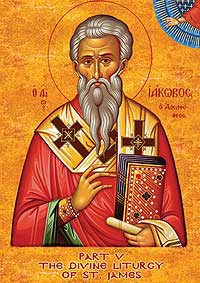
Chris also wrote of the hymn, "It comes from the Liturgy of St James of Jerusalem, and dates from the 4th century (if not earlier). It is sung in the liturgy while the priest and acolytes enter the altar with the bread and wine to be consecrated. Some Protestants alter the words of the hymn because it teaches the Real Presence. I wonder if Ortega's version includes these words:
Lord of Lords in human vesture, In the body and the blood
He will give to all the faithful, His own self for heavenly food"

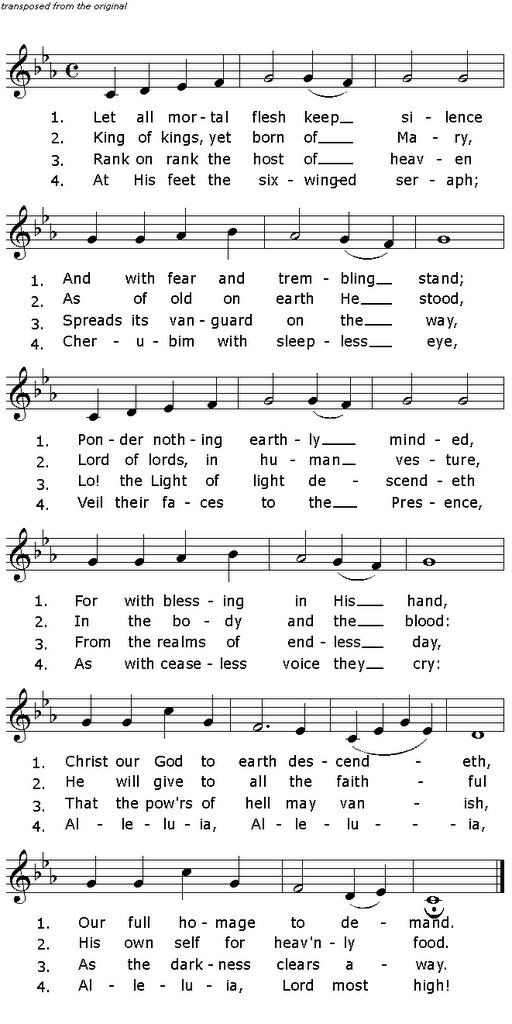
I decided to research Chris' question. I just listened to the song. He sings every verse that was printed on Twylah's post. Indeed, Fernando Ortega does sing the verse referring to Holy Communion! By singing that verse, he may or may not indicate that he believes in the Real Presence of Christ at Holy Communion. He may have just wanted to be true to the original lyrics, although I don't know what Christian could sing words of worship which he didn't mean. What a beautiful verse that is, His own self for heavenly food, especially when you first read Chris Jones' description: It is sung in the liturgy while the priest and acolytes enter the altar with the bread and wine to be consecrated. If anyone has ever been in an Orthodox service, you can imagine the sense of the holiness and worship of our God present there. You can hear ancient voices worshiping the one True God a thousand years before you were born. With that in mind, read the verses to this song again, singing it softly to yourself. When Fernando sings this hymn, he softly and slowly plays the piano and is accompanied by a quiet mandolin. At the last verse, he sings nearly accapella, with only a few piano chords, of the seraphim and cherubim hiding their faces in the presence of God as they sing "Alleluia Lord Most High". I have the feeling that this is a clearer picture of worship, in quietness and utter humbleness.


Let All Mortal Flesh Keep Silence
from the Liturgy of St. James
Let all mortal flesh keep silence,
And with fear and trembling stand;
Ponder nothing earthly minded,
For with blessing in His hand,
Christ our God to earth descending
Comes our homage to demand.
King of kings, yet born of Mary,
As of old on earth He stood,

Lord of lords in human vesture,
In the body and the blood,
He will give to all the faithful
His own Self for heavenly food.

Rank on rank the host of heaven
Spreads its vanguard on the way;
As the Light of light, descending
From the realms of endless day,
Comes, the powers of hell to vanquish,
As the darkness clears away.
At his feet the winged seraph,
Cherubim with sleepless eye,
Veil their faces to the Presence,
As with ceaseless voice they cry:
"Alleluia, alleluia, alleluia, Lord Most High!"

You can listen to this hauntingly beautiful liturgy here.
Ortega's version is here.
This clip reveals some of Ortega's guitar work.
Originally posted 12-22-04

Monday, November 07, 2005

A wedding story

The Garden of Eden: The Creation of Adam and Eve, the Fall, the Expulsion

by Lucas Cranach,1530

Kunsthistorisches Museum, Vienna


For All Saints Day, I arrived at my church in need of grace. I declared my sins, received absolution, was strengthen by the proclamation of the word and received forgiveness and strength through holy communion. My pastor offered a wonderful wedding story, woven together from the following scripture.


Isaiah 26
A Song of Praise
1 In that day this song will be sung in the land of Judah:
We have a strong city;
God makes salvation
its walls and ramparts.

2 Open the gates
that the righteous nation may enter,
the nation that keeps faith.

3 You will keep in perfect peace
him whose mind is steadfast,
because he trusts in you.

4 Trust in the LORD forever,
for the LORD, the LORD, is the Rock eternal.

5 He humbles those who dwell on high,
he lays the lofty city low;
he levels it to the ground
and casts it down to the dust.

6 Feet trample it down—
the feet of the oppressed,
the footsteps of the poor.

7 The path of the righteous is level;
O upright One, you make the way of the righteous smooth.

8 Yes, LORD, walking in the way of your laws, [a]
we wait for you;
your name and renown
are the desire of our hearts.

9 My soul yearns for you in the night;
in the morning my spirit longs for you.
When your judgments come upon the earth,
the people of the world learn righteousness.

10 Though grace is shown to the wicked,
they do not learn righteousness;
even in a land of uprightness they go on doing evil
and regard not the majesty of the LORD.

11 O LORD, your hand is lifted high,
but they do not see it.
Let them see your zeal for your people and be put to shame;
let the fire reserved for your enemies consume them.

12 LORD, you establish peace for us;
all that we have accomplished you have done for us.

13 O LORD, our God, other lords besides you have ruled over us,
but your name alone do we honor.

14 They are now dead, they live no more;
those departed spirits do not rise.
You punished them and brought them to ruin;
you wiped out all memory of them.

15 You have enlarged the nation, O LORD;
you have enlarged the nation.
You have gained glory for yourself;
you have extended all the borders of the land.

16 LORD, they came to you in their distress;
when you disciplined them,
they could barely whisper a prayer. [b]

17 As a woman with child and about to give birth
writhes and cries out in her pain,
so were we in your presence, O LORD.

18 We were with child, we writhed in pain,
but we gave birth to wind.
We have not brought salvation to the earth;
we have not given birth to people of the world.

19 But your dead will live;
their bodies will rise.
You who dwell in the dust,
wake up and shout for joy.
Your dew is like the dew of the morning;
the earth will give birth to her dead.

20 Go, my people, enter your rooms
and shut the doors behind you;
hide yourselves for a little while
until his wrath has passed by.

21 See, the LORD is coming out of his dwelling
to punish the people of the earth for their sins.
The earth will disclose the blood shed upon her;
she will conceal her slain no longer.


Revelation 21:9-22:5

9One of the seven angels who had the seven bowls full of the seven last plagues came and said to me, "Come, I will show you the bride, the wife of the Lamb." 10And he carried me away in the Spirit to a mountain great and high, and showed me the Holy City, Jerusalem, coming down out of heaven from God. 11It shone with the glory of God, and its brilliance was like that of a very precious jewel, like a jasper, clear as crystal. 12It had a great, high wall with twelve gates, and with twelve angels at the gates. On the gates were written the names of the twelve tribes of Israel. 13There were three gates on the east, three on the north, three on the south and three on the west. 14The wall of the city had twelve foundations, and on them were the names of the twelve apostles of the Lamb.

15The angel who talked with me had a measuring rod of gold to measure the city, its gates and its walls. 16The city was laid out like a square, as long as it was wide. He measured the city with the rod and found it to be 12,000 stadia[a]in length, and as wide and high as it is long. 17He measured its wall and it was 144 cubits[b] thick,[c] by man's measurement, which the angel was using. 18The wall was made of jasper, and the city of pure gold, as pure as glass. 19The foundations of the city walls were decorated with every kind of precious stone. The first foundation was jasper, the second sapphire, the third chalcedony, the fourth emerald, 20the fifth sardonyx, the sixth carnelian, the seventh chrysolite, the eighth beryl, the ninth topaz, the tenth chrysoprase, the eleventh jacinth, and the twelfth amethyst.[d] 21The twelve gates were twelve pearls, each gate made of a single pearl. The great street of the city was of pure gold, like transparent glass.

22I did not see a temple in the city, because the Lord God Almighty and the Lamb are its temple. 23The city does not need the sun or the moon to shine on it, for the glory of God gives it light, and the Lamb is its lamp. 24The nations will walk by its light, and the kings of the earth will bring their splendor into it. 25On no day will its gates ever be shut, for there will be no night there. 26The glory and honor of the nations will be brought into it. 27Nothing impure will ever enter it, nor will anyone who does what is shameful or deceitful, but only those whose names are written in the Lamb's book of life.

Revelation 22 : The River of Life

1Then the angel showed me the river of the water of life, as clear as crystal, flowing from the throne of God and of the Lamb 2down the middle of the great street of the city. On each side of the river stood the tree of life, bearing twelve crops of fruit, yielding its fruit every month. And the leaves of the tree are for the healing of the nations. 3No longer will there be any curse. The throne of God and of the Lamb will be in the city, and his servants will serve him. 4They will see his face, and his name will be on their foreheads. 5There will be no more night. They will not need the light of a lamp or the light of the sun, for the Lord God will give them light. And they will reign for ever and ever.


Matthew 5 : The Beatitudes

1Now when he saw the crowds, he went up on a mountainside and sat down. His disciples came to him, 2and he began to teach them saying:
3"Blessed are the poor in spirit,
for theirs is the kingdom of heaven.
4Blessed are those who mourn,
for they will be comforted.
5Blessed are the meek,
for they will inherit the earth.
6Blessed are those who hunger and thirst for righteousness,
for they will be filled.
7Blessed are the merciful,
for they will be shown mercy.
8Blessed are the pure in heart,
for they will see God.
9Blessed are the peacemakers,
for they will be called sons of God.
10Blessed are those who are persecuted because of righteousness,
for theirs is the kingdom of heaven.

11"Blessed are you when people insult you, persecute you and falsely say all kinds of evil against you because of me. 12Rejoice and be glad, because great is your reward in heaven, for in the same way they persecuted the prophets who were before you.


The Wedding Story

The bride was created on Day 6 of creation. There was no sin, only saints. Adam and Eve walked with God in the cool of the day. It didn't last for long. The Devil wormed his way into their hearts and Adam did nothing to stop his wife from falling for his lies. They fell into sin. What did the bridegroom do? He remained faithful. He came in the days of Caesar Augustus, hiding as a newborn infant. Shepherds and wise men recognized the bridegroom and received him, but the rest of the world mocked and killed him. The bridegroom wasn't surprised; He knew he would be killed at the hands of evil men. Still, He rose again, offering peace, forgiveness, passion and mercy to his bride. The wedding was still on!

We are the bride. We are saints. We are also sinners. Our natural desire is to be unfaithful everyday. We wonder if He still loves us? Are you still coming, we wonder. Are you still the groom? Why is the world so evil? Are you still faithful?

Our bridegroom remains faithful. He promises a wedding gift to His bride:

But your dead will live;
their bodies will rise.
You who dwell in the dust,
wake up and shout for joy.
Your dew is like the dew of the morning;
the earth will give birth to her dead.

His wedding ring for us is the gospel through the water and the word.