Showing posts with label ELCA. Show all posts

Tuesday, January 31, 2006

Baptism dialogue


Dr. Gene Edward Veith's Cranach blog, that great spot for cultural debate, is currently featuring an excellent thread on baptism. The television show, Lost, spurred the discussion, but that show was soon lost in the discussion of what baptism really accomplishes.

Instead of focusing on what I said, I'd like to feature key dialogue and responses. I am not trying to highlight my witty responses (as if), but I want to remember how to address very common objections made by those who have decided that God cannot possibly work faith in the hearts of baptized infants and children. I made these same claims for nearly 20 years before looking more closely at scripture.

Below is the dialogue, so far. I've left off monikers because that would detract from the discussion. Keep in mind that this discussion took place on a confessional Lutheran website, Dr. Gene Edward Veith's Cranach Institute blog, so it is natural that the Lutherans would rise to the defense of their practice infant baptism as a way that God works to create saving faith. I want to post this as an educational tool for explaining my faith in Christ as full substitutionary atonement for the sins of all with no strings attached, my faith in God to work through His Word and the Holy Spirit to draw us to Himself, creating and sustaining faith and my faith that we are powerless to save ourselves and are very capable of rejecting God's gift to us.

Point A: I agree - Instead of being the response to a repentant heart and faith in Jesus Christ, baptism was depicted on "Lost" as some kind of magical ceremony where salvation is conferred on the recipients by going through "religious" actions. Why any Christian would be happy about this is beyond me. I know the Lutherans at this site have no problem with infant baptism, but I sure do.


Point B: Speaking as one of those Lutherans, we do NOT believe that baptism is just the response from the heart. As if the heart is the source of faith. Is the Word of God, the message of the Gospel, a response from the heart? Or is it the external stimulus that God uses to create that faith in the heart? We believe that what makes Baptism effective is, in the words of Luther's catechism, "not simple water only, but the Word of God which is in and with the water, and faith, which trusts such Word of God in the water."

Furthermore, according to 1 Peter 3:21, "Baptism now saves you." I don't understand how other Christians, while having other theologies about it, can dare say--as I've heard it said in Reformed baptismal rites--that "baptism does NOT save you." Baptism saves not as a magical rite. But when we are given remission of our sins, are buried into Christ's death, raised with Him, and when we "put on Christ"--that saves--and that's what happens in Baptism (Acts 2:38, Romans 6:3, Gal 3:26-27). Infants can't believe? Neither can unregenerate adults. But Baptism is the beginning. Afterwards, just as infants can love and trust their parents, they can certainly love and trust God.


Point A
: You don't have to be baptized to be saved. You're saved by grace through FAITH. Unregenerate adults believe and then are regenerated. "That if you confess with your mouth, "Jesus is Lord," and believe in your heart that God raised him from the dead, you will be saved." Baptism is a public declaration of the regeneration that has already occurred when one trusts in Christ.

You left out part of the "baptism now saves you" scripture - the part about it being the pledge of a good conscience toward God. Until repentance occurs, the conscience isn't good. How can an infant repent without the capacity to acknowledge sin? It can't.

Luther was making a heroic effort to escape the bad doctrine of the Roman Catholic sacramental system where grace is dispensed by merely performing a ritual. He made a great start, but didn't go far enough.


Point B
: So infants can't have faith?

Ps 8:2 (cf. Matt 21:16)
"Out of the mouth of infants and suckling babes You have prepared praise for Yourself."

Ps 22:9-10
"Yet You are He who brought me forth from the womb; You made me trust when upon my mother's breasts. Upon You I was cast from birth; You have been my God from my mother's womb."

Matt 18:6
"... these little ones who believe in Me ..."

Luke 1:44
"For behold, when the sound of your greeting reached my ears, the baby leaped in my womb for joy."

Hebr 11:23,24:
"By faith Moses when he was born..."
"By faith Moses when he had grown up..."

Lutherans do not deny that the saving benefits of baptism are received by faith. We simply believe by the witness of the Scriptures that God gives infants faith as easily as He gives stubborn old adults faith.


Point B
: 1 Peter 3:21-22 reads, "There is also an antitype which now saves us—baptism (not the removal of the filth of the flesh, but the answer of a good conscience toward God), through the resurrection of Jesus Christ, who has gone into heaven and is at the right hand of God, angels and authorities and powers having been made subject to Him."

This means that baptism is not the washing of dirt from the flesh but the cleansing of the conscience so that we can now come to God with a clear conscience despite our sinful nature. This happens through Christ's death and resurrection, not by anything that we do.


Point B
: What I think I hear some saying on this thread is, "Some human ritual can't save us. Faith alone saves." And, as a confessional Lutheran, I respond: AMEN!

Absolutely right! The Sacraments do not save "ex opera operato" (by the doing of the work). They save because of the promise of God.

And God attaches all sorts of promises to the washing waters of baptism!

In Acts 2, the Holy Spirit is promised in baptism. Further, it is promised to "you and your household." That would involve even little babies! And let's not forget what Paul says to Timothy, "from infancy you have known the Holy Scriptures." Exaggeration? Not if you read the passage as the Church has from its very beginning.

One passage Luther thought was important in this was Titus 3:5ff, "Not by works of righteousness which we have done, but according to his mercy he saved us, by the washing of regeneration, and renewing of the Holy Ghost; Which he shed on us abundantly through Jesus Christ our Saviour; That being justified by his grace, we should be made heirs according to the hope of eternal life."

Is this apart from faith? No, of course not. If baptism saves... If it is a washing that regenerates... If it gives the Holy Spirit... If it is for the forgiveness of sins, then surely God gives all of these gifts in Baptism through the gift of faith that comes in Baptism.

Baptism is not some human ritual that gets us a get out of hell free card. It is God's washing us through water used in accord and with God's Word. It makes us children of God, just as Jesus teaches Nicodemus in John 3.


Point A: Interesting scriptures.

So how do you discern which infants truly have the faith to warrant baptism? Do you mean to tell me that all the infants being baptized in all the churches that practice infant baptism are going to spend eternity with God? I seriously doubt it. If not, then it isn't really the baptismal ceremony which saves them at all. It has to do with whether or not God has predestined them to be justified through faith in Christ.


Point B
: Please read the text from 1 Peter a bit more closely, perhaps in the greek if you are able, and take note of how the language flows and what refers to what. (BTW, The idea that either faith or repentance is just an intellectual exercise is not biblical). But back to the text, Peter says "baptism now saves you". Ok, therefore, the matter is settled, baptism is a means by which God has chosen to apply his grace to us. It does not come to us *because* we do something, anything, as if we could obligate God to act, or do something because we are doing our part. Rather, we come to God's promise to act, to save, in this way, and He acts, because He is faithful. Our actions do not and cannot make anything happen. We come, as Luther said, as beggars, and wait in faith for Him to act as He has promised and through the means He has chosen.

But now to your attempt to misread the phrase that follows saves. Literally it reads, "not the removal of dirt of the flesh, but the *answer/promise* of a good conscience before God, through the resurrection of Jesus Christ" Please note the way in which the word, which you take to be a human *pledge", does not mean that at all. It is not *my* pledge, but rather God's promise of a good conscience. (what, after all would God care if I pledged Him a good conscience? This makes no sense at all. The only one who can ease the burdens of my conscience is Christ). How? "Through the resurrection of Jesus Christ". What does this mean? That God, being satisfied with Christ's work on the cross for me, has *baptized me into Christ* (note the voice-passive in Romans 6, something is BEING DONE TO ME), and because of Christ's resurrection, we know that the work is done, sin is paid for and we, along with Christ, arise to a new life. I have a good conscience, NOT because I pledge something to God, but because God has promised me that in Christ, the one into whom I have been baptized, I have been saved, rescued, delivered from the condemnation which I deserved.

The ironic thing about those who think that Luther did not go far enough from Rome's magical thinking, actually mimic the same kind of thought when they disconnect God's grace from the means. Then all we know about God and his work is that he somehow, in some way, falls upon us for no rhyme or reason, or worse, they stumble into Rome's more serious errors, in which they claim that God's spirit will act upon us *because* we have pledged, repented etc...that is salvation comes to us because of something we do, rather than man dependent on God's faithful work, which He has tied to his means. Rome and these folk answer the question why some are saved and not others in the same way...(not because of God's grace), something man does...makes a decision, applies himself to grace, etc.


Point B: I think that some are confusing faith and belief. We can believe something or not, but we cannot have faith. Even the language is such that faith is not something we can do. It is not a verb, not an action. It is given to us, worked in us by the Holy Spirit.

You may believe, but do you always? If you search your heart, don't you have to admit that sometimes you doubt? If there are times that we don't believe, does that mean that we don't have faith? And if it means that we don't have faith, does that mean that we are not saved?

I think the answer is that we often doubt because we are human, but we still have faith and still are saved because faith is a gift from God, not something that we do for God. Faith comes with Baptism, when we receive the Holy Spirit. We can reject the gifts God gives in Baptism, but we cannot obtain those gifts by any action on our part.


Point A: The events that took place when Peter visited the household of Cornelius indicate the the Holy Spirit is received prior to baptism, and that in the early church some measure of belief in Christ was required before someone was baptized.

Then Peter began to speak: "I now realize how true it is that God does not show favoritism but accepts men from every nation who fear him and do what is right. You know the message God sent to the people of Israel, telling the good news of peace through Jesus Christ, who is Lord of all. You know what has happened throughout Judea, beginning in Galilee after the baptism that John preached— how God anointed Jesus of Nazareth with the Holy Spirit and power, and how he went around doing good and healing all who were under the power of the devil, because God was with him.

"We are witnesses of everything he did in the country of the Jews and in Jerusalem. They killed him by hanging him on a tree, but God raised him from the dead on the third day and caused him to be seen. He was not seen by all the people, but by witnesses whom God had already chosen—by us who ate and drank with him after he rose from the dead. He commanded us to preach to the people and to testify that he is the one whom God appointed as judge of the living and the dead.

All the prophets testify about him that everyone who believes in him receives forgiveness of sins through his name."

While Peter was still speaking these words, the Holy Spirit came on all who heard the message. The circumcised believers who had come with Peter were astonished that the gift of the Holy Spirit had been poured out even on the Gentiles. For they heard them speaking in tongues and praising God.

Then Peter said, "Can anyone keep these people from being baptized with water? They have received the Holy Spirit just as we have." So he ordered that they be baptized in the name of Jesus Christ.


Point B: "Do you mean to tell me that all the infants being baptized in all the churches that practice infant baptism are going to spend eternity with God? I seriously doubt it."

Unfortunately, your statement here is true. Not all of those who were baptized as infants will spend eternity with God. Similarly, not all of those who participate in an altar call or pray the sinner's prayer will spend an eternity with God either.

The sad fact is that many who once had saving faith will reject that faith and turn from God to their sinful rejection of Him again.

A person's faithlessness to God does not negate His faithfulness to him or her in His doings. The fact that a pig, once washed, rolls around in mud again, does not negate the efficacy of the first washing.

Can you discern with confidence whether an adult person has true faith or not when he is standing at the precipice of the baptistry? He or she may be faking their faith - or, as was the case during childhood, he or she may be going forward simply because all of his or her friends are getting baptized.

The fact that some are baptized without faith does not negate the wonderful gifts that God gives in baptism to them that receive them in faith - forgiveness of sins, life and salvation - Christ as clothing, a burial with Him, a participation in His death, &c.


Point B
: Someone early in this thread wrote about their "conversation" with the TV:
"Seal the deal. You're getting so close to presenting the Gospel! Go all the way! Come on, tell her the Gospel, tell her that baptism won't mean anything until she repents and seeks the mercy of Christ!" I'm sorry, the Gospel is what, exactly...? The Good News is that I have to save MYSELF?


Point B
: You have misinterpreted Acts 10 & 11. Peter clearly saw the reception of the Holy Spirit prior to baptism as quite strange...which is why he hurries to get them baptized! This is NOT the NT norm.

The NT norm can be deduced from these verses...

In our baptism, God does the following:

1) forgives our sins (Acts 2:38; Acts 22:16)
2) washes us clean (Eph 5:25-6; Titus 3:5)
3) buries us with Christ (Rom 6:3-4)
4) clears our conscience (1 Pet 3:21; Heb 10:22-3)
5) gives us the Holy Spirit (Acts 19:1-7; 1 Cor 6:11)

In short, in our baptisms, God saves us.


Point B
: We Lutherans confess, together with the Church, spread throughout time, that we believe in "one Baptism for the remission of sins." The Spirit of God moves upon the face of the waters, and God says, "Let there be light."

How can simple water accomplish these things?

"Are not Abana and Pharpar, rivers of Damascus, better than all the waters of Israel? may I not wash in them, and be clean? So [Naaman] turned and went away in a rage."

"And his servants came near, and spake unto him, and said, My father, if the prophet had bid thee do some great thing, wouldest thou not have done it? how much rather then, when he saith to thee, Wash, and be clean?"

Baptism is not simply water only, but water comprehended in God's command and connected to God's Word.


Point B: "So how do you discern which infants truly have the faith to warrant baptism"

That's the whole point. You can't discern. You can't discern in adults either. None of us is able to create saving faith on our own, even those of us who could speak the words might not "really" mean it in our hearts (anyone heard of chronic altar calls responders?).

You can deny that God cannot possibly create saving faith in the heart of an infant at baptism, but that doesn't make your denial into truth. There is no mention of age limits in scripture, regarding baptism. Please consider taking Jesus at His Word. God's Word guarantees this in baptism:

become a disciple of Jesus Christ (Matthew 28:19);

be born again of water and the Spirit (John 3:3-5);

have his sins forgiven (Acts 2:38) and washed away (Acts 22:16);

be baptized into Christ, into His death and resurrection (Romans 6:3-4);

become a new creation (2 Cor 5:17);

put on Christ (Gal. 3:27);

be cleansed and sanctified by the washing of water with the word (Ephesians 5:25-26); and

be saved by the washing of regeneration and renewal by the Holy Spirit (Titus 3:5)

We cannot possibly save ourselves due to sin. That is why God sent us an atoning sacrifice for our sin. He washes us new in baptism and sustains our faith through the Holy Spirit, the Word and holy communion (I imagine you might deny that, too.)

I do agree with you that not all baptized infants (or adults) will be in heaven. It is very possible to lose one's faith after being saved through sin and rejection of God's Word. The burden falls onto the parents to make sure that the child is raised in God's Word, but ultimately any soul can choose to reject God. They just can't choose to be saved - the Holy Spirit does that.

Good discussion all.


Point B
: It never ceases to amaze me how people who supposedly believe in the authority of Scripture can miss the point that Scripture clearly, unambiguously, and without any possibility of misunderstanding (save by letting a purely human philosophy which precludes God acting by way of means)say concerning baptism as a means by which God bestows the Spirit and- not to put too fine a point on it- saves us.

2 Peter, of course, asserts that last in so many words.

Of course we're saved by faith- and faith alone. Faith in the promise God makes in baptism! Substituting a purely human piece of works righteousness "the sinner's prayer" (as if there were any other kind!) or a "decision for Christ" (as if those "dead in trespasses and sins were capable of making such a decision) or "asking Jesus into one's heart" (as if one could do so if He were not already there) is hardly an improvement on the locus Scripture gives for the incorporation of a new believer into the Body of Christ: "the washing of water thorugh the Word."

No one can enter the Kingdom of Heaven unless he is born again. How are we born again? "Of water and the Spirit." How much more plainly could Jesus have made the point? And by the way, folks, we'd better hope that infants can have faith. Otherwise they're damned! No infant "prays the sinner's prayer!" Conversely, what more eloquent testimony could there be to salvation by grace alone than infant baptism- the baptism of one who can contribute literally nothing of his own! Baptism- unlike the "sinner' prayer" and other such wretched works-righteousness, is God's act, not ours. And that's why infants- the best qualified of all candidates for admission to the Kingdom- are brought to Jesus in the Lutheran tradition, and why we refuse to be numbered among those who forbid them to come.

Who, of all possible candidates, are most qualified to enter the Kingdom of Heaven? "Unless you become like little children... (Greek: infants). To say that Scripture doesn't clearly teach the baptism of infants, and specifically baptismal regeneration, is possible only by completely ignoring what Scripture says, and presumptuously superimposing one's own rationalistic philosophical presuppositions on the text, allowing it to dictate in typical Reformed Evangelical fashion what God's Word is going to be allowed to say by human philosophical presuppositions!

Hey, guys. It's not a surprise that that the Anabaptists of the Sixteenth Century were the first Christians in history to question the validity of infant baptism (even Tertullian urged only that it be delayed until the child could "take in something of the mystery-" that being the very mystery today's baptismal rationalists reject). It's not a surprise that the separation of baptism from the gift of the Holy Spirit and of faith and of salvation is a relatively recent development in church history. It's an innovation, a novum... and a rationalistic heresy.

Jesus doesn't mince words. Neither do His apostles. And they leave no doubt as to what they unanimously taught: baptism saves. It's where God locates His offer of salvation. Granted,
people who hear the Gospel proclaimed are brought to faith by it, and merely have God's promises confirmed (and the gift of His Spirit strengthened) in baptism. Granted, people who believe, but in good faith misunderstand Scripture's clear and consistent teaching about baptism, still are believers, and are still saved. Augustine's dictim applies here: "It is not the absence of baptism, but contempt for it, which condemns." But nobody who understands the biblical teaching, and still declines to be baptized, can possibly be a believer.

Sure, Cornelius believed before he was baptized. Nobody has suggested that the Spirit *only* works through baptism! But where people believe through the proclaimed Word, they are still directed to God's promise in baptism! And it never ceases to amaze me how the rationalist


Point B: miss the point that it was precisely the unusualness of the separation of the gift of the Spirit from baptism in Acts 8 (the Samaritans) and Acts 10 (the Gentiles)which draws the attention of the Apostles to the subsequent bestowal of the Spirit- and the point that both groups are fully acceptable to God in Christ.

The testimony of Scripture is plain and consistent: baptism saves. It is a means thorugh which the Spirit is bestowed. It is meant for infants, too- and if it's not the means by which infants believe, then infants cannot believe, and so are lost.

To deny that baptism saves is the sheerest rationalism, and the utter repudiation of the teaching of Scripture as universally understood through the first sixteen centuries of the Christian era- and still understood today by those who value the testimony of the Word above that of human philosphy and rationalistic presumption.


Point B
: Though not a viewer of "Lost," I'm pleased to hear that sacramental theology has found its way onto the tube. The last time I saw a good sacramental discussion on TV was a great episode on the Lord's Supper on "Northern Exposure."

This blog discussion has been great, though like the Alito confirmation hearings, it is divided mostly along partisan lines. That tends to happen when dogma runs ahead of exegesis.

As a professor of mine once said, "The opposite of an error is not the truth but the opposite error." Seeking to avoid the Roman ditch of opus operatum, radical Protestantism drove straight into the oppostie ditch of fideism and synergism, tossing out both the baptismal bath water and the baby. (Classic Calvinism also baptizes infants, albeit for different reasons than does Lutheranism.)

"Sola fidei" does not mean bare faith in faith (fideism), but faith in the promise of salvation won in the death/resurrection of Jesus which is offered, delivered, and applied to the individual by the external Word, with Holy Baptism at the fore. Faith and its external object are always together.

In addition to the verses amply cited by others extolling Holy Baptism as the gift and work of the Triune God and not simply our act of testimony and obedience, I would add these words from our Lord:

"He who believes and is baptized will be saved; but he who does not believe will be condemned." (Mark 16:16)

Notice that Jesus keeps faith and baptism together as one. Note also that there is no temporal sequence implied - both "believes" and "is baptized" are aorist participles describing the one who will be saved. Note finally that "is baptized" is an aorist passive participle. Baptism is something done to you, not something you do.

"Go therefore and make disciples of all nations, baptizing them in the name of the Father and of the Son and of the Holy Spirit, teaching them to observe all that I have commanded you; and lo, I am with you always, to the close of the age." (Mt 28:19-20)

The mandated activity of "discipling" ("make disciples" is the only imperitive in this verse!) is accomplished by "baptizing" and "teaching." Again no temporal sequence is implied by the two present active participles in this verse. They are simply the two activities that go into the one divinely mandated activity of "making disciples." Infants are baptized into teaching; adults and older children are taught into Baptism. Same result, either way.

For a Lutheran, Holy Baptism applied to an infant perfectly depicts the central article of the justification of a sinner by God's grace (undeserved kindness) through faith (trust in the promise of salvation in Christ) for Christ's sake.

As for "infant faith," Luther refused to speculate on things he could not know. Who can really know what an infant trusts? Baptism gives the person, whether infant or adult, something tangible to trust. It's nice to know that Christ died to save the world. It's even better to know in Baptism that He died "for you." The words "for you" require all hearts to believe.

I'll even dare to speak personally. (Yes, Lutherans have personal testimonials too!). I was baptized when I was five weeks old, was nurtured in the Liturgy, catechized by my parents and pastor, etc. As a result, I do not have a single conscious moment in my life when I did not know and trust Jesus Christ as my Savior. That's why I can't relate to "Amazing Grace" when it sings "I once was lost but now I'm found." I have to believe from the Scriptures that I once was lost, but I have no such memory or experience. I've always been found in Jesus.


Point B: I'd like to add that I spent 20 years, as an evangelical, questioning my own infant baptism. All because evangelicalism taught me that one must CHOOSE to be baptized. I even kept my own children from the saving waters of baptism - but not the saving grace of God's Word, which saved them anyway - because of my own doubts. I finally relented to have them baptized, reassuring myself that they had finally chosen it at ages 9 and 7, due to the continual request of my former old-school ELCA pastor. (I say old-school because the rest of the staff had thrown out Lutheran doctrine and education for Baptist teachings and curriculum.) How great was my joy, and how deep regret, to be convicted by the Holy Spirit that God had already acted for me in providing a way of salvation and that it was never up to me. The validity of my first baptism in the triune God immediately came rushing at me. We have a jealous God who created us, loves us, sustains us, provides salvation for us and seeks us out.

This is the joy of the gospel that Madre spoke of earlier. The gospel is the good news that we are saved through no action of our own. Faith comes from hearing the Word of God proclaim. The Holy Spirit works through the Word to draw us to the Father. For anyone to think that they can choose to believe has to spend a lot of energy denying God's omnipotence. Lutheran doctrine and practice has shown me a picture of God that is unimaginably more powerful, terrifyingly holy and relentlessly loving that any picture of God that evangelicalism ever showed me.

This thread has been very helpful to me. We should always be ready to give account for the joy that is in our heart!


I would like to add that I think the debaters maintained civility. For myself, I need to work on presenting my case of what scripture says without using labels that might inflame and detract from my point. Sometimes, though, labels appear to be necessary to explain myself. I'm still working on that.

Sunday, October 02, 2005

Guess who I met today...


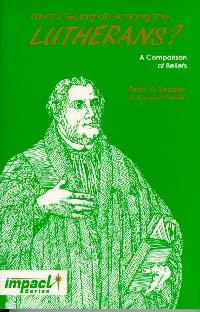
I met the author of a book that brought me to the Evangelical Lutheran Synod. Pastor J. Kincaid Smith, ELS pastor and co-author of What's Going On Among the Lutherans, attended Pastor David Russow's commissioning service today. I had stared at his photo on the back of his book for so long, often wondering if he were still alive; it was easy for me to recognize him! I was able to be introduced by another pastor after the service and I fought back the tears as I thanked him for writing the book. He was being pulled in different directions by others who wanted to say hello and photographers wanting to document the day, but he seemed genuinely interested in someone asking him about the book. He told me that Marvin Schwan funded the book's distribution to all Lutheran pastors in all synods across the country. He also told me that he received a variety of responses from those pastors, good and bad. If you have read the book, you can imagine that some ELCA pastors did not appreciate his work. One ELCA pastor told him that as soon as he finished writing his letter of complaint and criticism, he would drop the book down the outhouse hole! I asked him if he had considered updating the book and he said that he had and that he decided against it. We would have talked longer, but the time was not right.

Friday, September 09, 2005

Is God angry?

Following up on the children's Bible discussion, I've had these thoughts...

Regarding the concept of God being angry at sin and the undeserved gospel of grace, that certainly played a big part in my eventual desparation of American Evangelicalism. I could sense God's wrath and knew of his wrath through his Word; my knowledge of my sin nature rose above me like a towering giant and I knew I would never be good enough for God (let alone my fellow Christians). I had certainly heard part of the gospel, but since it was always tied in with my requirements, it was never really "good news". Simultaneously, my old ELCA mega-church was rapidly changing to reformed teachings and I couldn't stay any longer. The summer I spent meeting with a confessional lutheran pastor and going over what the Bible truly teaches about God, sin and salvation was life-altering and faith-saving.

The problem I am having as the parent of teenagers is how to help them realize their sin nature in typical teen behavior without driving them away from me. I fall back easily on the evangelical-God-playing model by thinking it is my job to make them aware every time they sin and to make them believe. I've got one who is very aware, but one who appears not make the connection between being sinful and being forgiven. I keep bringing them to the Word and fight myself off in trusting the Holy Spirit's presence in proclaiming God's Word. God save my children from me (said with tongue in cheek)!

Monday, July 04, 2005

Tired of hearing about sin?


Someone very dear to me recently asked why our pastors preach so often on the topic of sin. She's got one foot still in the door of our church, but her other foot is in the door of a modern, "evangelical" ELCA "lutheran" church known for its praise services and focus on joy and love. She said that the pastor in her new church is just as good as our pastors, but he doesn't focus on sin so much. She told me she is tired of hearing about sin; she wants to focus on joy and love. Funny thing is that the more time she spends at that church, the less joyful and loving she has become. I say "funny" sadly; I know that irony of trying to achieve love and joy too well. I have walked down that very road and have tried to warn her of the dangers such a church will bring to her faith. My loving warning received accusations of lack of love and judgmentalism. I know that I spoken those things to other Christians in the past. My human heart is so unfaithful; I am so thankful that God has a sure plan to bring me into His holiness someday. My own plans for perfection certainly didn't work!

The more focus a Christian attempts to put a focus on joy and love as a discipline - as the actions and attributes of the good Christian life - the more those things slip right out of your hands. It took me too many years to learn that the only way to become more loving and more joyful is to be totally, completely and daily confronted by my own sinful nature and utter helplessness to become the person I wish I were. It is only at that point that the Holy Spirit can whisper to my soul of where my help comes from. The apostle Paul knew this. He wrote:

What a wretched man I am! Who will rescue me from this body of death? Thanks be to God - through Jesus Christ our Lord!

And so my dear friend, if Paul himself knew that confession and absolution of sin must come before we can shout out for joy upon hearing the good news of our salvation, then how is it that your church is telling you otherwise?

Come to me, all you who are weary and burdened, and I will give you rest. Take my yoke upon you and learn from me, for I am gentle and humble in heart, and you will find rest for your souls. For my yoke is easy and my burden is light.


Jesus reminds us of where we can find rest from our sins and the gentleness and humility that we seek to own. Yesterday in church, my pastor reminded me that the ability to become loving, gentle and humble is a result of hearing the the law pronounced to me so that I understand that I am sinful; and hearing the gospel - the good news of my redeemer- and clinging to my king in desparate thankfulness. Jesus then shows me how to become that loving person I wish I were by taking His yoke upon me and learning from Him.


Even the Old Testament convicts of of our sin and points us to the Savior who will save us from our sins. This is why we can rejoice. Our king comes to us bearing our salvation!
The Coming of Zion's King
9 Rejoice greatly, O Daughter of Zion!
Shout, Daughter of Jerusalem!
See, your king comes to you,
righteous and having salvation,
gentle and riding on a donkey,
on a colt, the foal of a donkey.

10 I will take away the chariots from Ephraim
and the war-horses from Jerusalem,
and the battle bow will be broken.
He will proclaim peace to the nations.
His rule will extend from sea to sea
and from the River to the ends of the earth.

11 As for you, because of the blood of my covenant with you,
I will free your prisoners from the waterless pit.

12 Return to your fortress, O prisoners of hope;
even now I announce that I will restore twice as much to you.


The scripture for church yesterday is among my favorites. When Paul writes of his own sinful nature, he makes it clear that even the most "accomplished" Christian can not save himself and will not achieve holiness on this earth. But does this message discourage him or us? No! It is the source of our joy! Scripture is clear. We cannot know or experience real joy and love apart from the knowledge that God comes to us with the salvation that we are never able to achieve by ourselves. To tire of hearing about sin is to deny that you have a sinful nature and need a savior. A church that doesn't remind you that you are, indeed, sinful has no way to proclaim the good news that you have a savior. A joy-and-peace-only church is a church that doesn't need Jesus and cannot strengthen Christians. For the rest of us sinners, we need to hear about sin and we need Jesus.

Tuesday, June 07, 2005

What Do Lutherans Believe?

After twenty years of searching through the generic "evangelical" world for a true and authentic worship experience and stopping at many churches along the way, I have found authentic worship in the practices of the confessional Lutheranism. Many generic "evangelicals" display a knee-jerk negative reaction to the word "Lutheran". The statement, "I used to be Lutheran 'til I got saved.", is a very common one in the generic "evangelical" movement. I can't argue that a person making such a statement might not have had saving faith during the time he called himself a Lutheran, but I would argue whether he was truly a Lutheran. What does it mean to be Lutheran?

On numerous and un-erasable occasions, when asked what church I attended (a common proof of salvation amongst generic "evangelicals"), I would reply, "Oh, I'm a Christian, but God has called us to attend a Lutheran church right now." Yep. That came out of my mouth many times. To merely say that we attended a Lutheran church was too embarrassing - I had to add a disclaimer in order to identify myself as an authentic "evangelical". It pleased me that the ELCA Lutheran church I attended - the same one I grew up in and returned to when I had grown weary of the antics of the non-denominational world - was rapidly tossing out Lutheran biblical teachings in favor of the watered-down theology of the non-denominational churches I had just come from. At first this pleased me, but then I started to ask myself "What does it mean to be Lutheran?".

These practices caused me to question:
  • Either baptism saves or it doesn't. Which is it? If the Lutheran church traditionally baptized infants because they believe scripture says that it saves, then why are wenow praising parents who let their children "decide" when to be baptized? This became most apparent to me when I was praised publicly at the front of the church by one of the pastors for doing just that. I was finally allowing the baptism of my children, at their ages 7 and 9, after years of objections from my husband, parents, in-laws and an older ALC pastor. I had disregarded and dismissed their exhortations that the children should be baptized, but only the older pastor came close to putting it into understandable words. He told me that parents should bring children to the baptismal font. I agreed to have them baptized just in case I was wrong. The Holy Spirit had started to convict me of my unbelief in God's desire to save my children, but I wasn't fully convicted of my sin of unbelief until scripture was presented to me by a dear confessional Lutheran pastor. (I have since explained my sin and repentance to my family and children. I am also making sure that my kids are well-educated in what scripture teaches about baptism, as well as family roles in marriage, church and society.) I recently asked my husband why he allowed me to prevent our children from receiving God's grace through baptism and he replied that he just trusted me as the more spiritual in our marriage. I don't allow him to do that anymore; I have backed off and wait for him to take the lead without me hovering over his shoulder.
  • Either the bible warns about improper distribution of holy communuion or doesn't. Which is it? If the Lutheran church traditional believed that there was a scriptural warning not to take Holy Communion without saving faith, why did our church hand it out to anyone who walked up to the railing?
  • Either it is forbidden for women to be pastors or it isn't. Which is it? If scripture teaches that women should not have spiritual authority over men, why had we started to ordain women?
  • Either same-sex sexual relationships are right or wrong. Which is it? If the Bible says that certain relationships are not God's plan for men and women, then why are we "studying" it?
In the ELCA, I had heard of the Missouri Synod and the WELS, but not the ELS (which ironically had a large congregation less than a mile from my church). As our disenchantment grew, we left our ELCA church for a large local LCMS church for 2 years and found two of the four practices listed above; the main reason we left that church was because they communed anyone who came forward. It bothered me that the church would believe one thing about communion and then disregard it a few years later. I knew that was wrong to commune unbelievers, but I didn't understand why. We returned to our ELCA church.

The influence of non-denominational churches on our ELCA church continued, but I didn't know where else to turn. My husband was tired of me asking to switch churches every few years. Other Lutheran synods were never discussed at my church, although conservative non-denominational churches were often mentioned at great examples of churches. The thoughts of popular pastor/writers, like Osteen and Schuler were preached from the pulpit. It was rare to hear a sermon based solely on scripture in my ELCA church. In my continuing quest to answer my questions, I found the WELS website. I spend six months studying every question in Q & A section. It was there that I learned what Lutherans believe and I learned that my church really couldn't call itself Lutheran anymore. I contacted our local ELS church and started meeting with the pastors. Six months later we joined the church.

A new and favorite blogger in the confessional Lutheran blogosphere, Pastor Walter Snyder of Ask the Pastor, answers the question, "What do Lutherans believe?". I would like to add one thing to his answer: the Lutherans he speaks of have very little to do with many ELCA churches you might know. The ELCA synod was born of synods that reject the infallability of scripture, among other key doctrines (doctrine = what Jesus taught). The Lutherans he speaks of most often belong to one of three confessional Lutheran synods: LCMS, WELS and ELS.

Excerpts from What Do Lutherans Believe:

Look closely at the Lutherans and you’ll see resemblances to several other churches. We believe above all else that Jesus Christ is our only Savior from sin, and that we are saved by grace alone, through faith in Christ Jesus. Human works, no matter how good, are seen as the result of salvation, not its cause.

The Lutheran Church is a Biblical church. We hold that the Bible is the only source of Christian teaching. It decides what and how we believe, teach, and confess. In this, you'll see a strong resemblance to other “Bible-believing” churches.

Lutheranism is a preaching church. We proclaim the Word faithfully. We apply the full force of God’s Law to condemn sin and crush the sinner’s confidence. Even more, we pour out full measure of the healing balm of the Gospel: Sin is forgiven, God and man are reconciled in Christ, and the Lord grants fulfilling life on earth and eternal life in His presence to all who believe.

We believe in baptismal regeneration, trusting that Christ’s words with water give forgiveness of sins, new life, and salvation. We baptize infants, since we know from the words of Scripture that they are born in sin and need of Christ’s forgiveness and the new life He gives in Baptism.

Regarding the Lord’s Supper, we believe that we do not receive only bread and wine to remember Christ’s sacrifice, but that miraculously we receive the very body and blood of Christ. Through eating and drinking this Supper, God forgives sins, strengthens faith, and joins us ever more closely with our Savior. The Sacrament brings us into closer communion with the Father, who is one with Christ. The Supper also creates closer communion with brothers and sisters in the Faith—the Body of Christ, His Church. Since we believe in the unifying effect of the Supper and take seriously the commands and warnings in 1 Corinthians 10 and 11, we spend time carefully teaching those who desire to join us at Christ’s altar, that they might discern the body of Christ, know the Christian Faith, and join us in one confession.

Read on: Ask the Pastor: What Do Lutherans Believe?

Another good resource, What the Bible and Lutherans Teach, by Harold A. Essmann, as found on the WELS.net site. He writes:

Nearly 500 years ago, the Christian church was corrupted by many false teachings. A man named Martin Luther led people back to the teachings of the Bible. His work, and that of his friends, is called the Reformation. Through Luther God restored the church to purity of doctrine and a new life of faith in Christ. The doctrines of the Lutheran Church are not new. They are the teachings of the Bible. Thus the Lutheran Church is not a new church. It is not a sect or cult. It is a church whose teaching is based on the words written by the prophets of the Old Testament and the apostles of the New Testament. The Bible tells us about Jesus Christ. The teachings of the Lutheran Church are those of the original, ancient church of the apostles and early Christians.

Tuesday, May 24, 2005

Things your Old Adam doesn't like...

I've mentioned before that we are recent converts to confessional Lutheran Christian practice. One huge reason for our switch was that our old church, an ELCA mega-church, was rapidly abandoning anything Lutheran (except Lutefisk) and embracing Reformed teachings. One of the things tossed out was a formal confirmation program for the youth. The timing of our switch was no coincidence; our kids were in 7th and 5th grade in the spring of our big jump. I had been a confirmation leader and had witnessed first hand the things my daughter wasn't learning...things that I had learned in that same church thirty years earlier. Why had they dropped the program? Because parents had complained it was boring for their children. It was boring to learn from a pastor's lectures. It was a burden to memorize creeds and scripture. I wonder if our Norwegian ALC ancestors who went along with the thought that maybe scripture wasn't God's words, but men's words, foresaw the day when their great-great-great grandchildren would not be taught the strong truths of Christianity and never study Luther's Small Catechism. Thank God some brave Norwegians stayed strong.

My daughter was granted the speed version of confirmation, with one year of special sessions with the pastor along with her confirmation class. She was made strong in the grace that is Christ Jesus and learned to give an accurate account for the hope that she has in her heart. She gladly absorbed the lessons, memorized scripture and expressed herself well on Examination Day. I thought that I would be the only parent so moved as we stood at the rail blessing our children on Confirmation Day, but I had company. The sniffles and tears were, to me, a sign of the great joy of parents who saw to it that their children were fully-educated in their Christian faith and were now expressing a desire to be an adult member of the church. It was a truly joyous day.


Last fall, my son began confirmation as a 7th grader and will benefit from two years of the now three year program before he professes his faith to his church. He often comes home with little gems that have me thinking for days. One day, he said to me, "Mom, did you know that the reason we don't want to read scripture or go to church is because of our sin nature. It's our Old Adam telling us not to do those things." Wow. A simple, true and powerful statement. It's our Old Adam telling us that our family needs to sleep this Sunday morning. It's our Old Adam telling us that we don't have to send our kids to boring confirmation classes to memorize scripture. It's our Old Adam telling us that creeds are not important.

Bunnie Diehl highlighted a sermon that deals with our Old Adam and creeds. It is from Pastor Tim Pauls of Boise, Idaho. His sermon, The Benediction of Grace, Love and Communion, is based on 2 Corinthians 13:11-14.

"...there's a special reason why our Old Adam doesn't like saying the Athanasian Creed-or the Apostles' or Nicene Creeds, for that matter. It's the same reason why the creeds were written in the first place: they spell out who God is. They say what God says about Himself in the Bible. They do so in a clear, no-nonsense form that doesn't allow Old Adam a chance to revise who God is. They declare that salvation is solely His work, which should be especially Good News for us who can't manage to say two columns about God without daydreaming. [...snip...]

We live in a different time, where creeds are dismissed as unimportant: "Deeds, not creeds," "missions, not doctrine" is a rallying cry among some Christians, as if these are opposed to each other. This is not a good thing. There is immense pressure upon Christians today not to be specific about who God is. Rather than identify God explicitly, we are encouraged to view Him as a kindly old grandfather who sits in a chair and smiles indulgently while we walk around His living room and break His things. We are given the impression that God gives us a wink and says, "It doesn't matter if you know who I am or keep My laws. Just know that I love you."

If you're married, try that on your spouse sometime: "I really don't care to know your name or who you are or what you do. Just know that I love you and be there at my beck and call." It's not exactly a pledge of deep and abiding love. But that's how Old Adam wants us to regard God. You see, if we get specific about who God is, we upset old sinful natures and people start to fight. But more to the point: if we get specific about who God is, we'll see how astounding His grace and salvation truly are.

Tuesday, March 01, 2005

By grace alone, by faith alone, by Word alone - that's what I like about our church! - Part III of my faith journey

Below is a post I originally wrote one week and one day after beginning my blog. New readers have recently discovered it and have added comments, so I am updating it and posting it again.

Original post on Kiihnworld on June 8, 2004

One reason I began this weblog was to begin to put into words my thoughts and experiences in the Christian faith. In particular, I'm trying to write my story of going from being raised a mainstream lutheran to becoming an evangelical who eventually returned to her ELCA church (along with many other evangelicals who were given free reign to change the church) and then finally found a home in the Evangelical Lutheran Synod as a confessional lutheran. I've already written about being raised mainstream lutheran and becoming an evangelical. Today, with the help of a friend, I was able to put together the third part of my journey: going from the ELCA to the ELS. The middle part of my story covers twenty years, so I'll need some more time to work on that post.

It has been very difficult to verbalize my feelings towards the changing ELCA. It complicates my task to learn that the changes in the ELCA go beyond me and my life time:back many, many generations over more than a century and a half. The current situation in the ELCA is depressing. In fact, it is beyond depressing to live firsthand in the expansive moral morass. For me, words cannot describe the absolute state of confusion which is glorified there. I personally experienced incorporation of the false teachings of Robert Schuller , switching from saved by grace through baptism to decision theology (ie. use of the Alpha program for confirmation in place of Luther's small catechism and using similiar curricula for Sunday School lessons), abandoning formal confirmation classes because kids and their families complained it was too boring, loss of the liturgy for hand-clapping, emotional performances and meaningless songs, the impending vote next year to ordain and bless practicing homosexuals, etc. I had known for five years that I had to leave, but I kept thinking that I owed it to my home church to stay and try to be a positive influence.

Although it was hard to leave after 30 years of membership at my home church, I did it to protect my own salvation and for the benefit of my children. I now experience much joy at the biblical truths preached and practiced at confessional lutheran congregations, such as King of Grace. I know, after 20 years of searching through churches, that there is no perfect church and never will be on this earth. I was attracted to King of Grace and confessional lutheranism because the Word is faithfully preached and taught. It's strength is turning people to God's Word. I have confidence that Scripture will be the final word on changes made in the ELS. It's grace alone, faith alone, scripture alone and Christ alone - that's what I like about our church. I feel such freedom in the Evangelical Lutheran Synod and at King of Grace: freedom that comes from the peace of mind knowing that the Word is being clearly taught to me and my family, not on somebody's whim or interpretation. I know that my husband and I will grow old in this church and see our grandchildren baptized and confirmed at this church.

Since I am an avid fan of the Q&A section of the WELS website (see link below), I am aware of the many divisions in the more conservative Lutheran synods. I don't pretend to understand them and, in fact, I think that the arguers should realize that there are many newcomers to confessional lutheranism who have very little idea what all the fighting is about between WELS/ELS and LC/MS, etc. Not to belittle the arguments, since they surely stem from legitimate complaints, but God has obviously brought many new people into the church since then. I hope to see more evangelicals turn to confessional lutheranism. I also pray that long-standing members are always so patient with those of us relearning scriptural truths. So far, so good!

***In true lutheran fashion, there are even arguments about whether there are three, four or five solas! I know that there are five original solas, but only three are considered supremely important: Grace, faith and scripture. Gee, that leaves out Christ and God. That doesn't make sense. I'll leave that explanation to a more knowledgeable person than me to comment on that.

Three solas: Sola Gratia (grace alone), Sola Fide (faith alone), Sola Scriptura (scripture alone)

Five solas: Sola Fide (faith alone), Sola Gratia (grace alone), Solus Christus (Christ alone), Sola Scriptura (Scripture alone) and Soli Deo Gloria (to God alone be glory).

Original comments fromKiihnworld post on 6/8/04

they call him Tim said...
Thanks again for a helpful insight into your faith journey. I sometimes get confused over the disagreements between church bodies too. In a “jestful” sense, the Southern Baptists say that they use arguments and fights to “grow the Kingdom” through new church plants. It’s a sad commentary on people, but maybe God does use our failings in understanding Him properly to reach out beyond ourselves. Just a thought. It’s amazing to see the proliferation of Baptist churches in the South, one on every block.

they call him Tim said...
Aren't there five solas?


TKls2myhrt said...
In true lutheran fashion, there are even arguments about whether there are three, four or five solas! I know that there are five original solas, but only three are considered supremely important: Grace, faith and scripture. Gee, that leaves out Christ and God. That doesn't make sense. I'll leave that explanation to a more knowledgeable person than me to comment on that.Three solas: Sola Gratia (grace alone), Sola Fide (faith alone), Sola Scriptura (scripture alone)Five solas: Sola Fide (faith alone), Sola Gratia (grace alone), Solus Christus (Christ alone), Sola Scriptura (Scripture alone) and Soli Deo Gloria (to God alone be glory).


Swansmith said...
To me, who grew up Methodist/Independent/sort of Baptist and finally Evangelical Covenant, sola means one. ;) At least, that is what my studies of Spanish throughout high school and college taught me.But I am interested in learning more about Lutherans and doctrinal issues. And I can sing you a Spanish song--solamente in Cristo, solamente in el... (only in Christ, only in Him)

Wednesday, February 23, 2005

Newsletter from my old church - a contest!

I still receive the newsletter from our former church, suburban ELCA mega-church. I have good reasons for receiving it and reading it - my parents still belong there and I do care about the souls in that church. Usually, I don't find anything more bothersome than the things that caused me to pick my teen-aged children up in my arms and carry them out of there. This week, however, I was bothered by this letter from the pastor. Of course, this church continues to do many good things, some of which are very scriptural. Can you guess my concerns? More importantly, can you guess the sentence that I found sadly hilarious and extremely ironic?

Dear Friends,

Wow! When I think of all that has happened in the last couple weeks, it is mind boggling. A couple thousand people here for Ash Wednesday. Twelve hundred for supper. One hundred and seventy people at the Family Fun Time at (a local indoor waterslide park). Since then, we've gotten to know the Syro-Phoenecian Woman at last week's Lenten service. Then, we had tons of kids here for the TEC (Teens Encounter Christ) weekend. And, now we're getting ready to hear from the Rich Young Ruler at this week's Lenten service. I get tired just thinking about all that's happening. In addition to all of the special events, we have over a hundred people involved in Alpha, hundreds of kids in (Sunday School program), people meeting for Bible studies, support groups and all of the rest. In the midst of that we had 56 people get together for an absolutely great event in (warm sunny destination), gathering some of our “snow birds” together for an update on all that's happening at (ELCA mega-church). (Last week I told you there were only 40. Sorry about that). Thank you, thank you, thank you to the countless volunteers that make all of this possible.

This weekend we have a great opportunity at (ELCA mega-church). On Saturday night at 7:00, (ELCA mega-church) is host to (an inner city program). This great ecumenical program of worship has been meeting in different churches around the city for the last several years. We've wanted to host them before, but it hasn't worked out. This Saturday night, our choir will help to host and will perform throughout the first half of the program. (Joe Singer) and his wonderful musicians will perform throughout the evening. You've been hearing many of his songs the last couple weeks, and if you were able to be in church on Sunday you got to see him in person. It's going to be a great event. Hope you can come.

After hearing from the Rich Young Ruler at Lenten services this week, the theme of this weekend's services is “All American Religion.” We'll examine the kind of faith experiences that are so common in America today but bear little resemblance to Biblical faith. I think you'll find the topic fascinating and encouraging. Have a great week. See you in church.

Your Friend and Pastor,

XXX

Tuesday, February 22, 2005

Happy Baptism Anniversary!


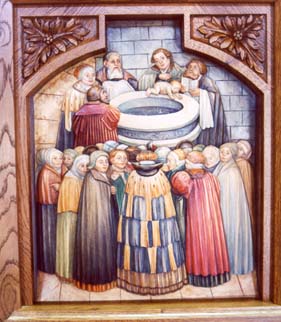
God's saving grace is available to all people. Posted by Hello


Five years ago, on February 20th, my children were baptized. This is a day for rejoicing and I was careful to remind them of the importance of the day. On that day, Erik and Kristiana:

became disciples of Jesus Christ;

were born again of water and the Spirit;

had their sins forgiven and washed away;

were baptized into Christ, into His death and resurrection;

became new creations;

put on Christ;

were cleansed and sanctified by the washing of water with the word; and

were saved by the washing of regeneration and renewal by the Holy Spirit.

In a word, they were saved.

(This list was lovingly compiled by John H. of Confessing Evangelical in commemoration of his son's baptism recently.)

The funniest thing of all is that God accomplished all this and I didn't even fully believe it at the time. I was beginning to suspect that God had more power than I had realized, but scripture wouldn't fully convict me for a couple more years.

My kids' baptism day also has special meaning for me. It is a day of joy, certainly...but it is also a day of shame for me. It is a day that forces me to remember my sin in withholding God's power from my children. Despite their requests and admonitions from my husband, mother, mother-in-law and my pastor, I kept them from the saving waters of Holy Baptism.

I had struggled with the purpose of baptism for 20 years! Since my own weak christian training didn't teach me that we are powerless to choose faith apart from the Holy Spirit and that Jesus commanded baptism of all people without mention of age, I hesitated to baptize my own children. I rationalized that even though I was baptised, my own faith didn't mature until I was 20 years old. My wish for mature faith for my children led me to the wrong conclusion that I should have my children wait for baptism until they made their own profession of faith. Thankfully, I did not neglect teaching them God's word and soon I realized that they were Christians through the power of God's Word.

Then it became a game of "Well, when are they old enough to be baptized?". Obviously, that method never gives an answer because children are still children and their faith will never seem mature for years to come. At what point can any of us say about ourselves or our children that faith is now mature and the person is ready for baptism? In those twenty years (before and after having children) of church searching, NO pastor (ELCA, independent, Baptist, Evan. Free, Assemblies of God, Methodist, Covenant, CMA, LCMS) ever told me what the bible truly says about baptism. In fact, pastors in each of these denominations commended me for waiting until my children were ready, that baptism was merely symbolic. During our adult catechism at our new church, I was overwhelmed with my enormous sense of guilt at keeping my children from holy baptism. I did repent of my sin and asked my husband's forgiveness, but I still can't believe how misguided I was.

Now, five years later we just rejoice in the day. In fact, we rejoice in our baptisms every day. That is the true beauty and purpose of baptism, to be remembered and lived in every moment of our lives.

Wednesday, February 09, 2005

Cerulean Sanctum: I want to be a clone

Dan E. of Cerulean Sanctum wrote this back on 11-12-04, but it's new to me and I thought others might enjoy it, too. It certainly echos concerns I had just a couple of years ago, both in church and as I listened to Christian radio.

Dan writes:

"Is it just me or has nearly every church in this country been cloned? In the last few months, my wife and I have visited about a half-dozen different churches. Just a decade ago, the differences between those churches in their musical choices, sermon styles, liturgy choices (including no liturgy at all), and the like would have been profoundly different. Even their emphases on particular doctrinal aspects of Christianity would have been prominently on display during a worship service, and uniquely geared to the denominational beliefs of the church. Today, though, it doesn't matter if you go to a Free Methodist, Friends, Vineyard, Baptist, Pentecostal, Presbyterian, or any other denomination because what they show you on Sundays and through the week is identical. Say what you will about the worth of denominational factionalism, but if our churches are all aspiring to a lowest common denominator sameness, is that an improvement?

Now you can make a claim for ecumenism here, but I think it goes far beyond that. Evangelicalism is enmeshed in the church growth movement to such a degree that denominations are jettisoning their cores in order to embrace the flavor of the week. I continue to be astonished at the rate with which The Willow Creek Association is consuming churches, asking them to ascribe to Willow Creek's ministry models without question. But is anyone asking the pivotal question: What if Willow Creek's ministry model and philosophies are wrong? read on...

These were my same questions about two years ago. I was in an ELCA mega-church which was rapidly (and still is) throwing out Luther's reminders of what the Bible teachers for complete opposite doctrine. My point isn't to argue doctrine, but to ask the same questions. Why are we changing and what are we changing to? It was very unsettling to watch infant baptism being downplayed, formal confirmation and spiritual education programs chucked for "Wednesday Night Live", confirmation rites replaced with Affirmation of Baptism services, Lutheran curriculum thrown out for Baptist curriculum, pastors arguing over doctrine, hymns for praise choruses, liturgy for testimonies, etc... Of course, on top of that there was the whole anti-American, pro-choice, pro blessing of same-s#x marriages... I was very quickly an evangelical Lutheran without a church home. But not for too long :)

Wednesday, December 01, 2004

Re-educating Theresa

It has been such a enlightening, strengthening journey to move from seeing God in one way to experiencing God in a much fuller way. That is how I describe my transformation from a self-described ecumenical "lutheran" evangelical to a confessional Lutheran. My transformation took place during the time when my daughter attended a confessional Lutheran grade school for her 7th and 8th grade years. In looking for a parochial school for her, I had closely examined the doctrine of this particular church/school. I told myself that I didn't want to get part way through the year and discover that they had some odd belief that I couldn't tolerate. I read through each statement of belief and couldn't find anything I disagreed with. In hindsight, I don't see how I was fully reading each statement. I don't think I had ever read through doctrinal statements with such careful attention and understanding (as limited as that may be) as I do now. Now, each and every word means something and I pay attention.

In the first year (7th grade), we remained at our old church. (I already written extensively about that here.) My daugher took a religion class and religion was interspersed throughout her entire learning day. She had a well-educated and opinionated teacher and sometimes my daughter would come home repeating statements her teacher had made that day. Some of his statements (about ecumenicalism, the ELCA, communion practices, nature of salvation, etc) struck a nerve with me and I would tell me daughter that if he really knew US he wouldn't say such a thing. Concurrently, I would study his claims with the bible and other resources. I became a great fan of the Wels Q&A site and read nearly every post every made to that section.

In the meantime, I was becoming painfully aware of the doctrinal problems (or lack of consistent and/or scriptural doctrine!) in my own church, upset by changes in the confirmation program and disgusted with a social justice worker/female pastor who refuses to pray for our troops and leaders at all. We left that church in June of 2003 and began attending the church which ran my daughter's school. My husband and I took the Bible Information Class over the summer- our pastors met with us in a private class and really took time to teach and explain what the Bible says on each doctrinal point.

By the fall, my daughter was allowed to joined the confirmation class and be on track to be confirmed that spring. I was likely the only parent who got so excited to study each lesson with her confirmand! I also soaked up each religion lesson she was assigned in school. I was asked to teach Sunday School, but refused until I could learn and absorb more instruction. I attend as many Bible studies as our family's schedule allows (I hope that doesn't sound like pride. I'm such a sinner in need of solid training that I get excited for any learning opportunity.)

Now, a year later, my son has started confirmation, as well as 7th grade at the school, and I get to learn things again with him. Praise God that I have this opportunity to learn with my kids; I hope that all parents use their kids' confirmation programs to re-learn (or learn) the solid biblical truths taught there. We all need to be able to read, understand and repeat to others the beliefs of our churches.

Yet again, I've found a article that puts into words the thoughts moving around in my head. Rick Ritchie, at Old Solar ezine, writes about his advice to a friend making the switch to confessional Lutheranism in Get a New Grid:

"You've been learning a lot of Reformation doctrine lately. But it seems to me you are hanging Reformation doctrines onto the grid of your old theology. I think it's time to throw out your old grid and get a new one.” I said this once to a co-worker at a Christian bookstore where theological conversation was common. My friend's background was in the holiness churches, but he had been studying Reformation doctrines and listening to the White Horse Inn radio broadcast and attending theology lectures. His study had moved him to embrace several doctrines at odds with his tradition. Sometime after I made my statement and he had joined a church more in line with his new beliefs, he said that I had given him the most helpful advice anyone ever gave him on that journey. Continue reading Rick's article...

I am adding Rick's article to this blog in hopes that it will be a resource for others making a similar journey. As my favorite morning radio host says, "Get wisdom. Get understanding. Guard her and she will serve you well."

Thursday, November 04, 2004

Boy: Will you be my nasty girl? Girl: I can't because my God is an awesome God!

Rob, of Love and Blunder, has an excellent commentary on a recent article posted at Associated Baptist Press. The article is entitled Speakers predict sermons will change in next wave of postmodern worship. Seems like lots of my evangelical readers have been blessed with rock-solid churches, but that was not my experience. Many of the mega-churches seem to be throwing out Jesus and the Word and replacing it with logic and reasoning, mixed in with emotion-based entertainment; this change is found in worship and in the education programs of the church, such as confirmation and Sunday school.

If this post's title doesn't make sense, read the related posts below. If you are in a rush, I will just summarize those posts by saying that the world we and our kids face today is tough and they need to know more than trendy songs. Our God is an Awesome God is a catchy tune, but does it prepare us for facing sin and temptation on a daily basis? Maybe. But, knowing "Marriage should be honored by all, and the marriage bed kept pure, for God will judge the adulterer and all the sexually immoral." would be more a little more useful when a teen is pressuring another teen for sex. We all need to be well-trained in God's Word, since that is how He speaks to us today. My church just added a year to the formal confirmation training, which along with fun events and singing, involves scripture memorization and thorough three-year study of God's Holy Word and Luther's Small Catechism. (Don't be thrown off by the study of Luther's Small Catechism; it is a thorough summary of the Christian faith and is useful for instructing new and young Christians.) The program is taught by our pastors and includes lots of discussion and pratical application. Our pastors even utilize all the senses to help the kids stay awake and interested. But it is often boring, just as any in-depth training can be at times. We parents encourage our kids and remind them of how important and useful their confirmation program is. We study the lessons together and relearn it ourselves.

My daughter recently learned the Latin word, confirmare. I was struck by its meaning: to strengthen, to declare, to make firm. That is what we do in confirmation: strengthen our kids and then they declare that they want to continue as adult Christian members of the church, then the pastor introduces them as such. The three years of hard work pays off and we all celebrate the end of their childhood training and the beginning of lifelong learning of scriptures.

Related posts:
Lack of doctrine among U.S. teens
Redefining Confirmation
Confirmation Follow-up


Thursday, October 28, 2004

More on Holy Baptism...

Please check out the interesting article on the miracle of holy baptism at Confessing Evangelical's blog.
 
Before joining our confessional lutheran church, I had struggled with the purpose of baptism for 20 years!  Since my own weak christian training didn't teach me that we are powerless to choose faith apart from the holy spirit and that Jesus commanded baptism of all people without mention of age, I hesitated to baptize my own children.   I rationalized that even though I was baptised, my own faith didn't mature until I was 20 years old.  My wish for mature faith for my children led me to the wrong conclusion that I should have my children wait for baptism until they made their own profession of faith.  Thankfully, I did not neglect teaching them God's word and soon I realized that they were Christians through the power of God's Word.  Then it became a game of "Well, when are they old enough to be baptized?".  Obviously, that method never gives an answer because children are still children and their faith will never seem mature for years to come.  At what point can any of us say about ourselves or our children that faith is now mature and the person is ready for baptism? 
 
In those twenty years (before and after having children) of church searching, NO pastor (ELCA, independent, Baptist, Evan. Free, Assemblies of God, Methodist, Covenant, CMA, LCMS) ever told me what the bible truly says about baptism.  In fact, pastors in each of these denominations told me to continue to wait until my children were ready, that baptism was merely symbolic.  I could go into more detail, but I don't wish to insult anyone.  During our bible information class with the pastor of our new church, I was overwhelmed with my enormous sense of guilt at keeping my children from holy baptism.  I even disregarded my husband's and parents' plea to baptize them.  I did repent of my sin and asked my husband's forgiveness, but I still can't believe how misguided I was.  My kids are baptized and I don't dwell on it at all.  I 'm just thank that my whole family is now getting a thorough christian education, as well as a complete worship experience and solid biblical teaching each Sunday.  Yet another reason I love my church!!!

Monday, June 14, 2004

The middle part of my faith journey or why I love liturgy and old hymns.- Part II A of faith journey

I credit my parents in bringing me to church and Sunday school on a regular basis. I was raised with liturgy and hymns. I grew up appreciating the sense of worshipping across the ages with the invisible Christian church and of being reminded each Sunday the basics of our faith in God.

In college, I began attending the InterVarsity Christian Fellowship meetings. We sang songs that reminded me of the ones we used to sing at summer church camp. We also watched movies that were basically designed to scare people into making a decision for Christ so that they wouldn't go to hell. I attended a local Bible church just outside of town. It was completely independent of any oversight by any governing body, except for the elders of the church. Every service was filled with old Baptist hymns and Bible-based sermons; we were supposed to have our Bibles out and ready with pens and paper during his sermons. This little Bible church was adamantly opposed to a printed service outline or ever having anything resembling a liturgy. The pastor never wanted to be tied down to an order of worship; he wanted to be ready to change topics whenever the spirit moved him. I attended many, many Bible studies at this church.

After about a year and a half, I had seen enough troubling events (pastor refused to take direction from church elders, pastor's life was not in good order, some church members falling in and out of sin over and over again, no governing authority outside of the church, etc.). I began attended the on-campus Lutheran worship center and was comforted once again by tradition. I loved being part of corporate worship, with emphasis placed on God and not on the individual worshipper. Once I got my own car, I began driving to the sponsoring ELCA church to attend services with a natural body of believers - adults, students, children. I still was mostly unaware of any synodical changes going on from the recent merger, as most young adults would be. I finished my college studies while attending this ELCA church, but I did keep attending the weekly campus InterVaristy meetings. I loved getting together with my Evangelical Christian friends to sing and pray. These same friends did not attend my Lutheran church on Sunday mornings, but remained at the little Bible church. This didn't bother me at all. I saw myself as melding my traditional lutheran upbringing with the best of the evangelical Christian world. I was too young and too untrained to see any problem with an ecumenical worldview. I would continue this pattern of buffet-style faith and worship until it nearly drained me of my faith twenty years later.

Tuesday, June 01, 2004

An Anniversary of Sorts - Part I of my faith journey

It has been one year since we left the ELCA. This past year has been the most spiritual rich of my life. I have learned so much and yet I feel like I'm just starting.

My life thus far...

My husband and I were raised lutheran (LCA and ELC). We were taught Luther's Small Catechism, memorized creeds and scripture and were confirmed in 10th grade in somber ceremonies. There were a few confirmands who seemed, to me, to be a bit overly religious for our age. The adults were impressed with those kids and had them speak at the confirmation service. After confirmation, we were still strongly "encouraged" to attend church, but at least we didn't have to sit through boring confirmation classes. Being teens, we didn't notice the talks the adults were having about a merger. I remember being told that the ELC had become the ELCA, but it meant nothing to me. I'm sure my mom tried to explain it to me. Our church didn't seem to change to me once we became part of the ELCA. Our pastors seemed old and boring to me, except for Pastor Maynard Nelson. For some reason, I paid attention to his sermons. He was the only one who didn't "preach" about world hunger or social justice; he actually preached from the Bible. It was his ability to preach the gospel that eventually brought me back to that ELCA church after years of searching through the evangelical, baptist and protestant world.

In my second year of college, through the influence of some new friends, I learned that it was "bad" to be lutheran. My new friends told that I needed to be born again. I was vulnerable to this teaching because I had spent the past year and a half listening to false friends who told me that life was just a big party. This turned about to be a lie and brought me lots of heartache. I was now confronted with my unconfessed sins and my friends seemed to be offering me hope of a fresh start. At the time I thought I had become born again through my "sinner's prayer". The one thought that I remember from that night was thinking, "I was taught about God and the Bible, but I thought He ceased to exist years ago and what was described in the Bible was just fiction." I had a very clear sense, all of a sudden, that God was real, He knew who I was and the Bible accounts were real. I'm ashamed to admit that I didn't learn for 23 more years that the reason I knew those things was because God's Holy Spirit already existed in me, due to my parents bringing me to the Holy waters of baptism, to Sunday School and to confirmation; and that the only way I could possibly confess Jesus Christ as Lord was because of the Holy Spirit already in me. This one false teaching kept me from peace for 23 years and this very prevalent teaching among campus ministries will put my kids into good lutheran colleges! Still, I was on the right track. At least I wasn't looking for fellowship in the bars! I became actively involved in InterVarsity Christian Fellowship. My goal became to rid my life of its sins, praise God, study the Bible and try to convert others. I attended an independent Bible church, because "everyone" knew that independent was best. I told people who asked that I was raised lutheran, but now I was a Christian. When I told my mom that I had become a Christian, she chuckled and asked what I was before. She knew that she had raised me in Christian faith. I think she was just glad that I was seeking God rather than parties. More later...