Showing posts with label Sanctification. Show all posts

Monday, August 14, 2006

Contempory Praise and Worship Music: A call to arms or a chance to teach?


My Drama:

An ugly shadow has reared its head outside the door of my castle...of my refuge and the place I hope to live out my days on this fallen earth. The knights of the roundtable of my castle are merely discussing whether or not to let the shadow in the door, but I know that harm has already come if such a thing is being discussed.

The shadow is a chameleon known to convince Christians that it is really an innocuous and pleasant diversion...a "modern" version of the same. The shadow disguises itself as light and calls to people. It tricks them into thinking that more people will come if it is used. It has been described as the smell of sulphur by one respected man. It has also been called the "stick of dynamite in the deconstruction of evangelicalism" by another. Yet another voice urges,

"...rather than spring into the usual defensive posture, what we really ought to do is become leaders in the area of sanctification. We need to take the initiative- not just showing the truth of Lutheran teaching, but also its great practicality, to say nothing of its evangelical heart! Out of love for our Lord and his church, it's high time we put our rich heritage into action."

I know I've irritated some by claiming this would never happen in my refuge. Those of you who were irritated may now rejoice that I was wrong. Or you can help. Pray for my castle. Submit links to aid in the educational opportunity. Or just consider this a fun guessing game and take a stab at my riddle. What is the shadow whispering at the door of my refuge and my castle?

An Explanation

This is fun! I can't remember the last time I had several comments. Of course, now that I've confused my own fellow church member, Norman, I probably should explain.

As a post-evangelical, I admit I have an adverse reaction to Contemporary Praise and Worship music. My faith once depended on it, or so I thought, as part of an overall Christian lifestyle. When my foundation of sand began to quickly fall apart a few short years ago, I started to notice the lack of doctrinal soundness in many of the P&W choruses. Yet it's influence on me was so great that the very first thing I asked my pastor-to-be on my first visit to him was borderline insane:

"If I become a confessional Lutheran, can I still listen to the local Christian radio station?

To this day, I don't know how he didn't burst into laughter. Instead he replied that I would find the station on in his home from time to time. With that major concern out of the way, I was able to go on with the minor matter of adult catechism. During that wonderful summer of learning, I was able to leave behind my dependence on contemporary praise and worship music. I learned that faith is given to me by God and sustained by God alone through His Word.

The first time I worshiped as a prospective member at my new church, I was underwhelmed by the music offered to me. My thought went something like, "How will I be able to tolerate this for the rest of my life?" No wonder I thought that, considering that I was used to clapping, drums, singers raising their hands and waving, etc. Over the course of a few weeks, the rich scripturally based liturgy and the timelessly-true hymns of praise and worship taught me and my family. I soon fell in love with the rich heritage of worship and song that confessional Lutherans have passed on from generation to generation dating back to ancient days. Not surprisingly, I am one of the more enthusiastic defenders of traditional liturgical worship.

So, when the idea of a modern modern liturgy or a few contemporary praise songs harmlessly added to a weeknight service gets brought up by a few very well-meaning members, I hit the panic button. Don't they understand the harm that music can bring? Or is it just me? Am I just being unreasonable based on my own past mistakes of how faith is created and sustained? Will my objections cause harm to the faith of those who ask the question of why not? How do I communicate my concerns without insulting or offending? These are my questions.

Tuesday, January 24, 2006

Saint or Sinner or both?

One thing that caused me to leave American Evangelicalism in search of a true Bible-based church was my utter despair at realizing that I was not becoming the kind of Christian that Ted Haggard and Bill Bright said I should be. I was being taught that after several years of Christianity, that sin in my life should be decreasing. In fact, I was taught I was no longer a sinner; I was saved! Something magical should have happened to me, if I was truly saved, and I should look more like a saint at my age.

Thankfully, God had still planted the seed of faith in me and I did not give up. Increasingly strange doctrinal changes at my former church basically forced me out of the door and we were without a church home! Interestingly, we had put our daughter in a private school the year before and did know of one place to turn: the confessional Lutheran church that ran the school. My daughter had been bringing home strange ideas (Bible is God's Word, women are not called to be pastors, Jesus is really present at communion, baptism saves even infants, etc) from her teacher, Mr. Olmanson, for a year and I decided to turn to his church for help. I had been reading the WELS Q&A site during that year to learn more about those strange ideas that were being taught to my daughter. Obviously, God's Holy Spirit spoke to me through God's Word and reassured me that my daughter was being taught scriptural truths.

Over the course of the next couple of years, three resources helped me understand what scripture truly teaches regarding justification and sanctification, beyond the Bible instruction classes taught one-on-one by my pastors, were offerings from Craig Parton and Rev. Todd Wilken .

One on one (or group) Bible instruction classes can be found at any good confessional Lutheran church; it is their hallmark. The classes are really a condensed version of catechism. In our church, even catechized parents take the classes to refresh their memories and be the lead teachers of their own children. As it should be! Luther himself said that it is the head of the family's responsibilities to instruct the children in the faith.

As the head of the family should teach them in a simple way to his household.

Craig Parton's article on the teaching of Bill Bright in his latter years, From Arrowhead to Augsburg: Bill Bright in the Light of the Lutheran Confessions, classically illustrates the common journey from saving yourself to being saved by God.

Excerpt:

Recently, Mr. Bright informed those who read his "Bright Side" newsletter that he and others in the Crusade leadership would embark on a forty day vigil of fasting and prayer. Friends and supporters were urged to send prayer requests.

After forty days of denial, the long expected report came. Others within the circle of Campus Crusade leadership, such as Vice-President Steve Douglass, according to the "Bright Side," got "into the Jet Stream of what Bill was praying for...." And what did the "Jet Stream" of the Lord reveal to Dr Bright?

Well, I'm personally still a bit unclear what the Jet Stream did say, at least initially. Of greater importance is what the God of the Burning Bush, who terrorized Moses, Isaiah, and Luther with His holiness, whose Word leveled Saul of Tarsus to the ground, whose law demands perfect obedience to all His commandments, did not say to Bill Bright. The Jet Stream did not speak to Bill Bright about his sin. Didn't need to. As Bright put it in the "Bright Side, "Since I learned how to breathe spiritually many years ago, I frankly do not have that much to confess."2

Let me see if I've understood correctly. After enough years of "spiritual breathing" your sins decrease. One enters an experience where sins of heart, word and deed (of both commission and omission) are numerically reduced.

Bill Bright's approach to the Christian life appears to be, strangely enough, classically medieval. Only certain terms are altered; the content remains thoroughly Roman. The "ladders of ascent" (prayer, fasting, penance, etc.) developed by the monastic orders in great detail during the Middle Ages (and which were well known and practiced aggressively by the young Luther) now reappear in our day under different phrases like "spiritual breathing."

Luther, however, provided an entirely different answer to questions of sin:

Thou, my Lord Jesus, art my Righteousness; I am Thy sin. Thou has taken from me what is mine and hast given me what is Thine. Thou has become what Thou wert not and madest me to be what I was not. Beware of your ceaseless striving after a righteousness so great that you no longer appear as a sinner in your own eyes, and do not want to be a sinner. For Christ dwells only in sinners. See C. F. W. Walther, The Proper Distinction Between Law & Gospel, trans. W. H. T. Dau, p. 110 (St Louis, 1929).

Bill Bright and other victorious life teachers of the past century say that over the course of your life you should succeed in slaying more and more sins through "spiritual breathing" and other such ladders. Luther, on the other hand, came to actually welcome his sins, in one sense, allowing them to drive him daily to Christ, the "only ladder to God." (See Luther, Against the Heavenly Prophets, St. Louis ed., XX, esp. p. 199 ff.). The Christian life, wrote Luther, is a life of continual repentance. Luther's search ended with finding a Christ ready to save even the sinning Christian. Luther discovered that Christ had no interest in, and offers nothing to, righteous people. It is not surprising then that the old Lutheran service of the Divine Word requires the confession of sin in the first sentence of public worship In the service. Well, second sentence really. "Amen" is the first sentence.
The Issues, Etc. interview by Pastor Todd Wilken of Ted Haggard, President of the National Association of Evangelicals and pastor of the 12,000 member New Life Church in Colorado Springs, CO was a most insightful listening experience! In the interview, Ted Haggard had much to say about how true Christians should be sinning less and less as they mature. He also openly ridiculed families who, as part of family prayer or table grace, ask for forgiveness for unknown sins. The Original broadcast was on 9/12/05.It was repeated on 9/13/05 with added commentary and listener call-ins. It was rebroadcast with commentary - part I and part II

Finally, from the WELS website comes this helpful question and answer post:

Question: My question is about sanctification. 2 Corinthians 3:18 says that we "are being transformed into his likeness with ever-increasing glory" and the confessions state that the work of the Holy Spirit is to "begin and daily to increase holiness on earth" through the Christian church and the forgiveness of sins. (from the third article of the Creed). The Bible also says though that if you break only one of God's laws you are guilty of breaking them all. How can we be increasing in holiness if, while we still have our earthly bodies, we still sin and each sin is like breaking all of God's commandments? Doesn't each sin we commit set us right back to square one? Is there really anything other than "square one" on this side of heaven?

Answer
: Just as the Apostle Paul stated so passionately and eloquently in Romans 7, this side of heaven I will always have my sinful nature rebelling against any inclination to serve my Savior. That sinful nature prevents me from offering perfect love to God and neighbor. And, as you (and the inspired author James) mentioned, since any breaking of the law of love in effect shatters the whole package of the law, that just proves the utter futility of any idea of working my way into God's favor. If the purpose of my sanctified life were to make God love me more or to earn - even in the minutest detail - my salvation, it would be a hopeless failure. Then indeed with every sin I would be back to square one - day after frustrating day! How thankful we can be that we don't have to earn our way past "square one," but our justification is absolutely perfect and complete in the substitutionary life, death and resurrection of Jesus. "God made him who had no sin to be sin for us, so that in him we might become the righteousness of God" (2 Corinthians 5:21). When it comes to our standing before God, we are way past "square one." We are to the finish line in absolute perfection because the perfect righteous life of Jesus has become our record. We have nothing to prove to God!

Nor is that the purpose of my life of sanctification. It isn't to prove anything to God or to achieve some degree of perfection this side of heaven. The purpose of sanctification is simply to let our light shine to the glory of my Father and to the service and salvation of my neighbor. It is the freely offered love by which we seek to delight in our Father just as in Christ he delights in us. In that, I can grow - even though I will certainly be dragging along my sinful nature kicking and screaming in opposition every step of the way. If I cannot grow in such sanctified living, then the following encouragement Paul gave to the Thessalonian Christians is meaningless. "Finally, brothers, we instructed you how to live in order to please God, as in fact you are living. Now we ask you and urge you in the Lord Jesus to do this more and more" (1 Thessalonians 4:1).

So, to answer your question, we can indeed grow past "square one" in sanctified living - even though our fruits of faith will forever be imperfect because of our sinful nature. But just as with all our sins, the imperfections are forgiven in Christ. God therefore chooses to delight in the thank offerings of his children. Moved and empowered by the gospel in Word and Sacraments, we can grow in such sanctified living day by day.


So, now I know that I am both a saint and a sinner. I find great comfort in knowing I am still a sinner. It helps me both laugh at myself and take my sins very, very seriously. I have never felt freer in Christ, knowing that I am a sinner, will be on my deathbed and that Jesus Christ paid the price for my sins. Operating from this point of view is my only hope at being a saint. Only by clinging to the cross of Christ as a sinner can I hope to do anything resembling a saint.

Thursday, December 29, 2005

The ugly sides of justification and sanctification

My first blog, the one that evolved into Katie's Beer, was always meant as a journal or record of the days that my family exists on this earth. At the very least, I will print up the pages and put them in a scrapbook which waits for the day when my children will be interested in their history. This blog, Be Strong in the Grace, was also meant as a journal of the spiritual life of my family. It was born of a small amount of anger at the false teachings we fell prey to in earlier days, but a greater sense of joy and urgency in making a permanent record of being retaught Christ's doctrines and laying them on top of man's doctrines we had chosen to follow in the past.

The one good thing of coming from a pietistic life to a life of grace is the removal of the large sack on my back; the sack which contained the good works which proved that I would be found in Christ on judgment Day. To say that a weight was lifted off my back on that day, the day I was convicted by the Holy Spirit of the futility of my own efforts to sanctify myself, is a gross understatement. To realize that I had been forgiven long ago and had been given salvation long ago was a bittersweet joy. How many days of my life had I wasted following man's teachings on how to be a better Christian! Days of self-imposed suffering that I could never have back.

Once the heavy load was removed by Christ, I sometimes was overwhelmed with freedom. I listened to secular music, amazed by the depth and beauty of many songs. I could watch movies and television shows, weed through what was good and bad, and be prepared to discuss a popular show's merits with friends and co-workers. I didn't fall into a trap of listening to or watching today's seedier fare; my well-honed aversion to offensive material remained in place. I enjoy my freedom to participate in what is good in today's culture, while being able to identify faith-harming offerings. My kids are another matter...

My two children were raised by a pietistic mother up until they were of confirmation age, 5th and 7th grades. Up to that point, I had carefully controlled what they watched, listened to and did. They obeyed me, most of the time, because they wanted to be found good Christians. I had observed that kids easily pick up on pietistic motivation, but that often backfires in the teenage years. Now that we have abandoned pietism for a life of faith and grace, our daily life hasn't changed that much, but our theological perspective has changed. My kids are teenagers now. They have both attended confessional Lutheran schools and gone through rigorous catechismal training. They have gone from self-centered praise sessions with little gospel preached to balance the law-based sermons, to more reverent and liturgical divine services with law and gospel rightly proclaimed. Both of them are able to explain to their friends concepts I never knew at their age - justification, sanctification, law and gospel, liturgy, etc. They are loving and wonderful children and I have every confidence that they will happily grow into Christian adulthood.

Yet from these two well-educated and well-loved souls sometimes comes gossip, slander, anger, coarse talk, and other sins. They sometimes defend television shows, movies and music that are completely incompatible with Christian doctrine. When I witness these acts, my old pietistic voice shouts at me that I've failed as a mother and as a Christian. Then I'm faced with the choice of beating down their spirits in an indignant and angry voice while waving God's Word in my hand or confidently running to Christ for the grace to calmly and lovingly point them to the cross.

This week, I was blessed, reassured and challenged by Reverend Paul T. McCain's post, Walk in Christ, As Christ Loved Us. He writes:

We have been buried with Christ by baptism into death, and raised to new life in Him. We are temples of the Holy Spirit, purchased and won from sin, death and hell by the precious blood of Christ. How then are we to deal with popular culture that surrounds us with vile and degrading speech, sexual impurity and all manner of sinful behaviors, which are rewarded, praised and idolized by so many?

Sadly, there are some who believe that they are free to consume the sinful pollution pumping out of the sewers of popular culture. Some Christians are so confused about what lives of sanctification are all about that they mistakenly think that concern about such things is somehow "pietism" or that striving to lead holy and pure lives marks one as a Pietist. This is wrong. This is error. This is sin.

The Gospel is never an excuse. Justification is about justifying sinners, not sin. The Gospel is about forgiveness of sin, not license to sin. We are set free to live new lives in Christ, not remain in the muck and mire of sin. We are not to think that we can do whatever we want just because we can run to church on Sunday to be forgiven.

We all need to keep a close guard over what comes our out of our mouths, and what we permit to fill our eyes, and our ears. We are to be serious about lives of Christian sanctification. No excuses. No avoiding the subject. We say, "No" to anything that is contrary to God's will in our lives, and say "Yes" to the upward calling of God that is ours in Christ Jesus. Lord, have mercy on me for those times I've forgotten, and neglected, my calling in Christ! Read on...


Still, I am sometimes bothered by my teens', and sometimes my own, immature understanding of grace and forgiveness. Too often they talk and act with the false confidence that they are already forgiven for whatever they might do. Is this what confessional Lutheranism has brought us, I wonder? Then I am reminded that all have sinned and have fallen short of the glory of God, pietists and Lutherans alike. We each have our areas of weakness. The Pietists grow to depend on salvation by works and Lutherans are tempted to flaunt their grace. Still, the Holy Spirit comforts me with God's Word proclaiming grace, forgiveness, peace and power.

The word of the cross is folly to those who are perishing, but to us who are being saved it is the power of God. For it is written, "I will destroy the wisdom of the wise, and the discernment of the discerning, I will thwart." Where is the one who is wise? Where is the scribe? Where is the debater of this age? Has not God made foolish the wisdom of the world? For since, in the wisdom of God, the world did not know God through wisdom, it pleased God through the folly that we preach to save those who believe. . . We preach Christ crucified. . . Christ, the power of God and the wisdom of God. For the foolishness of God is wiser than men, and the weakness of God is stronger than men. 1 Cor. 1:18-25


Wednesday, November 16, 2005

More on monergism and synergism

I hadn't expected that my exploration of the terms monergism and synergism would lead to a review of the Eastern Orthodox and Baptist doctrines. However, it seems that those coming from either background look at synergism through that corresponding lens. My background and lens is in the doctrine of Baptist and its daughter, American Evangelicalism, churches. The continuing theme of these responses is that synergism, no matter how practiced, is a form of works righteousness. In my experience, along with the scripture cited below, synergism is a path to spiritual death. One cannot cooperate with God in salvation, which is why a Savior was necessary. The more years spent thinking that one can do anything to become justified or sanctified, the further from the gospel one moves. This is my experience.

Orthodox

Question: Can the Eastern Orthodox position on Theosis be confused with the Lutheran terms for sanctification? From what I understand about Theosis is that man should not count the race won (I guess this is a position of humility) and strives for perfection. I also understand that the Orthodox view St. Ambrose as legit, that is, faith without the works saves. Could terms be misused for actual lines of agreement?

Answer: In Eastern Orthodox teaching theosis or divinization is a process by which human beings achieve the union with God that was lost in the fall into sin, a process whereby human beings become participants in the divine nature (2 Peter 1:4). The Orthodox do not think of theosis in terms of pantheism, however. Rather it is the process by which human beings are restored to the likeness of God. “As we cooperate with God's grace, he renews the distorted image in us so that we attain the likeness and consequently become godlike.” (Daniel B. Clendenin, Eastern Orthodox Christianity: A Western Perspective. p.134, Grand Rapids: Baker Books, 1994)

The Eastern Orthodox reject the Lutheran teaching of justification by faith alone and in reality confuse the scriptural doctrines of justification and sanctification. The disagreement between Easter Orthodoxy and Lutheranism is more than an argument about terms. The Eastern Orthodox have no understanding of total depravity, that human beings are born dead in trespasses and sins, unable to cooperate with God in conversion. In fact the Eastern Orthodox are strong proponents of synergism. They believe that a sinful human being can and must cooperate with God in every stage of the "process" of salvation.

Lutherans teach that human beings cannot cooperate in conversion or justification. Our salvation is attributable only to what God has done for us. Justification is always full and complete. Our salvation is sure and certain through faith in Jesus. Sanctification is a process in which the Holy Spirit makes us more God-like and leads us to produce good works in our lives. Good works have nothing to do with saving us (Ephesians 2:8-9). They show that we have been saved by God's grace alone. They show that we are new creatures of God created to do good works (Ephesians 2:10). Good works are our response of thanks to the God that has done everything for us. Sanctification in this life will always be incomplete because we will retain a sinful nature until the day we die. In sanctification our new man (the faith or new life which the Holy Spirit has created in us) does cooperate with the Holy Spirit. Yet even in sanctification we recognize that "it is God who works in you both to will and to act according to his good purpose" (Philippians 2:13).


Baptist


Question: I've enjoyed reading your answers to the questions submitted here. I don't know much of Lutheran faith or practices and have found your website very helpful. But, I have to disagree with your answers regarding certain Baptist teachings. I do agree that Baptists, in general, can be varied in their teachings to some degree. But _not_ to the extent of including works as a means of salvation. I am Southern Baptist (the largest group among Baptists by far) and I have never heard anything but that salvation is a free gift offered solely by God's grace...freely offered and given at His desire. The alter call which Baptist churches perform is intended for answers to God's offer....

Answer: ... Please allow me to explain why Lutherans see some Baptists as espousing a subtle form of work righteousness. Those Baptist groups that adhere most closely to the T.U.L.I.P. theology of Calvinism believe that their salvation is entirely in God's hands apart from anything that they can do. Other Baptists are closer to Arminianism and believe that the sinner has a role to play in his own conversion (Decision Theology). They teach that an unconverted sinner must decide for Christ or invite Jesus to come into his life in order to be saved.

Confessional Lutherans see such synergism or human cooperation in conversion as a subtle form of work righteousness. Lutherans believe that sinners by nature are dead in their transgressions and sins (Ephesians 2:1, 5). Because they are spiritually dead they have no power to cooperate in their own conversion and therefore cannot decide for Christ or ask Jesus to come into their lives or do their part. We believe that sinners are purely passive in conversion. God converts the sinner. He alone acts in conversion. The sinner is passive. He is converted by God and becomes a believer. Unbelievers cannot choose Christ. Rather Christ chooses us (John 15:16). If a person is asked to do his own part in conversion, then salvation ceases to be a free gift from God, but something which the sinner at least partially merits or deserves (Romans 4:4ff, Romans 11:5-6).

You state that the Holy Spirit convicts some of their sins and the sinner chooses to answer or not. That sounds to me like Decision Theology, a theology which Confessional Lutherans reject because they see it as work righteous and contrary to Scripture.


Ephesians 2

Made Alive in Christ v. 1-10

1As for you, you were dead in your transgressions and sins, 2in which you used to live when you followed the ways of this world and of the ruler of the kingdom of the air, the spirit who is now at work in those who are disobedient. 3All of us also lived among them at one time, gratifying the cravings of our sinful nature[a] and following its desires and thoughts. Like the rest, we were by nature objects of wrath. 4But because of his great love for us, God, who is rich in mercy, 5made us alive with Christ even when we were dead in transgressions—it is by grace you have been saved. 6And God raised us up with Christ and seated us with him in the heavenly realms in Christ Jesus, 7in order that in the coming ages he might show the incomparable riches of his grace, expressed in his kindness to us in Christ Jesus. 8For it is by grace you have been saved, through faith—and this not from yourselves, it is the gift of God— 9not by works, so that no one can boast. 10For we are God's workmanship, created in Christ Jesus to do good works, which God prepared in advance for us to do.


Sunday, November 06, 2005

Once saved, always saved?

I used to believe in the doctrine of once saved, always saved. I now believe the exact opposite, based on a study of scripture (thanks to the Holy Spirit!). Changing your mind on this doctrine has a profound change on how you see life. No longer do you drive around with the "I'm not perfect. I'm just saved." bumper sticker. You become much more aware of your daily sins and your dependence on salvation through Christ's death and resurrection. You also become more aware of activities and thought patterns that lead you toward Christ or away from Christ. No longer do you strive for holiness in order to obtain salvation; you strive to cling to Christ out of sheer thankfulness and desparation, thus turning from things that would keep you from clinging and thanking.

Below are two explanations of why the concept of once saved, always saved is not scriptural. They are taken from the WELS Q & A site and are written by theologian professors of a confessional Lutheran seminary:


Scripture makes it absolutely clear we cannot contribute the least speck to our salvation. Our baptism clothed us in Christ’s perfect righteousness (Galatians 3:27). By his Son’s life, death, and resurrection God declared us—by nature wicked—to be righteous in his sight (Romans 4:5). Even our faith, which clings to Christ’s salvation, is part of God’s complete gift package (Ephesians 2:8,9) worked by the Spirit (1 Corinthians 12:3) through the gospel (Romans 10:17).

You are also correct that salvation can be lost. In the final analysis, it’s only unbelief that damns and not "bad behavior" itself. Yet carelessly persisting in sin destroys faith. In Luke 8 Jesus speaks of those who fall in times of testing and others whose faith is choked by life’s worries, riches, and pleasures. 1 Timothy 1 mentions those who shipwrecked their faith by not "holding on to faith and a good conscience."

We cannot contribute one speck to our salvation, but by our own arrogance or carelessness we can throw it away. Therefore, Scripture urges us repeatedly to fight the good fight of faith (Ephesians 6 and 2 Timothy 4 for example). We can participate in this good fight because the Spirit planted a new self within us when he brought us to faith.

However, this cooperation in sanctification is in no way a meritorious work that partially earns salvation. Our sanctified life does not make us any more children of God than we already are. We are already heirs of heaven in Jesus.

Second, it’s not our good works that preserve faith. Good works aren’t a means of grace. Good works flow from faith worked in us by the means of grace. The most crucial battle of the good fight is living in daily repentance. That’s hardly a meritorious work!

Daily repentance means that the Spirit through his law crushes our natural proud arrogance. Daily we learn to hate what our sinful nature loves. Then daily through the gospel the Spirit cheers our spirit through Christ’s forgiveness that is new every morning. Through daily repentance the same gospel that created our faith preserves and strengthens our faith.

My sins threaten and weaken my faith, but the Spirit through the gospel in Word and sacraments strengthens and preserves my faith. That’s why Lutherans typically speak of God’s preservation of faith and not the perseverance of the saints. The key is not our perseverance but the Spirit’s preservation.

The rest of our sanctified life then flows from this strengthening and preserving work of the Spirit. Fruits of faith don’t strengthen or preserve faith but flow from a faith that has been strengthened and preserved. What is more, although our new self participates in this sanctified living, the praise belongs to the Spirit. That same gospel that preserves our faith graciously empowers our sanctified living. "It is God who works in you to will and to act according to his good pleasure" (Philippians 2:13).

Evil works can lose salvation by destroying faith. But the reverse isn’t true. It isn’t my good works that preserve faith. Keeping my faith has everything to do with the gospel, and that is purely the work of the Holy Spirit.

* * * * *
We teach that believers can fall from faith because the Bible teaches that believers can fall from faith. In explaining the parable of the sower our Savior says, “Those on the rock are the ones who receive the word with joy when they hear it, but they have no root. They believe for a while, but in the time of testing they fall away” (Luke 8:13).

Paul writes to the Galatians, “you who are trying to be justified by the law have been alienated from Christ; you have fallen from grace” (Galatians 5:4).

Again Paul writes, “Timothy, my son, I give you this instruction in keeping with the prophecies once made about you, so that by following them you may fight the good fight, holding on to the faith and a good conscience. Some have rejected these and so have shipwrecked their faith” (1 Timothy 1:19). To shipwreck one’s faith is to destroy one’s faith.

The Bible warns us, “If you think you are standing firm, be careful that you don’t fall!” (1 Corinthians 10:12)


To answer your question, one needs to understand the difference between the law and the gospel and the purpose of each. The passages that tell us that believers can fall from faith are law. The purpose of the law is not to comfort us but to warn us. The law will produce anxiety because it reveals our sin and our inability to do what God demands. God issues these warning so that we do not trust in our own strength, merit, or abilities. The purpose of the law is to make us despair of our own ability to save ourselves or contribute to our salvation in any way (Romans 3:19-20). If we rely on our strength or goodness we will fall.

When we are troubled by our sin, our weaknesses, and our inability to contribute to our salvation, we are to look to those wonderful promises of God.

“For it is by grace you have been saved, through faith—and this not from yourselves, it is the gift of God—not by works so that no one can boast” (Ephesians 2:8-9).

“The blood of Jesus, his Son, purifies us from every sin” (1 John 1:7).

“He is the atoning sacrifice for our sins for our sins, and not only for ours but also for the sins of the whole world” (1 John 2:2).

“My sheep listen to my voice; I know them, and they follow me. I give them eternal life, and they shall never perish; no one can snatch them out of my hand” (John 10:27-28).

Those promises give us comfort and strength. Thank God that our salvations lies in God’s hands from first to last (Romans 8:28-39). The Holy Spirit uses that message of God’s love and mercy in Christ to create and strengthen faith (Romans 10:13-17). It is in the promises of God that we find the assurance of our salvation.

We cannot find that comfort and our assurance in human reason or in the law. We find our assurance that we are saved when we hear God’s promises and the Holy Spirit leads us to believe them.

That's why every Christian will want to be faithful in the use of the means of grace (the gospel in God's Word and the sacraments) because it is through these means that God strengthens and preserves faith so that our assurance of heaven is firm. We can find certainty of salvation nowhere else.

Saturday, November 05, 2005

Answers to quiz by Amor et Labor

Amor et Labor asks folks to:

Put an E next to those issues (whatever your position) for which you would Die.
Put a BE next to those items for which you would Divide.
Put an A next to those items that are okay to disagree about.
Put an ? next to those items you don't know about or need to learn about.

Trinity: E
Divinity of Jesus: E
Literal Resurrection: E
Full Humanity of Jesus: E
Nature of the Lords Supper: E
Common Cup: A
Justification: E
Sanctification: E
Intinction: ?
Disposable Cups at Communion: A
Nature of Baptism: E
Age of Baptism: E
Mode of Baptism (sprinkling or dunking): A
Necessity of Holy Spirit Baptism: BE
Ordination of Women: BE
Ordination of Homosexual people: BE
Sacramental Marriage: A
Virgin birth: E
Perpetual virginity of Mary: A
Authority of Scripture: E
Authority of Tradition: BE
Inerrancy of Scripture: E
Use of Images in worship: BE
Specific translation of Scripture: A
Baptismal Regeneration: E
Decisional Regeneration: BE
Supralapsarianism/Infralapsariansim (order of decrees):?
Human nature after the Fall: E
Nature of the Atonement: E
One Person, two Natures: E
The Filioque: ?
Church Membership for Practicing Homosexual people: A, then BE if openly condoned
Rapture: BE
Millennium: BE
Primacy of the Word: ?
Beer: BE
Dancing: BE
Playing Cards: BE
Swearing:BE
Premarital Sex: BE
Postmarital Sex: BE
Healing continues: BE
Tongues continue: BE
Literal Hell: E
Literal Devil: E
The Rapture: Didn't we have this before? BE
Apocrypha (inclusion in Canon): BE
James (inclusion in Canon): BE
Revelation (inclusion in Canon): BE
Private Confession: A
Burial versus Cremation: A
Divorce: BE
Entire Sanctification: ?

Thursday, September 15, 2005

Living Among Mysteries: The Given Life


Not long after becoming a confessional Lutheran, I started to search for other people like me. I suppose that is just human nature. That search goes on and I have found another very interesting person who keep a blog entitled Living Among Mysteries. It is written by a recent Lutheran convert, Jeremy . Stories like Jeremy's are the reason that blog-keeping appealed to me and fueled my search for more stories like mine. Jeremy writes:

So why another blog when ten zillion are already out there? I'll be honest: it's mostly for my benefit. I plan to float ideas and ask for feedback because the way I learn is by interaction with other people. Writing (warning: I'm not too good at it) is my self-test for understanding. I don't believe I understand something until I can explain it to others. I also have an inordinate love of books and reading. I plan on passing on some recommendations along with thoughts inspired by my reading. Though I'm no scholar, I have an interest in Lutheran theology. I'm also a wannabe agrarian. My first post will be the story of Rachel's and my conversion from fundamentalist Pentecostalism to Augsburg Evangelicalism (hat tip to Here We Stand), aka Lutheranism. Hope you enjoy.

In a later post he writes of his conversion:

My wife and I were both raised in independent Pentecostal Holiness churches (henceforward PHC). The first order of business must be to explain what those churches believe since they have no formal confessions. First, they are classical Pentecostals, i.e., they are not charismatic or Word-Faith. They believe they have remained true to the Azusa Street revival at the turn of the 20th century without falling into the excesses of much of the rest of Pentecostalism. They believe in the Baptism of the Holy Ghost as a second (or, possibly, third) work of grace, the evidence of which is speaking in an unlearned, “unknown” tongue. This speaking in tongues, which ought to be the regular experience of those baptized in the Holy Ghost, is a completely unconscious experience uncontrolled and uninitiated by the speaker. They believe in nine gifts of the Spirit as enumerated in 1 Corinthians 12-14 that remain in operation today. They believe healing is a part of the atonement and is the right of every believer, though they deny that God is obligated to heal as many Word-Faith teachers believe. Their worship services are, theoretically, without a set order. The worship is spontaneous and exuberant. The Holy Ghost may “fall” on one or more worshipers and a “move of God” may take place. This means that the rest of the service may be occupied with worshipers dancing, running the aisles, praying, speaking in tongues, being “slain in the Spirit,” etc. There may be no preaching in these services. In fact, it is very often said that “the service was so wonderful that the preacher didn’t even get to preach.” They are firmly within the revivalist tradition with all of its concomitant practices such as altar calls. They are also independent churches, i.e., they have no denominational affiliation. There is a Pentecostal Holiness denomination out there, but they are not connected in any way to the group I am describing.

Secondly, they are the “Holiness People.” In fact, many of them refer to themselves primarily as Holiness rather than Pentecostal. This is due in part to many PHC’s belief in a second, definite experience of sanctification a la Wesleyanism. Mainly, though, the name Holiness refers to their belief in “standards.” These are very specific rules of dress and behavior. Let me name a few: women should have long, uncut hair; men should have short hair; women should wear dresses or skirts only and they must be at least knee length; no shorts; no sleeveless shirts; no makeup; no jewelry, including wedding rings; no television or movies; no secular or contemporary Christian music. The list could go on. There are variations in strictness between churches but the list would be pretty standard. Furthermore, they did not believe these were optional rules but God’s own requirements and to violate them was to sin. There is some question among them whether those who do not know about these rules can be saved but folks like me are almost certainly out.

So know you have an idea of what the PHC is like. Until my mid-twenties (I am now 28) I enthusiastically believed all of it. My wife and I were well respected and some believed we had a bright future among the PHC. I was editor and main contributor of a newsletter and sometime adult Sunday School teacher. A few even thought I should enter the ministry. We were quite happy where we were, but my voracious reading and curiosity is what did me in. Actually the internet was also a key factor since it introduced me to people I would have never known otherwise.
Be sure to read on: Living Among Mysteries: The Given Life

Tuesday, June 21, 2005

Book tag response

Bunnie Diehl has tagged me! Good thing I already had this post written because my friend, Suzi of Swansmith had already tagged me. So, I untag myself twice with one post. I’ve combined the tags. I've bolded the answers to Bunnie's tag.

Number of books I own:

Let me think… Each room has a minimum of 25 to 50 books, plus another 200 hundred in various places around the house. I’m guessing about 1000. This would demonstrate that I am a book nut. Like my friend Suzi, I have a hard time parting with anything with a written word on it. So that makes me part book nut and part would-be pack rat! I say “would-be” because, thankfully, a married a very non pack-rat person. I would also guess, very safely, that I have given away an equal number of books to the thrift store in my lifetime. I also frequent the church library and love to check out really old doctrine and church history books.

Anxiously awaiting in the mail:

Concordia: The Lutheran Confessions-A Reader's Edition of the Book of Concord

Currently reading (I tend to read several books at a time!)

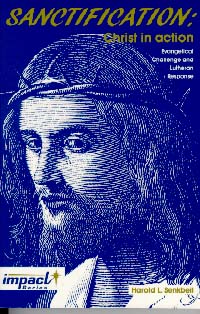
Sanctification by Harold L. Senkbeil

The Lord Will Answer: A Daily Prayer Catechism

Where in the world is God? By Harold L. Senkbeil

Paul: Ambassador of Peace by Jon D. Buchholz

The Reformation Era: A short history of the Reformation by N.S. Tjernagel

Remembering Tim Horton by Craig MacInnis

Grace for Grace – the first 90 years of the Norwegian Synod (1853-1943 and 1918 – 1943) by S.C.Ylvisaker, Chr. Anderson and G.O.Lillegard.

Last book I read:

Deconstructing Evangelicalism by D.G. Hartthis book confirmed my suspicion that I had been a very shallow evangelical and is an important book to me, especially because it WASN'T written from a lutheran perspective.

Books that have meant a lot to me:

God’s Holy Word – the Bible

Evangelical Lutheran Hymnary

Luther’s Small Catechism

A good dictionary – I have several and we can’t play scrabble without one

The Defense Never Rests by Craig Parton – made me realize my experience in American Christianity was not unique and gave me one of those wonderful, “Hey, I’m not alone on the planet” feelings – this book didn’t change the way I see the world, but it confirmed my change as not unique. This book is important because it gave me confidence that I wasn’t going crazy.

What’s Going on Among the Lutherans? By Patsy A. Leppien and J. Kincaid Smith this book is also important in helping me understand the history of the Christian church in layman's terms.

The People’s Bible Series by Northwestern Publishing House – invaluable bible commentaries

Mamornitz: A History of a Ukrainian Pioneer Community in Saskatechewan, 1900 to 2000 by Jennie Zayachowski - this book is important in helping me understand why my ancestors moved halfway around the world and what they faced. I owe them my freedom.

Directory of Essential Oils by Wanda Sellar – invaluable aid for understanding essential oils.

Smart Medicine for a Healthier Child – treated many a simple childhood illness

Prescription for Nutritional Healing by Balch and Balch

The Educated Child by William J. Bennett – empowered me to be my children’s first teacher

Peekaboo! by Matthew Price and Jean Claverie – my daughter’s first book

Sleep Sound in Jesus (book and CD) – I memorized these songs and sang them every night to my son for at least three years.

The Science Game: an introduction to research in the behavioral science by Neil Agnew and Sandra Pyle – helped me understand statistics and studies, especially how findings can be manufactured and manipulated to suit agendas

The Lord of the Rings by J.R.R. Tolkien

The Chronicles of Narnia by C.S. Lewis

A Wrinkle in Time (and following books) by Madeleine L’Engle

Minnesota: A History of the State by Theodore C. Blegen – helped me realize how cool Minnesota history is


Prized books:

The Acorn – my grandfather’s Coe College (Iowa) yearbooks from 1930, 1931 and 1932

My complete collection of Mary Engelbreit Home Companion magazines

My great-grandmother Viets’ family bible

Embarrassing Book:

The Disciplines of a Beautiful Woman by Anne Ortlund - never did become the perfect woman she was.


Now, who to tag? These are my picks:

This is hard because I can think of so many people whose libraries I would love a glimpse into:

Devona Brazier

Terrie Rosas

Margery Punnett

Thanks to Suzi at Swansmith for tagging me the first time and Bunnie Diehl for tagging me again!

Wednesday, June 08, 2005

Introducing Wretched of the Earth

I just discovered a new confessional Lutheran blog from a new confessional Lutheran, RyanWretched of the Earth

He describes his blog: "Seen here are the growing pains of emerging from the vacuity of 'evangelicalism' and rediscovering the grace of God in confessional Lutheranism. But it isn't nearly as profound as that sounds. My alternate description for this page is 'adventures in sanctification'. "

He has plans to travel to Thailand soon:

I'm going to Bangkok in approximately three months with Lutheran World Mission, and I need to raise $10,000. That isn't the news. The news is the fact that this hit me like a ton of bricks today, and I got the dry heaves and passed out at the library. Not quite, but I did start to get a little worried. LCMS (Lutheran Church-Missouri Synod) sent me this book called FriendRaising that is supposed to tell me how to raise support. I guess the premise is that you had better get some friends before you ask anyone for money. It's probably a better plan than my current one of waiting for a benefactor to show up, like in Great Expectations.

Sunday, June 05, 2005

Harold Senkbeil does indeed rock, Bob.


I've been reading Senkbeil's book, Sanctification, this weekend. It's incredible. I had been reading D.G. Hart's Deconstructing Evangelicalism and found it helpful in understanding what the current American Evangelical movement really is. But now reading Senkbeil's book, which I know comes from a confessional Lutheran perspective and was written about 15 years before Hart's book, I finally understand exactly what the movement is. I can finally answer my own question, "What is an Evangelical?" The answer is very simple. I will post on it soon.

Wednesday, June 01, 2005

My library is growing...

I splurged and ordered several books today:

two leather-bound indexed Concordia Study Bibles for my two Lutheran school students at a very low price

Two books by Harold Senkbeil - Where in the World is God and Sanctification

A book on the life of Paul and his journeys

The Lord Will Answer

Concordia: The Lutheran Confessions - A Reader's Edition of the Book of Concord

Wednesday, March 23, 2005

Be strong in this grace: God reaches out to us! Part 3

Sorry to take so long to finish this series! My daughter has been sick with one thing after another since February 22nd, but is finally on the mend.

Part I: Popular explanations concerning our natural human condition and what does the Bible say about our natural human condition?

Part II: Three Answers to our natural human condition

Part III: Some thoughts from Walther and Senkbeil

Walther

"Having this doctrine, what exceedingly happy and blessed people (we) are! This teaching takes us to Christ by a straight route. It opens heavens to us when we feel hell in our hearts. It enables us to obtain grace at any moment without losing time by following a wrong way, striving for grace by our own effort, as we sometimes do with a good intention. We can approach Christ directly and say, "Lord Jesus, I am a poor sinner; I know it; that has been my experience. But Thou has called me by Thy Gospel. I come to Thee just as I am; for I could not come any other way. That is the saving doctrine which (we) have learned from Christ and the apostles."

Senkbeil

"In our relativistic age, the validity of any concept is not in its truth by some objective standard, but its meaning for the individual. A wide variety of goods ranging from hamburgers to automobiles, are advertised with an appeal to personal self-interest. The consumer is reminded that what is best for him is best. Our society appears to be more concerned with subjective meaning than objective truth, even when it comes to moral values. Instead of searching for objective standards upon which to base action in achieving a consensus of opinion. "I feel" has been substituted for "I think". The obvious subjective thrust of Evangelical theology is tremendously attractive to such a world view. The individual who has "invited Jesus to come into his heart" has no need to substantiate the truth of his convictions. He "feels" like a Christian, and for him that is the most important part of believing. The ultimate absurdity of this approach to the Christian faith is best expressed in the words of the old Gospel hymn: You ask me how I know he lives? He lives within my heart. Whether the focus is on speaking in tongues or conquering a pet sin, Evangelical Christianity regards these human actions as a demonstration of God's reality in the human experience. In our subjective age, the attraction of this brand of demonstratable Christianity can hardly be underestimated.

Senkbeil, Sanctification: Christ in Action, pages 9 and 10

" In our pragmatic age, people are much more prone to ask "Does it work?" than "Is it true?" The assumption is made that if it works, then it must be true. More fascinated with results than theory, contemporary Americans are understandably impressed with Evangelicalism. Here is a theory which seems to work; here is a theology which appears to bring results. God is at work in the world; the believer only has to look to his own life to see the reality in his commitment to Christ working its way out in the lives of his people. This is no "paper god"; this is the living Lord of heaven and earth! In the lives of his people, it is held, God demonstrates his power in living reality.

Monday, March 07, 2005

Be strong in this grace: God reaches out to us! Part 1

One of our pastors did a fine job of teaching on the topic of sanctificaton yesterday in Sunday morning Bible Study. He resourced the book, Sanctification: Christ in Action, NPH: Milwaukee, 1989) by Harold L. Senkbeil. According to the NPH site, this book "offers a critical, yet sympathetic analysis of the Evangelical movement's impact on Lutheranism. Examines the historical roots of Evangelicalism; analyzes one of America's most popular Evangelical authors, Charles Swindol; and proposes a new Lutheran initiative in the face of the Evangelical challenge. I'm ordering it today!

Part I:

Popular explanations concerning our natural human condition

"Mankind has the potential for good."

"Mankind is innocent/good by nature."

"Mankind by nature is sinful and spiritually is dead, unable to do anything positive before God, for self or others, not for life nor salvation."

As you read each of the above popular explanations, ask yourself these questions:

1. Who embraces this explanation?
2 What does baptism do in this system?

What does the Bible say about our natural human condition?

When God created man, he made him in the likeness of God. He created then male and female and blessed them. And when they were created, he called them "man". When Adam had lived 130 years, he had a son in his own likenss, in his own image; and he named him Seth." Genesis 5:1-3

" The LORD saw how great man's wickedness on the earth had become, and that every inclination of the thoughts of his heart was only evil all the time, " Genesis 6:5

"Surely I was sinful at birth, sinful from the time my mother conceived me, " Psalm 51:5

"For from within, out of men's hearts, come evil thoughts, sexual immorality, theft, murder, adultery, greed malice, deceit, lewdness, envy, slander, arrogance and folly. All these evils come from inside and make a man 'unclean', " Mark 7:21-22

"Flesh gives birth to flesh." John 3:6

"Jesus replied, 'I tell you the truth, everyone who sins is a slave to sin," John 8:34

"I know that nothing good lives in me, that is, in my sinful nature. For I have the desire to do what is good, but I cannot carry it out." Romans 7:18

"...the sinful mind is hostile to God. It does not submit to God's law, nor can it do so." Romans 8:7

"There is no difference, for all have sinned and fall short of the glory of God." Romans 3:23

"The man without the Spirit does not accept the things that come from the Spirit of God, for they are foolishness to him, and he cannot understand them, because they are spiritually discerned." 1 Corinthians 2:14

"As for you, you were dead in your transgressions and sins...we were by nature objects of wrath." Ephesians 2:1,3

"If we claim to be without sin, we deceive ourselves and the truth is not in us." 1 John 1:8

"He who does what is sinful is of the devil." 1 John 3:8

Sunday, March 06, 2005

Update on "Is Christianity Broken?"

I've been watching Cerulean Sanctum for comments to Dan's post, "Is Christianity Broken?". Dan did add his comments to my response post, clarifying his point. Tonight I was surprised to read a voice from my past in the comments section of his blog tonight. It is an anonymous comment, but I know that voice way too well. The comments are not reflective of Dan's excellent and helpful blog. I don't speak of the anonymous person, but of the evil influencing him/her. It is the voice of Satan telling saved Christians they still aren't good enough for heaven, that they haven't done enough yet to please God. The voice that denies scripture by saying that the Holy Spirit is something that you must be filled with AFTER "accepting" Jesus into your heart. That voice that confuses Christians into believing that they can acheive some god-like state here on earth. I am so thankful to have walked away from that perversion of Christianity!

"Christianity in the modern western world isn't broken, it has failed and continues to fail. God has not failed us, WE have failed God. Most people have no interest in overcoming sin. They do not want to know what dying to self means. In short, they do not want to be filled with the Holy Spirit. This cuts across ALL groups and denominations. These are diseases called self and flesh and pride. They have infected every Christian group, whether charismatic, evangelical, fundmentalist or any other. Some of the groups that claim to be Full Gospel are the worst. I beleive only a small group of people in the United States (Maybe one percent of the whole population, at best) have any interest in obeying Jesus. They are not a part of any single group or denomination. They are the only reason God has not already destroyed this country. Everyone else just makes excuses. Jesus will reward those who OVERCOME SIN."

I hope that no one decides to accuse me of denying that there is any victory over sin through Jesus. There certainly is! That's not what the anonymous comments are speaking about. Do you think I'm overreacting? It is interesting that our Bible Study this morning was on sanctification. I will be posting on that topic this week. Our pastor gave an excellent lesson on that important topic. How do we know we are saved and going to heaven? The Bible tells us so!

Friday, March 04, 2005

Cerulean Sanctum asks: "Is Christianity broken?"

Dan of Cerulean Sanctum, after a morning's reading of various Christian blogs asks a great question, "Is Christianity broken?"

I've been using Bloglines to read the feeds from about fifty Christian blogs. The service works well and allows a person a quick way of scanning updated feeds. I can read through those fifty blogs as they post in less than fifteen minutes. It's almost like reading through a copy of Christianity Today, except with a far looser editorial standard. And that's a problem.

Since 2001, I've had a blog up. Cerulean Sanctum came about in late 2003 because I saw a need that was going unfilled, a blog that called people back to the heart of the first century Church. I've considered this blog to be a ministry for me; I've received many letters over the last eighteen months from people who have been blessed by this blog.

But now as I read all over the blogosphere, I wonder if we Christian bloggers are actually doing a disservice to people, especially to those who are struggling in the faith or are considering the claims of Christ for the first time.

My reasoning? Well, as I go through my list of fifty blogs, I often leave them feeling confused, angry, depressed, and just about every feeling but the one the Lord wants to cultivate most in us, joyful. This is not to say that there are no Christian blogs that are edifying. But as I read the blogs, see the dissension, note the snarky comments left, and take in some of the more extreme ideas out there, I am left with only one question, Is Christianity broken?

It's hard to escape that impression after a few visits to popular Christian blogs: See list here.

After a while you can't avoid the question. The blogs beg for it. The conclusion seems inescapable. Even writing about this seems to only add fuel to "Is Christianity broken?" If a cross-sectional reading of popular Christian blogs is any indication, the answer must be "Yes."

So on this Friday morning I'm wondering if those of us who blog are only making the Christian walk harder for people rather than easier. This weekend I plan on taking some time to ponder this question. I don't know what this means for this blog, but I'd like to hear what others think about how we Christian bloggers are portraying Christianity to the world. Truthfully, we have an enormous burden in an age when ideas are so readily presentable to the entire planet via the Internet. Maybe we just need to tone down our rhetoric and be a little less dogmatic in some of our thinking. Or maybe all we need is to simply shut up and listen for a change.

Dan asked for comments and I had lots to say. So much, in fact, that I decided to post my comments (and more) here. It's a good post and good questions, Dan. You've given me much to think about here. First of all I would like to offer that Christianity isn't broken at all. Jesus Christ is the same yesterday, today and forever. People are broken. We are all sinners who fall short of the glory of God. Christians remain sinners to their last day on earth, and often succomb to temptation...especially when they imagine that they've been a Christian for so long that they might just be immune to sin (Bill Bright's famous comments come to mind). Blogs are online journals, not poorly edited versions of Christianity today as you aptly noted. It is easy to think of blogs as "gospel", but they are not.

This new technology has enabled individuals to each publish their own household magazine. Very unedited, too. Do any of you have teens whose friends have Xanga journals? A few of them are good, most are really bad. I have to sit with my teen and point out that she can choose not to look at certain ones. Another example... in your town, are all stores good and helpful ones? No. There are churches, grocery stores, clothing stores, pharmacies and porn shops all in the same town. You and your family go the helpful stores and avoid the bad ones. Blogs are the same way; there are good ones and not so good ones. Not every blog that calls itself Christian will be a helpful blog to other Christians. Sometimes I stumble onto a Christian blog that is obviously a very personal view into someone's distorted life and I move on. Same with books and magazines...and that's been true for years. We have to discern whether someone is trying to be uplifting to others or not. And yes, we should all be aware that non-believers might be reading our blogs. Non-believers might be watching us at the hockey rink or at school or at the grocery store (perhaps a more sobering thought than merely reading our anonymous blogs).

Rather than be saddened by the inevitable sin nature of my fellow Christians, bloggers and otherwise, I think we should instead try to encourage and comment on good and helpful posts and contemplate this admonition by Craig Parton:

"Luther said the Christian life is one of continual repentance, and that every Christian is no more than one day old. Adam still rears his head, the flesh is still at war. One day we will enter into a final rest with our Lord Christ in whom is true RedemptiIon and Sanctification, the forgiveness of our daily trespasses."

It is in this contemplation of our own sin nature and through our only hope through Jesus Christ that we can fix our broken blogs and be joyful. Only when we are strong in the grace that is Christ Jesus can we truly be joyful.