
Showing posts with label Vocation. Show all posts

Sunday, September 24, 2006

Lutheran Carnival XXXIII

September


a poem by Longfellow, thanks to Norman Teigen


I bear the Scales, where hang in equipoise

The night and day; and when unto my lips

I put my trumpet, with its stress and noise

Fly the white clouds like tattered sails of ships;

The tree-top lash the air with sounding whips;

Southward the clamorous sea-fowl wing their flight;

The hedges are all red with haws and hips.

The Hunter's Moon reigns empress of the night.

September has always been my favorite month. It is the month of my birthday, which mostly likely caused me to rejoice when I was younger. Nowadays, I cringe at the actual number of my birthdays, but I still love September. Why? Falling leaves, the start of school, cool nights and shortening days, the first chance to put on a sweater since spring, chrysanthemums, my big red sugar maple tree, squirrels busily burying their nuts. What isn't there to like about September? Of course, I haven't asked any 9/11 survivors if they love September. Nor my dear sister-in-law who just lost her mother on 9/11, just nine days after her own birthday. Nor the family who just lost their ten year old daughter in the Rogers tornado. But for now, I love September. And I love blogs!


One of my favorite ELS blogger, Norman Teigen, wrapped up his series on his take of the history of the ELS. His thoughts are his own, of course, but he has experienced life in the ELS from a unique viewpoint - both by family ties and by the events of his generation. See parts I, II, III, IV, V, VI. Norman Teigen is one of my favorite people. Not only is he a fellow church member, but he's also an interesting person. I love his blog! He takes the vocation of blog-keeping even more seriously than I do (at least he posts every day). He and my hubby talk after church until my kids have to pull dad away, out of the building and toward the car. Norman and Rob ususally talk about sports: Iowa v. Minnesota, the Vikings, the Twins. Talking to people after church is one of my favorite things about church and Norman is a good person to talk to.


Onto the rest of the bloggers that I haven't yet had the pleasure of meeting in person. Everyone's favorite aardvark has a blog, Aardvark Alley . The ol' Aard playfully invoked the noted author's greatest work in providing a title for Dante Alighieri: Classic Comedian. His commemorative post touches upon Dante's importance both in the Church and for Western liturature and summarizes most of his important works, including the three volumes of the Divine Comedy. Cyprian of Carthage, Bishop and Martyr, is certainly a lesser-known hero of the early Christian Church. Because of that, Aardvark Alley tries to show his influence on Christian theology and practice as well as noting some areas where Saint Cyprian's teachings were not followed by the majority of orthodox Christendom.


A dear friend of the Aardvark, Pastor Snyder, of Ask the Pastor , gets a wide variety of questions but this was a first. A man wanted to know, Can a Christian Be a Comic Book Author? Pastor Snyder responds by talking about truth revealed in fiction as he leads his readers to examine how they could live out the Faith in this and other vocations. A serious topic that Christians often ignore rather than face is the Imprecatory Psalms. Ask the Pastor confronts these harsh songs of the Old Testament through Praying Evil upon Our Enemies. Pastor Snyder says that there are proper times, ways, and attitudes for Christians to join voices in these requests for divine vengeance. However, he also reminds us that the full harshness of God's curse fell squarely upon His Son in order to save sinful, accursed mankind.


GHP's recent Luther Library review of Caitlin Flanagan's To Hell with All That: Loving and Loathing Our Inner Housewife touches upon several of the book's strengths and shortcomings. While sincerely recommending this work, he also comments on some of the weaknesses he perceives and also gently inserts a bit of his own thinking without letting it get in the way of encouraging others to read it for themselves.


After a very blessed experience at the Image of God Conference, the Rebellious Pastor's Wife contemplates a topic not addressed there in her post, One Thing Missing. Another blogging pastor's wife, Kelly of Kelly's Blog, contributes two related posts, Youth - not a "tribe apart" , a contemplation of being a youth leader, her own experiences with youth group hopping and where strong cetechesis fits into the picture, and More Youth Thoughts While Cruising the Cemetery, thoughts on the nature of youth groups spurred by a wander through the town cemetery.


Ritewinger at Theocon discusses, in Seeds of the Sower, the lack of Law in the "Sinner's Prayer" and in crusade conversion.


Everyone's favorite British blog-keeper, John H. of Confessing Evangelical cites, in Run away! Run away!, a superb post by Internet Monk, Michael Spencer, as well as a stirring quotation from CH Spurgeon, each reinforcing the message that adultery is a Really Bad Idea - one which should be obvious, but which, sadly, bears frequent repetition. John H. also offers, A Dangerous Element. Continuing John H's tendency to post non-Lutherans saying very Lutheran-sounding things, here is a glorious quotation from Martyn Lloyd-Jones on how true Gospel preaching will always be accused of antinomianism.


Resident referree of the Confessional Lutheran blogosphere, Dan at Necessary Roughness points us to his developing series on the Divine Service. He's got seven posts in the series already! One of my favorite blog-keeping Lutheran moms, Mutti Beck of Beckfest, has begun a series entitled Hymn I Love. She has begun with Salvation Has Come Unto Us.

It has been a pleasure to edit this 33rd issue of the Lutheran Carnival. Thanks to all those who submitted posts or allowed me to borrow posts. If you weren't in this issue, please consider joining in next time.


Friday, August 18, 2006

The Masks of God

The other day I picked up a photo on my pastor's desk. It was of his first son, Hugh, taken just hours before he died last August. Although Hugh's skin tone and the tubes attached to his little body indicated a sick child, the sparkle in his eyes and the smile on his face were full of life and expressed delight and joy.

I was struck by the contrast in the photo: dying child full of life. How could that be? I know if it had been a photo of me as I lay dying, I would have made sure to look sick in the photo! Hugh hadn't learned that trick yet. He was still reveling in the joy of life...of a life soon to change.

I think there is a lesson in that photo. I need to find some scripture to go along with it. God put life into the child and gave him a soul. Baptism brought his soul into faith in Christ. Disease, born of a sinful earth, robbed Hugh of his earthly body, but not the life God gave him.

In honor of the one-year anniversary of Hugh Brooks' arrival at heaven's gate, I am posting something I wrote after attending his funeral. Up to that point in my life, I had never been to the funeral of a pastor's children nor had ever been to the funeral of a child. Here are my reflections of that day...


Masks of God

orginally posted in August of 2005


All our work in the field, in the garden, in the city, in the home, in struggle, in government--to what does it all amount before God except child's play, by means of which God is pleased to give his gifts in the field, at home, and everywhere? These are the masks of our Lord God, behind which he wants to be hidden and to do all things. --Martin Luther, "Exposition of Psalm 147" from Masks of God blog


Our pastor and his wife recently buried their young son. During his four short months on this earth, struggling to overcome a heart defect, his parents kept on online journal. One entry, made on a more hopeful day, struck me deeply:

We are so thankful to see God working and to see Him hiding Himself behind the vocations of cardiologist, neurologist, anesthetologist, surgeon and nurse. Doctor is one of the masks God wears.
This young pastor also wears a mask of God, and his wife as well. Even in their deep and utter grief, though they were both emotionally and physically near exhaustion from the death of their sweet firstborn son, God's love could be seen beaming through in their eyes, their smiles and their touch. They were not spiritually exhausted; they were reaching out to all of us, hugging everyone and reminding us of the joy of salvation that sweet Hugh has now obtained through Jesus' death on the cross.

I had never seen a pastor at the funeral of one of his own. I had never been at the funeral of a baby nor a child. Now, I don't base my faith on what my eyes have seen and I can't believe in God just because of how my pastor and his wife gave clear account for the joy that is in their hearts; but seeing them doing so confirmed what I already knew to be true through the witness of the Holy Spirit. God has provided a clear and joyous salvation from this fallen creation - where little boys are born with heart defects- through the atoning sacrifice of his Son, Jesus Christ, who was raised from the dead, ascended into heaven and sits at the right hand of God. He has prepared a place for all who believe this is true. As if that wern't good enough, God has also sent his Holy Spirit to plant the seed of faith in the hearts of all who are washed in the waters of Holy Baptism and to grow and strengthen the faith of all who hear His Word preached and partake of Holy Communion. My pastor taught me this and he didn't run from it when his own little son died. Pastor and wife are one of the masks God wears.


During this last week, I have struggled fruitlessly on my own to defeat the evil plot of a computer programmer who has used his God-given talents for understanding numbers and computer programming to trick people, steal their money and corrupt minds and souls. He or she is faceless and nameless to me, but not to God. He is wasting his talent and rejecting God's urging to come to Him.

Just when I was ready to give up, I was led by my ISP provider to a young man who also has great God-given talents for understanding the same things as his evil counterpart. He uses those talents to continually learn more about viruses and trojans and hackers. He freely gives his time for no pay to companies in exchange for learning more.

To date, he has spent three hours straight on his phone dime, doing the work of a entry-level computer support person while also searching for an elusive hidden trojan virus. Sure, he is compensated in others ways and hopes to one day invent a little device to clean your machine in five minutes! But, he's got a long way to go and on his way he has helped countless numbers of people rid their machines of trouble and get back to work. Computer programmer,"geek", forensic network specialist are also masks God wears.

Pastor Snyder recently posted about the new Lutheran Carnival and the confessional Lutheran blogosphere: Ask the Pastor: Lutheran Carnival III and Beyond. He wrote:

"Lutherans are among those rare few who realize that even when we talk of “ships and sails and sealing wax, of cabbages and kings,” we also are talking theology. While I’m pretty sure that there will be plenty of theologizing from blogging pastors I’d be interested not only in lay theological perspectives about jobs, careers, marriage, and other vocational areas, but also reading some of the “daily grind.” Many of the bloggers I read, including Love and Blunder, Kiihnworld, and Pastor Steve Billings let me see much of their hearts and their theology through windows opened into the “ordinary” in their lives."
Yes, Pastor Snyder mentioned me in his last sentence and it really touched my heart, but that is NOT why I am mentioning his post. Blogs have been taking a bad rap lately, especially among our own. That deeply saddens me because blog-keeper is also a very honorable vocation. I began writing not thinking that anyone would ever read. I wrote to make sense of my life and faith.

About two months after starting my blog, I did a random search for confessional lutheran blog, thinking I would find nothing. With great surprise and delight I clicked on The Random Thoughts of a Confessional Lutheran and my world changed. From that blog, I discovered so many others, Confessing Evangelical and Bunnie Diehl were among the firsts and are still my favorites, although I've met so many more fellow saints since then. For the first time in months I realized that I wasn't alone in coming to the Lutheran confessions. Now how else would I have found other confessional Lutherans to strengthen my faith - mutual consolation of the saints, as the wise Wildboar once wrote.

Writing about my very ordinary life through the lens of my faith in God has helped me to be able to be able to more easily give account for the joy that God placed in my heart. And I'm not talking about blogging, I'm talking about my everyday REAL life. Writing about my faith is helping me to be open about my faith to others. I used to save my "Christian comments" for fellow Christians; now I can more easily leave God in His rightful and natural place in the world and include Him in my conversations with people. I attribute my ability to account for the joy to God; His Holy Spirit has planted it in my heart. I do believe that He also expects me to find and know good preaching, so that I learn more and practice saying and writing it down.

To you, dear reader, and to all the established, burgeoning or just-learning writers who decide to keep a blog, I thank you. Blog-keepers also wear a mask of God. I can't possibly begin to name those of you that have blessed my faith and my life, but I will try: Pastor Snyder, Rob and Devona, John, Bunnie, Scottius Maximus, Daniel, Elle, Dan, Glen, Bob, David, Jason, Floyd, Mutti, Brian and Matt, Pastor Steigemeyer, Chris W., Prof. Chris, Terrie, Vicar Lehmann, Michael and Timotheos, Pastor Brandos, Pastor McCain, Rev. Klages, Ron and Erica, Twylah, Josh S., Wildboar (wherever you are), Suzi and Tim, Monergon and Theophorus, Worthy Woman, Rick, Michael S., Rev. Chryst, Minister2B, Maria, Webcritter and Mr. Critter, and the many others that I've probably missed (probably because you don't have an RSS feed. If your name isn't here, email me and I'll ADD it! I've thanked you before and I'll thank you again for sharing your life and vocation through your blogs. It is a blessing to me. God be with you today and always!
.

Sunday, March 12, 2006

Lutheran Carnival XIX

Lutheran Carnival XIX

I am most privileged to host this nineteenth issue of the Lutheran Carnival. This issue has over 30 posts from Christian blogkeepers who maintain a quia subscription to the Book of Concord. What does that mean? They believe that the Book of Concord is a right and proper exposition of the Word of God. Their posts are written on many topics, as long as they are written from a confessional Lutheran perspective.

For this carnival, I would like to introduce you to a forefather of my beloved Norwegian Synod: Jakob Aall Ottesen. Bethany Lutheran College Professor Erling Teigen stated in his presentation to the 150th gathering of the Evangelical Lutheran Synod (formerly the Norwegian Synod) in 2003,


"Of the three fathers (Preus, Koren and Ottesen) who have been shaped into a sort of holy trinity for the Norwegian Synod, the “forgotten” or less visible person of that trinity might be Jakob Aall Ottesen...What is of chief interest to us in this essay is the theological legacy, especially the Reformation, confessional Lutheran legacy Ottesen left on the immigrant church he helped organize. One part of that legacy is fellowship with the Missouri Synod, which led to the formation of the Synodical Conference in 1872."


Jakob Aall Ottesen

Who is Jakob Aall Ottesen? The answer is not short, except there are few short bios on this good man. His name is not on the lips of many Lutherans, but his life was dedicated to our service. The details of his life's work are more suitable to a college course, but I'll attempt a brief summary. My information comes from the Ottesen Museum, located between the campuses of Bethany Lutheran College (BLC) and Bethany Lutheran Theological Seminary in Mankato, Minnesota; from a lecture, The Legacy of Jakob Aall Ottesen, given by BLC Professor Erling T. Teigen commemorating the 150th anniversary of the Norwegian Synod and an excellent geneological website by Ms. Dixie Hansen. We'll start with his obituary, since it is the earthly sum of his life:

PASTOR OTTESEN IS DEAD
One of the founders of the Norwegian Synod lays down his pilgrim's staff

A Life of Sacrifice

The old pastor, Jacob Aal Ottesen, one of the pioneers and veterans of the Norwegian Synod, died about 12 o'clock Saturday night, and his death did not come unexpectedly, neither for himself nor for those nearest to him, as he had been in poor health for a long time.

Pastor Ottesen was born in the Fet Parsonage in Norway 11 June, 1825, and he therefore got to be 79 years and 5 months old. His father and grandfather had been ministers in Fet for about half a century. The family belongs to one of the oldest ones in the country, and there have been approximately 50 ministers among Pastor Ottesen's kin.

Following his graduation with distinction from the university, Ottesen for three years was a teacher at Nissens Latin og Realskole (Nissen's Latin and High School) in Kristiania. However, Norway was not where our Lord had decided for him to work, and since many of his compatriots had emigrated to America, he accepted in 1852 the call from a congregation, which had been formed in Manitowoc, Wisconsin. After his ordination by Bishop Arup, he left with his young wife, Katarine Doderlein, a daughter of School Principal Døderlein of Kristiania Katedralskole (Cathedral School) for the unknown America. Ole Bull had just started his disastrous colony, Oleana, in Pennsylvania, and Pastor Ottesen was requested to go and preach the gospel for his compatriots there. His parish in Manitowoc consisted of three organized congregations in and around the town as well as a mission field in the area from Green Bay to Milwaukee. This was truly mission and pioneer work that not only called for a sincere love for the Lord and His work, but also required much bodily strength and perseverance. Most of his time was spent traveling, especially on horseback in all kinds of weather and through thick forests without roads. Pastor Ottesen traveled that way, often 30 to 50 miles a day, and picked up a bad case of rheumatism, which resulted in permanent damage to one of his legs. In 1853 he was one of seven ministers who met in Koshkonong together with 42 representatives from 28 congregations to consider the question of establishing the Norwegian Synod. Its constitution was adopted here, and then later at the Synod Conference in October, 1853, got voted in after having been presented to the congregations.

Pastor Ottesen was the Synod Secretary for many years. The old pioneers had a keen eye for how to succeed with their work. They had to get their pastors educated in this country, and Pastors Ottesen and Brandt were sent in 1857 as delegates to visit the Lutheran schools in St. Louis, Columbus and Buffalo to see what could be done to get the Norwegian ministers educated at one of these schools. Based on the report that the two delegates brought to the Synod, the Seminary of the Germans in St. Louis was chosen, and a professorship was filled by theNorwegians, and a hand of friendship given tying the Norwegian Synod to the Missouri Synod. This has lasted until this day. In 1860 Pastor Ottesen was called to Koshkonong, where he served the three congregations: Eastern and Western Koshkonong as well as Liberty Prairie until 1891.

From 1861 to 68, he and Pastor H. A. Preus edited Kirkelig Maanedstidende (Monthly Periodical for the Church). In 1877 he was appointed Professor of Theology at Luther Seminary, which had just been established, but he declined the appointment. That same year, he was also selected as the first chairman for the Eastern District. The Synod was divided into districts that year. He also turned down this position. He was a member of the Synod's Church Council for many years.

During the tragic church controversy that broke out in the Synod during the 80's, Ottesen and his congregations suffered much, and in 1891 he stepped down as a minister and moved to Decorah, where he has since lived. Last year during the jubilee for the Synod here, as one of the few original ministers, he was present and spoke to the Synod. A short time before the Synod Conference, he and Pastor H. A. Stub received from King Oscar the Order of Knight of St. Olaf for long and honorable service to the church. Pastor Koren was made Commander of the Order of St. Olaf. Pastor Ottesen for more than a generation has carried the burden that goes with a large parish, although he was not strong physically, and this was in addition to all the work that the community had him do. However, he had a good education in the classics, sharp judgment, and was a competent writer, and more than anything else he had an intense love for his Lord and His work and was willing to offer everything for it. Although Pastor Ottesen's work has not attracted the attention of the big world, because it was done quietly among the members of his own congregation, he often did some really heroic deeds. He lived a life of self-denial at all times and that should be known in wide circles. We all owe an invaluable debt to men, who like Ottesen, just lived for one reason, namely to break bread for others and to take the gospel of Our Savior to as many as possible. Bless the memory of them!

Pastor Ottesen had a happy family life. Ottesen had a sharp and witty mind, and there are many who carry happy and amusing memories from the parsonage at Koshkonong. Pastor and Mrs. Ottesen had six children; three of them died quite young. A daughter, Diderikke, married to Professor Dr. H. G. Stub, left at her death two sons, who now are ministers. The two children who survive him are: his son, Pastor Otto Christian in Rio, Wisconsin, and his daughter Hanna Cathinka, who has stayed with him all the time here and who faithfully and lovingly has cared for him. An adopted son, Olaf Mandt, died young after serving as a minister in Baltimore for a short time.

From 1894 to 1896, Ottesen was the minister for the Synod congregation here in this town after Pastor Hove moved to Mankato and before Prof Stub became the minister here. He has otherwise, except for the last two years, preached off and on. His last task as a minister, as far as we remember, was the ordination of his daughter's son, Jacob Stub, to the holy work as a preacher in the fall of 1902. Ottesen has written and translated much. He wrote Kort Uddrag af Synodens Historie (A Short Excerpt of the Synod's History), which was presented at the World Exhibit in Chicago. At the request of the Synod, he rewrote the Catechism and translated Gynter's Symbolik from German.

Professor Erling Teigen illuminates some personal facts of Ottesen's life. First of all, he was known as having a keen mind, he avoided the spotlight, he worked tirelessly and suffered rheumatism and depression from it, and he raised children who contributed to the faith and to society in future generations.

Ottesen was one of the seven pastors who organized the Norwegian Synod in 1853 (C.L. Clausen, H.A. Stub, A.C. Preus, G.F. Dietrichsen, H.A. Preus, Nils O. Brandt, and Ottesen), having just arrived in 1852. Aside from his long service as a parish pastor, Ottesen’s contributions are in the form of theological writing, particularly polemical articles in the church paper, first called Kirkelig Maanedstidende, but Luthersk Kirketidende after it became necessary to publish semi-monthly and weekly. He served several times in the early years as secretary of the synod, but a most momentous and far-reaching assignment for this young pastor came in 1857 when he was sent by the Synod (the resolution was passed at the 1855 convention) with Pastor Nils Brandt to visit some Lutheran seminaries in the U. S. The mission was to find a place to train pastors for the Norwegian immigrant church. From 1859-1868, he was co-editor with H.A. Preus of the church paper, Maanedstidende, which was the platform for a large part of his writing, much of it doctrinal and polemical. He wrote a brief history of the Norwegian Synod (to be distributed at the Chicago Exposition in 1893), as well as a series of articles entitled “A Look at the Missouri Synod.” He translated Guenther’s Symbolik from German to Norwegian, as well as Walther’s The Evangelical Lutheran Church: God’s True Visible Church on Earth.

Ottesen had one son who entered the ministry, Otto Christian Ottesen, who did not outlive his father by many years, dying in 1917. Two grandsons, Hans Andrews Stub and Jacob Aall Ottesen Stub also became pastors, and had notable service in the merged Norwegian Lutheran Church in America after 1917. Their mother, Diderikke Aall Ottesen, was married to H.G. Stub, who led the Norwegian Synod into the 1917 merger. The young mother died in 1879, soon after the birth of her second son. The first daughter born to the Ottesens was named Hannah, but she died soon after birth, as did another girl. Including Diderikke, the young mother, the Ottesens left three children buried at Koshkonong. (Nils Brandt was married to a Diderikke Ottesen, who apparently was a sister of J. A. Ottesen.) One daughter lived to adulthood, also named Hannah, who lived with the Ottesens until the death of Mrs. Ottesen (Cathinka) in 1899, and Pastor Ottesen in 1904. Ottesen also had a foster son, Olaf Mandt, who lived with the family in Koshkonong for confirmation instruction, and then was sent by Ottesen to Luther College, and Concordia Seminary in St. Louis. After his ordination, he served in Baltimore, where he died after two years in the ministry.

But that was not all the sorrow Ottesen left at Koshkonong. On August 10, 1891, the Ottesens were taken to the depot in Stoughton and took the train to Decorah, Iowa, where they would spend the rest of their lives. Ottesen’s friend Halvor Halvorson notes that in the ensuing 13 years, Ottesen traveled some, coming as close to Koshkonong as Spring Prairie, (where he performed the wedding of his niece Cathinka Hjort to pastor J. Strand), but never visiting there. He was invited by the congregations often, and always sent a greeting for festival occasions, but never visited. It does not seem that this reluctance to return to the place where he had served as pastor for 31 years was rooted in a circumspect pastoral ethic to stay away from places one has previously served.

While serving the three-point parish, West and East Koshkonong, and Liberty (near Deerfield), Ottesen confirmed about 3,000 young people. From that number, one can project an even larger number of baptisms, as well as a great number of marriages, and funerals. And there is a great deal of evidence that Ottesen was a dearly loved pastor among his people. In the late ‘70s, he was permitted to leave for several months to visit Norway, which included the final visit with his father.

But Ottesen had health problems. Early on, there is mention of his being sickly, and not always able to carry the full load of his ministerial duties. Certainly the East and West congregations on Koshkonong Prairie as well as Liberty congregation to the North grew rapidly, and one wonders how one man could keep up with that work.

George Orvick reports what may be the recollection of Julia Reque:

Ottesen traveled a distance of 30-50 miles a day on horseback, in summer heat and winter storm. As a result of these strenuous journeys, Ottesen contracted chronic rheumatism which worked havoc with the nerves of his legs, so that it was difficult for him to talk or stand long. Because of this Ottesen was often forced to sit in the pulpit when delivering his sermons.

This condition may have exacerbated another condition—there is some evidence that Ottesen suffered some depression, which might today be called depression and anxiety. In any case, even before the outbreak of full-scale doctrinal warfare, because of Ottesen’s illnesses, the congregations hired a “kapellan,” a curate or assistant pastor, which would have serious repercussions in the controversial years to follow.
The election controversy which began in 1877 took a toll on his condition. Ottesen wrote in 1885:
But I will add that in the last four to five years, I have been under a great deal pressure from sorrow and distress, both because of physical illness, namely, an often painful nervousness [nervøsitet], and also because of the emergency I saw in the congregation during the bitter controversy, which has gone on here in these years. No one will be surprised that during all this have often been more despondent [modløs] and irresolute [radløs, indecisive] than I would have been otherwise.
What he describes, mentioned also by others, appears to be an already existing condition exacerbated by unusually stressful circumstances.

In reading through the life of Rev. Ottesen, I was struck by the accounts of others of his daughters: Didrikke Aall Ottesen Stub and Hannah Cathinka Ottesen. Didrikke died following a short illness while visiting her parents. Her son (and Ottesen's grandson) Jacob Aall Ottesen Stub, writes:

My mother - Diderikke - I cannot remember. I am told she was a tall and queenly woman. combined with her woman's love of home and dear ones was a keen interest in life in general. She was well educated, loved books and music, but also the out-of-doors. One of her friends, who knew her well, has told me that she was an excellent driver and utterly fearless. In corroboration hereof she showed me a newspaper clipping which tells of her stopping a runaway team, and preventing what would probably have been a serious accident. She did not live to see her two little boys grow beyond babyhood. Blessed be her memory!


His other surviving daughter, Hannah, never married but lived to age 70. She cared for her parents until their deaths and enjoyed learning from her father and the many intellectuals who visited their home. She willed several family heirlooms to the ELS. This Ottesen collection, together with other artifacts, comprises the holdings of the Ottesen Museum. It was the women of the synod who provided the impetus for establishing the Ottesen Museum. As the synod was preparing, at its 1941 annual meeting, to celebrate its 90th anniversary (1943), which also would mark the 25th year of the re-organized synod (1918–1943), a group of women began to discuss the possibility of establishing the Ottesen Museum. Sixteeen women met at Bethany Lutheran College on June 16, 1941, and determined to organize the museum.


On to Lutheran Carnival XIX!!!

That Rev. Ottesen encouraged his daughters in the faith and educated them well reminds me yet again of why I love my Norwegian Synod so! In the few short years that I have been a member of my church, King of Grace, my interest in scriptures has been encouraged and supplemented by our pastors and elders. I had my same interests in the twenty years I spent walking through American Evangelicalism, but instead of getting much of an education I received a series of trends topics and incomplete truths. In the spirit of truly embracing our God-given roles and in the expectation that we all become well-catechized, I am pleased to offer the many good posts by women and men of the confessional Lutheran blogosphere.

In her paper titled, Women & Scriptures, Sandra Ostopowich, of Higher Things and keeper of the blog, Madre's Missives, does a great job of summarizing how women are valued, educated and held in such high esteem in the confessional Lutheran church. In a humorous account, she describes how she - a Lutheran seminary student- was asked one day: "Why do you want to be a pastor? Women are way too important to God to be pastors!" She was mad and incredulous at that question, but took the challenge of studying scripture for a good response.

Sola Gratia of Living Stones offers a post entitled Crucifixaphobia. It discusses fear of the crucifix among some evangelicals. New Carnival contributor, Lora of The Rebellious Pastor's Wife, posts The Confessional Consumer. And another new Carnival contributor, Rebecca of Musings of a Saint and Sinner, offers two posts. In My Battle with Lent , Rebecca writes, "In my teenage years, I became an obsessive freak, trying in every which way to please God and make myself acceptable to Him. I never felt like I succeeded. When I heard Martin Luther's story, it was like I heard the message of grace for the first time. But my struggle with Lent is that emotionally it feels like going back to those old teenage years." In Ash Wednesday she talks about her strange love of Ash Wednesday, primarily because of its fundamental honesty. "There are few times in life when we are able to get down and gritty and admit these two things: I am a sinner and I am going to die. When we get honest about our brokenness, God hears our confession and moves in to bring healing. Then the Great Exchange happens where Christ takes all of our sin, brokenness, and death and gives us His life, health, resurrection, and righteousness."

In a commentary on Ash Wednesday, Scottius Maximus reviews one of my favorite books,
the wonderful daily devotion book, The Lord Will Answer- A Daily Prayer Catechism. I highly recommend Scottius Maximus for a daily dose of humor, baseball and Lutheran commentary!

Ryan of Wretched of the Earth blog, posts A good architect is important. Ryan reflects on the foundation of the Church, even as the foundation of his apartment is about to crumble.

The wise professor, CPA of Three Hierarchies, looks at the "Crunchy Con", finding many valuable lessons in good living, but offering historical perspective and warning against tendencies to merging the two kingdoms, and utopianism. His series of articles are:

British Lutheran blogger, John H. of Confessing Evangelical, contributes to the carnival with Lent for Evangelicals. John looks at contrasting attitudes towards Lent among Augsburg and
non-Augsburg evangelicals, and quotes Bo Giertz on what truly distinguishes evangelical Christianity from Roman Catholicism.

Kletos, blogkeeper of Amor et Labor posts Cage Stage Lutheran? Kletos wonders aloud if he is stuck in the 'cage stage' of development in Lutheranism.
On the third day, is the post of Richard of dokeo kago grapho soi kratistos Theophilos.

Married blogkeepers, Mr. and Mrs. Terrible Swede, one of the newlywed sweethearts of the confessional Lutheran blogosphere, find time to post interesting pieces. Mrs. Swede, keeper of Journalistic Jargon blog, offers us "Roe v. Wade for Men" Following a report on ABC Nightly News, Mrs. T. Swede shares her commentary about a controversial move that one man is attempting to make: Asking that Roe v. Wade be revised to include the rights of fathers to "opt out" of fatherhood. Mrs. Swede says that Roe v. Wade should not exist in the first place, and with that said, the issue of men having rights equal to those given in Roe v. Wade is a moot point.

Mr. Swede, affectionately known to us as the Terrible Swede, reminds us of Luther's Disputation on the Divinity and Humanity of Christ that was published in 1540. Of all the theses, the Swede's favorite is "1. This is the catholic faith, that we confess one Lord Jesus Christ, true God and man." He encourages Lutherans to read the preface as well. You can find this post, It's Either Today or Tomorrow, at The Terrible Swede, the "Earthy" Lutheran Blog

Another newlywed blog, Love and Blunder, posts Meditations of Sin and Children. Devona wisely writes,
"We believe, as Lutherans, that everyone is guilty of sin. Even the 14 week old fetus I'm currently incubating will go to Hell if not for the grace of God offered in Christ. This is a hard teaching that we do not want to accept."

Another favorite Lutheran Blogosphere married couple, Pastor Alex Klages and his wife, writer and artist Kelly Klages both submit posts to this carnival. Kelly's Blog offers The fun of reading stuff into the ending of The Fellowship of the Ring! She writes,
"How does an ending moment in the movie The Fellowship of the Ring relate to the Nunc Dimittis? In what way do the shadows of Elijah and Elisha also lurk in Parth Galen? Only a nutcase LOTR fan and a very geeky Lutheran could have come up with this post. Mea culpa." Kelly's husband, Pastor Klages, turns to one of his favorite pastimes, watching hockey, and unveils his plans for how to make Canada's international hockey chances better. He posts, On Hockey in Canada: A Modest Proposal, at his blog, A Beggar At The Table.

The confessional Lutheran blogosphere's first known cyber sweethearts and founders of this beloved carnival, Random Dan and Intolerant Elle, both take a break from their nightly cyber talks to offers posts. Elle, in The Value of the Law, critiques a woefully inadequate tract left at her door by one of the largest churches in the state of Alaska. Daniel of Random Thoughts of a Confessional Lutheran waxes poetic about "The Good Old Days" there were only 10 Confessional Lutheran bloggers in the world. This post meant much to me because as a new confessional Lutheran I was seeking out kindred souls and his is the first I found on the internet. If he and his friends hadn't begun blogging, I don't know that I would have had any reason to continue blogging about my faith. He also offers Blogging is Hard.

I will wrap up this Carnival with two workhorses of the confessional Lutheran blogosphere: Dan of Necessary Roughness and Pastor Snyder! Dan of Necessary Roughness offers Teaching a Variety of Students in Faraway Places. He offers up a description of his vocation as instructor. He identifies some of the problems involved in teaching computer to people with a wide variety of computer knowledge. In Roman Church vs. State in Los Angeles , Dan comments on a Cardinal in Los Angeles who is ordering his priests to ignore immigration law. Dan points out that this might not be the best way to address immigration from the church's point of view. First Person Life takes aim at the immigration proposal itself in Criminalizing Mercy. In Evidence Speaks for Itself
, Dan points out fictional and nonfictional consequences of using scripture to come to conclusions about practice or leaving out biblical evidence so that opinions may be bolstered.

Dan has also scoured the blogosphere and has brought back some great posts. He points us to:

Over at Aardvark Alley, the Aardvark, self-appointed keeper of the ecclesiastic calendar, provides a pair of posts with background material, readings, and prayers. The first, Ash Wednesday, deals not only with the day itself but also with the observance of the Lenten season. He also introduces Saints Perpetua and Felicitas and their three companions in martyrdom.

This past fortnight saw two new reviews published on Luther Library. The first, a guest submission by Sam Powell of Nerd Heaven , examines Worship, Gottesdienst, Cultus Dei, a study of the theology of worship in light of the Lutheran Confessions. Dan (of Necessary Roughness fame) provides the second review. He looks at Anne Rice's dramatic shift from the blood and evil of vampires to the expression of her new faith in the novel Christ the Lord: Out of Egypt, set during Jesus' seventh year.

Current observations say there are no such things but Pastor Snyder (Ask the Pastor) opines that based upon the testimony of Job 41, Biblical Dragons (whom the Lord called Leviathan) once lived, and likely terrified all who encountered them. He then responds to the question, Should Christians Pray with Non-Christians? Rather than give away the answer, we'll let you read it for yourself.

A new blogger as of this past Monday, Pastor Paul Beisel of One Lutheran ... Ablog! lost no time in providing quality material for our edification. Check out his Catechism on Church Attendance, which he wrote to answer delinquent members' frequent question, "Why do I need to go to church?"

Don't miss this thoughtful study of the expression common to readers of C. S. Lewis's Chronicles of Narnia. The author rebukes "feminist idolatry" as she shows how the Daughters of Eve live as new creatures in Christ at the Alliance of Evangelical Lutheran Laypeople .

Sunday, October 23, 2005

Lutheran Carnival IX

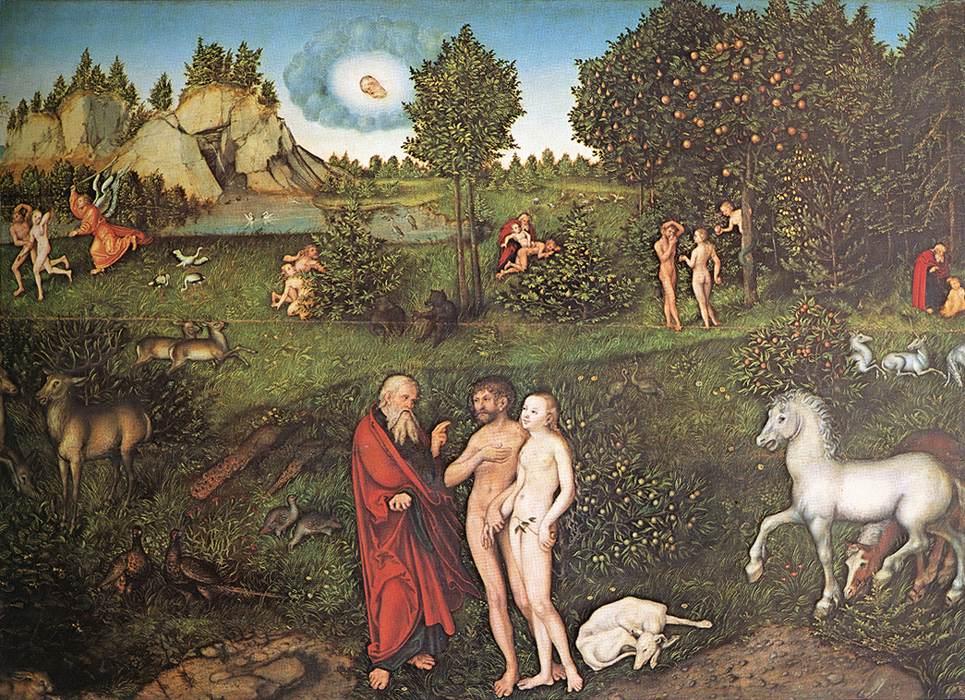
The Paradise
Lucas Cranach(the elder), 1530
Kunsthistorisches Museum, Vienna
From EuroWeb archives


Why have I chosen Lucas Cranach the Elder's painting, Paradise, as my theme for this issue of the Lutheran Carnival? On the surface, it is a busy painting. You must stop and carefully note what each set of figures is depicting. Certainly, as you analyze each little scene within a scene, you realize a theme. As I read through the many excellent submissions to this ninth issue of the Lutheran Carnival, my mind searched for a theme. Maybe that is human nature and a failing of my character, but it actually wasn't hard to see a pattern. The people who write for the Lutheran Carnival understand what being a Lutheran actually means and demonstrate Luther's doctrine of vocation, no matter what their subject matter. Fittingly, Dr. Gene E. Veith, Jr. recently debuted the Cranach blog, devoted to the topic of vocation. Be sure to visit daily for discussions and learn who Cranach is and what he did. Luther's thoughts on vocation are summarized in his own words:

What is our work in field and garden, in town and house, in battling and in ruling, to God, but the work of his children. Our works are God's mask, behind which He remains hidden, although He does all things.

To start off this issue of Lutheran Carnival, Pastor Paul T. McCain has summarized confessional Lutheranism in his post, Does Being Lutheran Still Matter?. He writes:

People who are passionate about the truth of Biblical Lutheranism know that the Bible teaches often and clearly that we are all sinful human beings in need of God’s constant mercy, which He so lavishly gives in Christ. To be truly Lutheran is to receive the gifts of God with humility, repentantly recognizing our great need. It is tempting for Lutherans to be proud and arrogant of their great heritage, but this is a terrible evil! To be Lutheran is to be always mindful of our great sin and our great need for a Savior. To be a Lutheran is to be a sinner calling out to fellow sinners, “Come and see!”
He also warns us of pride in being Lutheran, as if we were the only ones in true faith. No! That is a lie the devil whispers to us to convince us that God is not actually as powerful as we wished he were. Pastor McCain wisely reminds us, "We must realize that the Word of God is powerful and active, wherever and whenever it is heard, read or meditated upon."

So now that we understand what it means to be a Lutheran and how we should live our daily lives, how then do we keep our blogs? Weekend Fisher, of Heart, Mind, Soul and Strength, posts on the vocation of blog-keeping with Humility and the aftermath of GodBlogCon I and notes that many prominent "Christian" blogs rarely discuss God. Aardvark Alley shows the "dark side of standing for the pure Gospel in The Meanies of Grace, namely getting a reputation of being mean-spirited and unloving for refusing to compromise it. Then he recruits modern-day "meanies" to band together in promoting confessional Lutheran blogs by blogrolling and referencing favorite posts in The Truth (Blog-) Rolls Along. Ol' Aardvark writes:

The way I look at it, confessional Lutheran bloggers should do what we can to keep the truth near the top o fthe search engines, burying racism, evolutionary biology, and other false doctrines and philosophies of men as deeply as possible.

Beyond the vocation of blog-keeper (a side job, to be sure), Lutherans must live in this world. They are pastors, parents, children, employees, bosses, doctors, dentists, patients, educators, students, geologists, writers, computer geeks and much more. They are called to be prepared to give an account for the joy they have in Christ Jesus.

Dan of Necessary Roughness defended the gospel of Christ in one of the modern day marketplaces of our electronic world, the Free Republic, where Rick Warren's chance to spread the gospel message on a Starbucks coffee cup was being discussed.
Dan looks at what Rev. Warren has chosen to tell the world. You won't see Christ... His account, Coffee Beans, Not Creeds, reminded me of Paul's experience in Athens. Paul scoped out the city and its people while waiting for others to arrive. He reasoned with people and was invited to the Areopagus where ideas were discussed. I think the Free Republic might just be a modern version of the Areopagus, especially in that many people want to hear new ideas, discuss them at length and when the conversation turns pointed, they ask people like Paul politely, but insincerely, to come back another day to discuss it again. In The Divine Service is the True "Children's Church", Dan also write of his experience in bringing his children to the worship service of a church that doesn't appear to welcome the little ones, at least not in the actual service. This is an exellent post and an important topic!

Daniel of Random Thoughts of a Confessional Lutheran, who often ties in geology and faith as no one else could do, writes on the lessons to be learned as an ESL teacher. He writes:

Patience isn't a virtue I have a lot of, but I find I have more than I thought I did when I teach ESL. Frustration can come easy and overtake you if you are not careful.

Kletos Sumboulos of Amor Et Labor examines his chosen profession of psychologist in light of scripture in Excuses For Sin. He writes,

One of my goals for my internship is to try to spell out what a confessional Lutheran psychologist would look like in practice. I've been troubled at the following thought, "Is what I am doing as a counselor merely helping clients make excuses for sin?"

This future psychologist is a man after Dr. Laura's, as well as Luther's, heart! Collegiate musician Sean of Hot Lutheran on Lutheran Action explains how Bach's KlavierUebung Part II ties in to Luther's Small Catechism.
Jumping off a lecture on the 3rd part of the J.S.Bach's KlavierÜbung given by Christoph Wolff (world famous Bach scholar), this post discusses this work and its connection with Luther's Catechism. Bach understands vocation, and generally blows us all away with his deep theological commentaries in his music.

Lutherans engaged in life have many opportunities to discuss important issues of our day, such as evolution, bird flu, abuse, abortion and other sufferings of this world.
Pastor's Wife at Lonesome Grove reminds us of a time, in the midst of a terrible time of sickness, when a beautiful hymn was written. The pastor of a dying congregation wrote of the great joy we have in life or death, sickness or health, peace or war, abuse or respect. She is reminded, "Who of you by worrying can add a single hour to his life?" Amid reports of a 'potential pandemic' sweeping around the nations, Just Me finds comfort in God's word and our Lutheran hymnody in wake, awake, for night is flying.

Madre's Missives provides wise counsel on the topic of abuse in our relationships, but also helps readers to put abuse into God's perspective. In You meant it for evil, but God meant it for good, she writes,

God does not mean for the worst possible thing to happen to us. That's the last thing He means for us. In giving Christ all the worst things that could happen to every human being since Creation, we are given all the best things the Only-Begotten Son deserves. He didn't deserve God's punishment, but He took it because in Christ God loved us and meant for our salvation and deliverance from sin, death, and the devil.
Ron, that great and Terrible Swede, examines a more helpful approach to discussing abortion in Abortion and the Message of the Church. Ron describes the tract from Lutherans for Life combating the Devil's lies and reminding us of God's forgiveness. One excerpt:
"Failing to preach about abortion offends women more grieviously than preaching about it. If the sin of abortion is never mentioned, then the Gospel - that Gospel pastors have been called to proclaim - is never applied to that sin nor to those caught up in the pain and guilt of abortion. Instead, Satan whispers through the silence, 'This sin is so awful, even Jesus can't forgive you.' ...The Church has the message of forgiveness and hope that can bring healing."
Does God need us to defend Him when others are suffering? Joy in the Lord is for now, not just in a distant future. Pastor Borghardt of Bloghardt's Reflector reminds us of the lavishness of God's grace as he proclaims The Gospel Is THAT Audacious! While it is true that God calls us to repentance in Christ through the cataclysmic event, it is also true that the mundane is His means for the same, too. However, the routine is often the means for despair both because it is banal and we because have tuned out where He can be found in it. Ste. Em of Quicunque Vult posts Mundane Catastrophes. She writes:
For what is the ordinary task but service to neighbor? And what is the defeat of Satan bu the confession of our own sin (not the neighbor's) in repentance?
Bob Waters, of Watersblogged, challenges us,
in The Wrong Question, to consider the true differences between evolution, creation science and intelligent design:
I think that conservative Christians have once again blundered in their attempt to advance Intelligent Design as science, and thus as the proper subject matter of a public school science class. In fact, it is no more science than materialism is. Both are philosophical conclusions from the data, and neither have any place in the public school classroom.

Rather than trying to get Creationism or Intelligent Design taught too- thereby choosing to battle on ground which compels us to argue that, contrary to fact, either one of them is any more "science" than materialism is- why not choose to fight the battle on ground which guarantees victory? Most scientists believe in evolution. Many consider it a scientific fact. I see nothing offensive to the Faith or to the First Amendment in the theory and the conclusions most scientists reach about it being taught to public school students on precisely those grounds.
He also reminds us of the purpose of public school classrooms:

It seems to me, finally, that we need to take account of whence the movement to teach Creationism and not Intelligent Design in the public schools originates. It comes from those Fundamentalistic traditions most apt across the board to confuse the Two Kingdoms, and to see the State as an appropriate agent of the work God has properly assigned to the Church. It comes from the same folks who promote the inaccurate and scandalously revisionist version of history which seeks to transform the United States into something meant by its founders to be a "Christian nation."

Our daily lives also give us opportunity for reading, reflecting on prayer and discussing faith and blog-keeping with a friend, as Karl, the not-very-disgruntled world citizen , relates. I can relate to the Tevia comparison as Karl writes on prayer:

"...I'll find myself in church praying and my mind starts to wander, or I'll be mouthing the words, but my brain is disengaged and before I realize it, I've missed it and I have martryed the Lord's Prayer,yet again.

I have often wished I could be like Tevia in Fiddler on the Roof his style of prayer is wonderful. He has conversations with God. He knows who his god is and isn't afraid to go to him with problems, or praise. Why is it that I can't do that, aside from the fact that people might look at me like I'm crazy..."
Lutherans value the vocation of all Christians, but we sure love our pastors! It is tradition to send our brightest young men to seminary and make sure they learn Greek, Latin and Hebrew so that they can teach us well from scripture. My sister and I used to have a little joke about creating our very own pocket pastors because of the way our pastors could explain Bible passages. We wanted to be able to carry that wisdom around in our pockets! Pastor Walter Snyder of Ask the Pastor talks about issues in Biblical translation while answering questions on Translating, Copyrighting, and Profiting from God's Word. He also clarifies the Biblical teaching of simil iustus et peccator in Sinner and Saint: Why Do I Do Wrong?

Vicar Charles Lehmann, of Drowning Myself Whenever I Can does a good job, in That Too Gross to be in the Bible, of showing teens that the Bible is relevant to all ages, just as it is written, without our artifical attempts to make it more exciting. It is an example of a way to get kids interested in studying God's Word (and seeing Jesus!). The smiling vicar also posts A Sermon for Trinity 22 He writes:

We want to be like Peter. Peter doesn't realize that he's the unmerciful servant he's condemning, the same unmerciful servant who has received his very life from the King. We want to try to hold all that love, all that life, inside of us. But, friends, it just doesn't work that way. If you try to keep Jesus to yourself, He'll burst forth from you, and that's not going to be good. He'll leave you behind, because Jesus is Gift, and He's not going to be satisfied unless He's being given out.

And so we don't get to keep Him to ourselves. We don't get to make a little box, put Jesus inside it, and keep him there in a nice cool dark place where He can never have His way with us. The grave couldn't hold him, and neither can we.

Pastor Scott Stiegemeyer, of A Burr in the Burgh, informs us that he is for "preaching the law of God, first as a mirror which reveals my sin, but also as a rule for life. It's about preaching the work of the Holy Spirit in the Christian, through the Word. It's about vocation. It's about understanding the two realms we inhabit." In Antinomianism: I'm Against It he attempts to explain the importance of preaching God's law to Christians, not only to accuse them and bring them to daily repentance, but also to instruct them for living.

As much as the little ones need to hear the law preached along with the gospel, so do our eldest Christians. Pastor Tom Chryst, of Preachrblog, writes The Law is but a Mirror Bright...
about a funny, but poignant sermon to residents of a nursing home.

Along with our excellent pastors, Lutherans also are blessed with laymen who take seriously the catechism of the congregation, often by using their training and talents in other fields. Who is most excellent Theophilus? Richard of dokeo kago grapho soi kratistos theophilos explains. CPA of Three Hierarchies, weighs in on Christian Liberty. His post was the longest of this carnival, so I saved it to read last. CPA often writes in detail and adds in his unique perspective of Asian history. You can never breeze through one of his posts, but if you take the time to study what he writes you will be blessed in return. He writes:

The first question is, what is Christian liberty for? Let’s go back to Paul. Paul’s teaching of Christian liberty, as enunciated in his famous chapters in Galatians, 1 Corinthians, Romans, and Colossians, is primarily occasioned by the need to integrate two different cultures in one church: Jewish and Gentile. (This is not to say that cultural integration within one church is the only possible use of Christian liberty, but that was the occasion for its scriptural enunciation.) These two cultures differed in their calendar (Jews observed lunar months and sabbaths [i.e. Saturday], while Gentiles had only the Roman solar calendar and pagan festivals), eating habits (Jews had access to kosher butchers and could eat meat, but Gentile Christians had access only to pagan butchers who dedicated their victims to the pagan gods and hence found meat-eating problematic), and bodily care (Jews circumcised, Gentiles didn’t).

As with any good blog post, sometimes the best part is the discussions following it. So it was with the post on Christian liberty. Finally, since I didn't have time to post during my famous battle with a nameless, faceless cowardly troll, I will highlight a exchange of ideas that took place on Beggars All between Tim the Enchanter, Glen of Territorial Bloggings and I on Blogging, Prudence and the Adult Children of Fundamentalists.
Like our Lord, Christian bloggers need to "know what is in men" and to not entrust ourselves so freely to them (John 2:24-25). The world is not always a friendly place, especially to confessional Christians, and maybe that's why bloggers use goofy pseudonyms, like my own, even though anyone with half a brain could easily figure out who we really are. (Hey, if folks can figure out who the elusive Kathy Luder is, they can figure out who we are!)

I think blogs, even those produced by humble layfolks like myself, have a place. Like the "Wittenberg Trail" stories in the Issues, Etc. Journal, I think that such personal confessions of the liberating power of the Gospel so clearly taught in our Confessions are very much needed today.
Be sure to read the rest of his post! Thanks for the opportunity to host this carnival. I believe it is the first time that I've actually studied posts rather than merely breeze through them. For the benefit of that alone, I encourage blog-keepers to take their turns hosting. Likewise with the seemingly questionable painting at the top of this post; look at it closely and you will see a detailed portrayal, in all its joy and sadness, of paradise. Long live the Lutheran Carnival!

Thursday, October 13, 2005

Cranach: Christianity and culture with a Lutheran Twist

Shamelessly stolen from one of my favorite bloggers, Glen of Territorial Bloggings:

A most hearty welcome goes out to the newest member of the Worldmagblog family to come online, the Cranach blog!

The Cranach blog is an offshoot of the Cranach mailing/discussion list. Per the “about” section on the Cranach blog’s main page,

Lucas Cranach was a good friend of Martin Luther’s, who became a great artist. He was also a businessman who ran a pharmacy and the printing shop that published Luther’s translation of the Bible. He was also something of a politician, who served on the Wittenberg town council and for awhile was mayor of the city. As a layman who lived out his faith in his various callings, Cranach embodies the Reformation doctrine of vocation. In the spirit of Lucas Cranach, this blog will discuss issues of Christianity and culture with a Lutheran twist.

Cranach is a good mailing/discussion list, but I’m really looking forward to the blog! Dr. Veith is an amazing intellect, and has written a boatload of great books, so I’m anticipating that Cranach will be a hugely beneficial addition to the blogosphere.

Check it out!!!

Saturday, September 03, 2005

The masks God wears


All our work in the field, in the garden, in the city, in the home, in struggle, in government--to what does it all amount before God except child's play, by means of which God is pleased to give his gifts in the field, at home, and everywhere? These are the masks of our Lord God, behind which he wants to be hidden and to do all things. --Martin Luther, "Exposition of Psalm 147" from Masks of God blog


Our pastor and his wife recently buried their young son. During his four short months on this earth, struggling to overcome a heart defect, his parents kept on online journal. One entry, made on a more hopeful day, struck me deeply:

We are so thankful to see God working and to see Him hiding Himself behind the vocations of cardiologist, neurologist, anesthetologist, surgeon and nurse. Doctor is one of the masks God wears.
This young pastor also wears a mask of God, and his wife as well. Even in their deep and utter grief, though they were both emotionally and physically near exhaustion from the death of their sweet firstborn son, God's love could be seen beaming through in their eyes, their smiles and their touch. They were not spiritually exhausted; they were reaching out to all of us, hugging everyone and reminding us of the joy of salvation that sweet Hugh has now obtained through Jesus' death on the cross.

I had never seen a pastor at the funeral of one of his own. I had never been at the funeral of a baby nor a child. Now, I don't base my faith on what my eyes have seen and I can't believe in God just because of how my pastor and his wife gave clear account for the joy that is in their hearts; but seeing them doing so confirmed what I already knew to be true through the witness of the Holy Spirit. God has provided a clear and joyous salvation from this fallen creation - where little boys are born with heart defects- through the atoning sacrifice of his Son, Jesus Christ, who was raised from the dead, ascended into heaven and sits at the right hand of God. He has prepared a place for all who believe this is true. As if that wern't good enough, God has also sent his Holy Spirit to plant the seed of faith in the hearts of all who are washed in the waters of Holy Baptism and to grow and strengthen the faith of all who hear His Word preached and partake of Holy Communion. My pastor taught me this and he didn't run from it when his own little son died. Pastor and wife are one of the masks God wears.


During this last week, I have struggled fruitlessly on my own to defeat the evil plot of a computer programmer who has used his God-given talents for understanding numbers and computer programming to trick people, steal their money and corrupt minds and souls. He or she is faceless and nameless to me, but not to God. He is wasting his talent and rejecting God's urging to come to Him. Just when I was ready to give up, I was led by my ISP provider to a young man who also has great God-given talents for understanding the same things as his evil counterpart. He uses those talents to continually learn more about viruses and trojans and hackers. He freely gives his time for no pay to companies in exchange for learning more. To date, he has spent three hours straight on his phone dime, doing the work of a entry-level computer support person while also searching for an elusive hidden trojan virus. Sure, he is compensated in others ways and hopes to one day invent a little device to clean your machine in five minutes! But, he's got a long way to go and on his way he has helped countless numbers of people rid their machines of trouble and get back to work. Computer programmer,"geek", forensic network specialist are also masks God wears.

Pastor Snyder recently posted about the new Lutheran Carnival and the confessional Lutheran blogosphere: Ask the Pastor: Lutheran Carnival III and Beyond. He wrote:

"Lutherans are among those rare few who realize that even when we talk of “ships and sails and sealing wax, of cabbages and kings,” we also are talking theology. While I’m pretty sure that there will be plenty of theologizing from blogging pastors I’d be interested not only in lay theological perspectives about jobs, careers, marriage, and other vocational areas, but also reading some of the “daily grind.” Many of the bloggers I read, including Love and Blunder, Kiihnworld, and Pastor Steve Billings let me see much of their hearts and their theology through windows opened into the “ordinary” in their lives."
Yes, pastor mentioned me in his last sentence and it really touched my heart, but that is NOT why I am mentioning his post. Blogs have been taking a bad rap lately, especially among out own. That deeply saddens me because writer/blog-keeper is also a very honorable vocation. I began writing not thinking that anyone would ever read. I wrote to make sense of my life and faith. About two months after starting my blog, I did a random search for confessional lutheran blog, thinking I would find nothing. With great surprise and delight I clicked on The Random Thoughts of a Confessional Lutheran and my world changed. From that blog, I discovered so many others, Confessing Evangelical and Bunnie Diehl were among the firsts and are still my favorites, although I've met so many more fellow saints since then. For the first time in months I realized that I wasn't alone in coming to the Lutheran confessions. Now how else would I have found other confessional Lutherans to strengthen my faith - mutual consolation of the saints, as the wise Wildboar once wrote.

Writing about my very ordinary life through the lens of my faith in God has helped me to be able to be able to more easily give account for the joy that God placed in my heart. And I'm not talking about blogging, I'm talking about my everyday REAL life. Writing about my faith is helping me to be open about my faith to others. I used to save my "Christian comments" for fellow Christians; now I can more easily leave God in His rightful and natural place in the world and include Him in my conversations with people. I attribute my ability to account for the joy to God; His Holy Spirit has planted it in my heart. I do believe that He also expects me to find and know good preaching, so that I learn more and practice saying and writing it down.

To you, dear reader, and to all the established, burgeoning or just-learning writers who decide to keep a blog, I thank you. Blog-keepers also wear a mask of God. I can't possibly begin to name those of you that have blessed my faith and my life, but I will try: Pastor Snyder, Rob and Devona, John, Bunnie, Scottius Maximus, Daniel, Elle, Dan, Glen, Bob, David, Jason, Floyd, Mutti, Brian and Matt, Pastor Steigemeyer, Chris W., Prof. Chris, Terrie, Vicar Lehmann, Michael and Timotheos, Pastor Brandos, Pastor McCain, Rev. Klages, Ron and Erica, Twylah, Josh S., Wildboar (wherever you are), Suzi and Tim, Monergon and Theophorus, Worthy Woman, Rick, Michael S., Rev. Chryst, Minister2B, Maria, Webcritter and Mr. Critter, and the many others that I've probably missed (probably because you don't have an RSS feed. If your name isn't here, email me and I'll ADD it! I've thanked you before and I'll thank you again for sharing your life and vocation through your blogs. It is a blessing to me. God be with you today and always!
.