
Vicar Charles Lehmann hosts Lutheran Carnival XV with help from Leo the Great and no help from me. I am sorry to say that this is the very first carnival I've missed, if memory serves.

Surely I was sinful at birth,
sinful from the time my mother conceived me.
~Psalm 51:5
We have been buried with Christ by baptism into death, and raised to new life in Him. We are temples of the Holy Spirit, purchased and won from sin, death and hell by the precious blood of Christ. How then are we to deal with popular culture that surrounds us with vile and degrading speech, sexual impurity and all manner of sinful behaviors, which are rewarded, praised and idolized by so many?
Sadly, there are some who believe that they are free to consume the sinful pollution pumping out of the sewers of popular culture. Some Christians are so confused about what lives of sanctification are all about that they mistakenly think that concern about such things is somehow "pietism" or that striving to lead holy and pure lives marks one as a Pietist. This is wrong. This is error. This is sin.
The Gospel is never an excuse. Justification is about justifying sinners, not sin. The Gospel is about forgiveness of sin, not license to sin. We are set free to live new lives in Christ, not remain in the muck and mire of sin. We are not to think that we can do whatever we want just because we can run to church on Sunday to be forgiven.
We all need to keep a close guard over what comes our out of our mouths, and what we permit to fill our eyes, and our ears. We are to be serious about lives of Christian sanctification. No excuses. No avoiding the subject. We say, "No" to anything that is contrary to God's will in our lives, and say "Yes" to the upward calling of God that is ours in Christ Jesus. Lord, have mercy on me for those times I've forgotten, and neglected, my calling in Christ! Read on...
The word of the cross is folly to those who are perishing, but to us who are being saved it is the power of God. For it is written, "I will destroy the wisdom of the wise, and the discernment of the discerning, I will thwart." Where is the one who is wise? Where is the scribe? Where is the debater of this age? Has not God made foolish the wisdom of the world? For since, in the wisdom of God, the world did not know God through wisdom, it pleased God through the folly that we preach to save those who believe. . . We preach Christ crucified. . . Christ, the power of God and the wisdom of God. For the foolishness of God is wiser than men, and the weakness of God is stronger than men. 1 Cor. 1:18-25

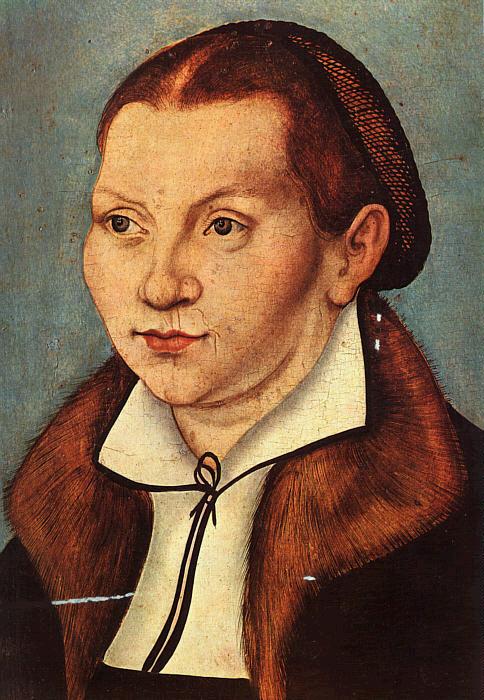
Katherine von Bora is the best known woman of the Reformation because she was Luther's wife. While Katherine has been eclipsed in history by the great fame of her husband, she was far from a wallflower. She was a rock of support at her husband's side throughout their married life.
Katherine was born in January of 1499, and at the age of ten she was placed in the nunnery at Nimschen near Grimma when her father remarried.
In the 1520s the writings of Luther began to infiltrate the nunnery. The message of salvation through faith alone in Christ brought comfort and peace to the sisters' hearts. A number of them turned to Luther for advice and he counseled escape, which was shortly accomplished. On April 7, 1523, Katherine and the other sisters reached Wittenberg. Luther felt responsible for finding suitable mates for the former nuns and managed for the most part, but this was not the case in Katherine's situation. This may be due to the fact that she had her eye on Luther. In any event Luther and Katie were married in June of 1525. Their relationship probably was not the most romantic at the start, yet years later Luther would declare, "I would not exchange Katie for France or Venice, because God has given her to me, and other women have worse faults."
With this marriage the Black Cloister of Wittenberg became the first Lutheran parsonage. With marriage came also an entirely different lifestyle for Luther. Katherine brought order out of chaos at the Black Cloister. Not only did she provide a clean house and a made bed, which were an unknown luxury for the unmarried Luther, but she also brought about financial responsibility. She kept Luther from giving away everything they had and she put the household on a budget. Katherine helped support the household by managing a farm and a brewery. It was not long before Martin and Katherine had still more responsibility. Within eight years they became the parents of six children. Three sons and three daughters were born to this union. They also raised a number of orphaned relatives.
Katherine was a faithful wife to Luther. In times of sickness she was his compassionate nurse. In Lutherís dark periods burdened down by the struggles of life, Katie was able to comfort him with that same long hidden Gospel treasure that God through Luther had restored to the world. Katie was indeed Luther's faithful rib. Katherine saw the death of her beloved husband in 1546 and outlived him by six years. In the summer of 1552 the plague broke out in Wittenberg. By fall Katie decided they had to leave. On the way the horses became frightened and bolted. Katie jumped from the wagon and was seriously injured. For months she lay suffering and finally died in the Lord on December 20, 1552.
One of the greatest legacies the church has received from the marriage of Martin and Katherine Luther is the Lutheran parsonage. The Luther home became the example for future Lutheran parsonages and Lutheran homes in general. The Luther house was given to hospitality. It was filled with children, students, and relatives. There was always a place for those in need. It was a place of culture and music and of joy and happiness.
This heritage continued even in the Lutheran Church in America. The early Lutheran parsonages were shelters for the needy, inns for travelers, and centers of culture. Frontier parsonages such as the home of Elisabeth and Ulrik Koren were a great blessing to the Lutheran Church. May the Lutheran home and parsonage always be a place of hospitality. This is the legacy of Katie Luther, the first lady of the Reformation.
 Originally posted 12-22-04
 Hour 1 WMA
 Hour 1 MP3 Hour 2 WMA Hour 2 MP3
 Mr. and Mrs. Sinner
"As I stumbled into the Reformation, this single doctrine struck me as the only thing that 'made sense'. After years of pretending to be 'victorious', it was such a blessed relief to simply be honest about myself and my continued need for grace.
Dietrich Bonhoeffer writes about 1 John 1 and "walking in the light" in the last chapter of his Life Together:
"He who is alone with his sin is utterly alone. It may be that Christians, notwithstanding corporate worship, common prayer, and all their fellowship in service, may still be left to their lonliness. The final break-through to fellowship does not occur, because, though they have fellowship with one another as believers and as devout people, they do not have fellowship as the undevout, as sinners. The pious fellowship permits no one to be a sinner. So everybody must conceal his sin from himself and from the fellowship. We dare not be sinners. The fact is that we are sinners!
But it is the grace of the Gospel, which is so hard for the pious to understand, that it confronts us with the truth and says: You are a sinner, a great, desperate sinner; now come, as the sinner that you are, to God who loves you. He wants you as you are; He does not want anything from you, a sacrifice, a work; He wants you alone. "My son, give me thine heart" (Prov. 23:26) You can hide nothing from God. The mask you wear before men will do you no good before Him. He wants to see you as you are, He wants to be gracious to you...He wants to love you."

25"There will be signs in the sun, moon and stars. On the earth, nations will be in anguish and perplexity at the roaring and tossing of the sea. 26Men will faint from terror, apprehensive of what is coming on the world, for the heavenly bodies will be shaken. 27At that time they will see the Son of Man coming in a cloud with power and great glory. 28When these things begin to take place, stand up and lift up your heads, because your redemption is drawing near."In Minnesota, we embrace winter and rejoice in its beauty. It is true that winter can be beautiful. However, would you want to spend eternity in winter? The truth is that winter is harsh and unforgiving. It brings a temporary death or absence of many things. Some of us enjoy cross-country skiing or snowmobiling, while others struggle to pay for their heating bills or warm clothing. That is winter's reality. God intends for us to live in the warmth of summer with Him in eternity. Vicar Lehmann posted a sermon that reminds us that Jesus is coming and He's bringing summer with Him! Please read his message in a quiet moment when you can reflect on what he is trying to teach us...
29He told them this parable: "Look at the fig tree and all the trees. 30When they sprout leaves, you can see for yourselves and know that summer is near. 31Even so, when you see these things happening, you know that the kingdom of God is near.
32"I tell you the truth, this generation[a] will certainly not pass away until all these things have happened. 33Heaven and earth will pass away, but my words will never pass away.
34"Be careful, or your hearts will be weighed down with dissipation, drunkenness and the anxieties of life, and that day will close on you unexpectedly like a trap. 35For it will come upon all those who live on the face of the whole earth. 36Be always on the watch, and pray that you may be able to escape all that is about to happen, and that you may be able to stand before the Son of Man."


Ephesians 2
Made Alive in Christ v. 1-10
1As for you, you were dead in your transgressions and sins, 2in which you used to live when you followed the ways of this world and of the ruler of the kingdom of the air, the spirit who is now at work in those who are disobedient. 3All of us also lived among them at one time, gratifying the cravings of our sinful nature[a] and following its desires and thoughts. Like the rest, we were by nature objects of wrath. 4But because of his great love for us, God, who is rich in mercy, 5made us alive with Christ even when we were dead in transgressions—it is by grace you have been saved. 6And God raised us up with Christ and seated us with him in the heavenly realms in Christ Jesus, 7in order that in the coming ages he might show the incomparable riches of his grace, expressed in his kindness to us in Christ Jesus. 8For it is by grace you have been saved, through faith—and this not from yourselves, it is the gift of God— 9not by works, so that no one can boast. 10For we are God's workmanship, created in Christ Jesus to do good works, which God prepared in advance for us to do.


 Peek Into Narnia

Question: I read the book, A Summary of Christian Doctrine, by Edward Koehler. It is very conservative Lutheran. In it, it does mention mortal and venial sin. Did the Lutherans acknowledge this at one time. I've learned to think that a sin is a sin, mortal or venial, greater or lesser. I've never thought of sins as some greater than the other. They're all damnable unless you repent. The Catholic church is heavy on the terminology of mortal and venial. If the Lutheran church acknowledges mortal and venial sin, is it referred to as mortal sin as being impenitence and venial sins as the sins Christians do commit but that they are forgiven because of faith?
Answer: Lutherans have historically used the terms "mortal" and "venial" in classifying sins, but define the terms differently than Roman Catholicism does. Edward Koehler, at this particular point, is quite brief and it is understandable that questions be asked and clarifications be sought.
Your comments and explanations are right on target. All sins we commit are worthy of death and mortal in that sense. They are also, because of Christ's work, fully forgivable and through faith are therefore venial. In classifying sins, therefore, we always refer to the spiritual state of the person who sins, not to the nature of the sin itself. "Mortal sins" are sins that are not accompanied by faith and forgiveness. So they are inseparable from spiritual death. "Venial sins" are those committed (in ignorance or weakness) by people who still possess saving faith and forgiveness.
Question: Lutheran theology, as I understand it, distinguishes between "willful" sins and sins of "weakness." Could you explain the distinction and provide some specific examples? Also, is faith lost only through willful sins?
Answer: Even though the Bible simply speaks about sin, we can make some distinctions. The first is to distinguish between voluntary and involuntary sins. An involuntary sin would include any of the following:
--sin of ignorance in general (Leviticus 4:2)
--sin of ignorance regarding God's will or law (1 Timothy 1:13)
--sin of ignorance where one is ignorant of the fact (Genesis 29:23,25)
--sin of ignorance where one has chosen to be ignorant (Isaiah 7:10-12)
--sin of ignorance where one has not chosen to be ignorant (Genesis 19:33)
--sin of weakness (Matthew 26:69-74)
When a person knows something is a sin and yet chooses to do it anyway, he is committing a voluntary sin. While it is not easy to determine how "willing" a person has to be in committing a certain sin before he falls from the faith, we could say that habitual, persistent voluntary sin may signal a fall from grace. King David (2 Samuel 11 & 12) would be an example of a willful sin. David had fallen from the faith. Fortunately the Lord sent the prophet Nathan to confront David with his sin. David confessed his sin and was forgiven.
Another helpful distinction is venial sins and mortal sins. A venial sin is not damning. This is the case not because it is less serious but because it has forgiveness connected to it. On the other hand a mortal sin is damning, not because it is so per se, but because it marks a loss of saving faith in Christ as Savior. Because a Christian is living in a state of forgiveness, every sin he or she commits is a venial sin. Likewise every sin an unbeliever commits--whether "big" or "small"--is a mortal sin because it is done in a state of unbelief. A believer's sin would be considered mortal only if it resulted in a fall from faith.
When writing about Contemplative Prayer, he (Merton) at one point addresses the intense danger that individualism poses to the faith, most especially as regards prayer and liturgy:
Interior life of the individualist is precisely the kind of life that closes in on itself without dread, and rests in itself with more or less permanent satisfaction. It is to some extent immune to dread, and is able to take the inevitable constrictions and lesions of an inner life complacently enough, spiriting them away with devotional formulas.
Individualism in prayer is content precisely with the petty consolations of devotionalism and sentimentality. But more than that, individualism resists the summons to communal witness and collective human response to God. ..."The full maturity of the spiritual life cannot be reached unless we first pass through the dread, anguish, trouble and fear that necessarily accompany the inner crisis of "spiritual death," in which we finally abandon our attachment to our exterior self and surrender completely to Christ."


Isaiah 26
A Song of Praise
1 In that day this song will be sung in the land of Judah:
We have a strong city;
God makes salvation
its walls and ramparts.
2 Open the gates
that the righteous nation may enter,
the nation that keeps faith.
3 You will keep in perfect peace
him whose mind is steadfast,
because he trusts in you.
4 Trust in the LORD forever,
for the LORD, the LORD, is the Rock eternal.
5 He humbles those who dwell on high,
he lays the lofty city low;
he levels it to the ground
and casts it down to the dust.
6 Feet trample it down—
the feet of the oppressed,
the footsteps of the poor.
7 The path of the righteous is level;
O upright One, you make the way of the righteous smooth.
8 Yes, LORD, walking in the way of your laws, [a]
we wait for you;
your name and renown
are the desire of our hearts.
9 My soul yearns for you in the night;
in the morning my spirit longs for you.
When your judgments come upon the earth,
the people of the world learn righteousness.
10 Though grace is shown to the wicked,
they do not learn righteousness;
even in a land of uprightness they go on doing evil
and regard not the majesty of the LORD.
11 O LORD, your hand is lifted high,
but they do not see it.
Let them see your zeal for your people and be put to shame;
let the fire reserved for your enemies consume them.
12 LORD, you establish peace for us;
all that we have accomplished you have done for us.
13 O LORD, our God, other lords besides you have ruled over us,
but your name alone do we honor.
14 They are now dead, they live no more;
those departed spirits do not rise.
You punished them and brought them to ruin;
you wiped out all memory of them.
15 You have enlarged the nation, O LORD;
you have enlarged the nation.
You have gained glory for yourself;
you have extended all the borders of the land.
16 LORD, they came to you in their distress;
when you disciplined them,
they could barely whisper a prayer. [b]
17 As a woman with child and about to give birth
writhes and cries out in her pain,
so were we in your presence, O LORD.
18 We were with child, we writhed in pain,
but we gave birth to wind.
We have not brought salvation to the earth;
we have not given birth to people of the world.
19 But your dead will live;
their bodies will rise.
You who dwell in the dust,
wake up and shout for joy.
Your dew is like the dew of the morning;
the earth will give birth to her dead.
20 Go, my people, enter your rooms
and shut the doors behind you;
hide yourselves for a little while
until his wrath has passed by.
21 See, the LORD is coming out of his dwelling
to punish the people of the earth for their sins.
The earth will disclose the blood shed upon her;
she will conceal her slain no longer.
Revelation 21:9-22:5
9One of the seven angels who had the seven bowls full of the seven last plagues came and said to me, "Come, I will show you the bride, the wife of the Lamb." 10And he carried me away in the Spirit to a mountain great and high, and showed me the Holy City, Jerusalem, coming down out of heaven from God. 11It shone with the glory of God, and its brilliance was like that of a very precious jewel, like a jasper, clear as crystal. 12It had a great, high wall with twelve gates, and with twelve angels at the gates. On the gates were written the names of the twelve tribes of Israel. 13There were three gates on the east, three on the north, three on the south and three on the west. 14The wall of the city had twelve foundations, and on them were the names of the twelve apostles of the Lamb.
15The angel who talked with me had a measuring rod of gold to measure the city, its gates and its walls. 16The city was laid out like a square, as long as it was wide. He measured the city with the rod and found it to be 12,000 stadia[a]in length, and as wide and high as it is long. 17He measured its wall and it was 144 cubits[b] thick,[c] by man's measurement, which the angel was using. 18The wall was made of jasper, and the city of pure gold, as pure as glass. 19The foundations of the city walls were decorated with every kind of precious stone. The first foundation was jasper, the second sapphire, the third chalcedony, the fourth emerald, 20the fifth sardonyx, the sixth carnelian, the seventh chrysolite, the eighth beryl, the ninth topaz, the tenth chrysoprase, the eleventh jacinth, and the twelfth amethyst.[d] 21The twelve gates were twelve pearls, each gate made of a single pearl. The great street of the city was of pure gold, like transparent glass.
22I did not see a temple in the city, because the Lord God Almighty and the Lamb are its temple. 23The city does not need the sun or the moon to shine on it, for the glory of God gives it light, and the Lamb is its lamp. 24The nations will walk by its light, and the kings of the earth will bring their splendor into it. 25On no day will its gates ever be shut, for there will be no night there. 26The glory and honor of the nations will be brought into it. 27Nothing impure will ever enter it, nor will anyone who does what is shameful or deceitful, but only those whose names are written in the Lamb's book of life.
Revelation 22 : The River of Life
1Then the angel showed me the river of the water of life, as clear as crystal, flowing from the throne of God and of the Lamb 2down the middle of the great street of the city. On each side of the river stood the tree of life, bearing twelve crops of fruit, yielding its fruit every month. And the leaves of the tree are for the healing of the nations. 3No longer will there be any curse. The throne of God and of the Lamb will be in the city, and his servants will serve him. 4They will see his face, and his name will be on their foreheads. 5There will be no more night. They will not need the light of a lamp or the light of the sun, for the Lord God will give them light. And they will reign for ever and ever.
Matthew 5 : The Beatitudes
1Now when he saw the crowds, he went up on a mountainside and sat down. His disciples came to him, 2and he began to teach them saying:
3"Blessed are the poor in spirit,
for theirs is the kingdom of heaven.
4Blessed are those who mourn,
for they will be comforted.
5Blessed are the meek,
for they will inherit the earth.
6Blessed are those who hunger and thirst for righteousness,
for they will be filled.
7Blessed are the merciful,
for they will be shown mercy.
8Blessed are the pure in heart,
for they will see God.
9Blessed are the peacemakers,
for they will be called sons of God.
10Blessed are those who are persecuted because of righteousness,
for theirs is the kingdom of heaven.
11"Blessed are you when people insult you, persecute you and falsely say all kinds of evil against you because of me. 12Rejoice and be glad, because great is your reward in heaven, for in the same way they persecuted the prophets who were before you.


