"I consider myself convicted by the testimony of Holy Scripture, which is my basis; my conscience is captive to the Word of God." -Martin Luther
Friday, March 16, 2007
Paul Gerhardt Service in Princeton
Monday, March 05, 2007
Thoughts on Vocation...

The first time I ever heard of the concept of vocation was in college. Without using the actual term, someone once told me that Christians should strive to praise God in daily activities. Especially in the things often seen as mindless, boring and not very spiritual - like washing the dishes. At that point in my life, I had immersed myself in the evangelical world of self-sanctification, especially through activities like witnessing, waving my arms in praise, planning for mission trips, etc. This new concept of vocation (serving God in daily life through the gifts and places He's given you) seemed strange, intriguing. Not surprisingly, I wouldn't hear more of it until leaving evangelicalism.
Sunday, February 25, 2007
The devil waxes furious...
A Blog. Lutheran. Catholic. Sacramental. Addressing the contemporary life of the church from an authentic, ancient Christian point of view. And the occasional thought on rock and roll.The perfect blog, then.
Leo the Great on Lent and Satan and the Christian
And, dearly-beloved, no season requires and bestows this fortitude more than the present, when by the observance of a special strictness a habit is acquired which must be persevered in. For it is well known to you that this is the time when throughout the world the devil waxes furious, and the Christian army has to combat him, and any that have grown lukewarm and slothful, or that are absorbed in worldly cares, must now be furnished with spiritual armour and their ardour kindled for the fray by the heavenly trumpet, inasmuch as he, through whose envy death came into the world, is now consumed with the strongest jealousy and now tortured with the greatest vexation.
For he sees whole tribes of the human race brought in afresh to the adoption of God's sons and the offspring of the New Birth multiplied through the virgin fertility of the Church. He sees himself robbed of all his tyrannic power, and driven from the hearts of those he once possessed, while from either sex thousands of the old, the young, the middle-aged are snatched away from him, and no one is debarred by sin either of his own or original, where justification is not paid for deserts, but simply given as a free gift. He sees, too, those that have lapsed, and have been deceived by his treacherous snares, washed in the tears of penitence and, by the Apostle's key unlocking the gates of mercy, admitted to the benefit of reconciliation. He feels, moreover, that the day of the Lord's Passion is at hand, and that he is crushed by the power of that cross which in Christ, Who was free from all debt of sin, was the world's ransom and not the penalty of sin.
Sermon XLIX: On Lent XI
Thursday, February 22, 2007
True Christian Piety, part 1
True Christian piety does not consist primarily in what we do but in recognizing what our God has done for us.
Author: John M. Brenner
pi·e·ty n. pl.: The condition of reverence and devotion to God that comes with faith in Christ.
pi·e·tism n. :Making subjective standards of piety and religious experience the essential measure of Christianity or the Christian faith.
Luther was not the first to try to reform the church. Many before him recognized that something was wrong in the life of God's people. But most who went before Luther focused on behavior or organizational reforms.
Luther, however, recognized that the real problem in the church was not how people were living but what the church was teaching. The Roman Church emphasized what people were to do to contribute to their salvation rather than teaching that Jesus has accomplished everything for salvation in our place. Rome had raised tradition and the decisions and decrees of popes and councils to a position of equal or superior authority to the Holy Scriptures.
Medieval piety included making pilgrimages to "holy" places and praying to Mary and the saints. Taking monastic vows and doing works of penance were considered meritorious. Among the common people, knowledge of the basic teachings of the Bible was often minimal. The Lord's Supper was viewed as a sacrifice we offer to gain God's favor rather than a gracious meal of life by which God offers and seals the forgiveness of sins, life, and salvation.
Striving to gain God's favor by leading a life of medieval piety drove Luther to the point of despair. The more he tried to keep God's law and appease God by what he did, the more his conscience became burdened with the knowledge that all of his efforts fell far short.
Piety in Luther's time
As Luther studied the Scriptures, he came to understand that true Christian piety does not consist primarily in what we do but in recognizing what our God has done for us. The message of the Lutheran Reformation centered on God's full and free forgiveness won by the perfect life and sacrifice
of God's own Son. Jesus made
full atonement for our sins. He has defeated the Prince of Darkness and opened heaven's doors. True Christian piety consists in trusting that message.
To foster true piety, Luther and his colleagues translated the Bible into
the language of the people, published books of sermons and devotional material, and wrote hymns and catechisms.
Luther's Small Catechism provided a summary and explanation of the basic truths of Christianity in terms so simple that even a child could understand. Those basic truths were so important that he reviewed them every day. In his preface to the Large Catechism, Luther wrote,
I, too, am a doctor and a preacher. . . . Yet I continue to do as a child does that is being taught the Catechism. Mornings and when I otherwise have time, I read and recite word for word the Lord's Prayer, the Ten Commandments, the Creed, Psalms, etc. I must still read and study the Catechism daily, yet I cannot master it as I like, but must remain a child and student of the Catechism.
Read on: http://tinyurl.com/yol4qs
The law and gospel of adultery
Question:
I strayed very badly from God last year. I was extremely sexually immoral. In a nutshell, I committed adultery. My question is, is there any hope for me to be saved? I knew God before I did this unspeakable gross act. In fact, I did it in the face of Him. How can I expect to be saved? Yes, I'm highly repentant of my sins. Yet, how can I expect Him to forgive me?
Pastoral response:
What you are saying is that you have committed the sin of adultery. You are saying that you did it last year. You are saying that you did it deliberately in the face of God! You wonder how you can expect to be saved? You say that you are highly repentant, but wonder, "How can I expect him to forgive me?"
There are five sections of the Scripture to which I would like to refer you: II Samuel 11; II Samuel 12:13; Psalm 32:3-5; II Corinthians 5:19; and Romans 8:1 ff.
In II Samuel 11 we have the account in God's Word about how David and Bathsheba sinned. Like you, David knew that what he was doing was a sin. When Bathsheba became pregnant, David even tried to cover up his sin by having Uriah, Bathsheba's husband come to her to sleep with her so that everyone might think that Uriah was the child's father. When that did not work David arranged to have Uriah murdered in such a way that it looked like he died in battle.
Just like you, David knowingly and willfully sinned. Can you see the comparisons between David and you?
God sent Nathan the prophet to confront David about his sin. David repented. He said: II Samuel 12:13, "I have sinned against the Lord." I hear you saying the same thing.
Then, in Psalm 32:3-5, David tells his people about his sin and his forgiveness from God. He first describes the emotions I hear you expressing: vs. 3-4 "When I kept silent, my bones wasted away through my groaning all day long. For day and night your hand was heavy upon me; my strength was sapped as in the heat of summer."
This is the pain I hear you saying. "How can I expect to be saved?" I deliberately and knowingly sinned! How can I expect God to forgive me?"
David describes his faith in God's solution in this way: vs. 5 "I said, ' I will confess my transgressions to the Lord' -- and you forgave the iniquity of my sin."
I hear you saying, "I am highly repentant of my sins." David said the same thing. Now, you ask, "How did David get that confidence and trust that God forgave him and I don't have it?
Repentance always involves two things. The one -- that we confess our sins to God. The other -- that we believe that we receive absolution or forgiveness from God because of Jesus."
I hear you saying that you have confessed your sins. I also hear you saying that because of the way you feel you sinned so knowingly and willingly, and because you so strongly feel guilt for your sin, you can't understand how God could forgive you.
First: God forgave David who not only knowingly and willingly committed adultery, but also knowingly and willingly caused his lover's husband to be murdered. God forgave David because of Christ who has paid for the sins of the whole world upon the cross. God forgives you also because of Jesus.
When Jesus went to the cross, he paid for all the sins of all people of all time. That includes the sins of King David and your sins also. Listen to what God tells us in II Corinthians 5:19: "God was reconciling the world to himself in Christ, not counting men's sins against them." You are a part of the world for whom Christ died. You can't tell me or God that you are not a part of the world for whose sins Christ went to the cross. You are also a part of the whole world which has been reconciled to God because of Christ. That part is just as true. To be reconciled to God means that God, in Christ, has made peace between you and him.
In others words, trust in the mercy of God. Jesus died on the cross for your sins. He has made peace between you and God. Be at Peace!
Romans 8:1 "There is now no condemnation for those who are in Christ Jesus." Jesus died for you. He paid for your sins upon the cross. Be assured that there is nothing in all creation that "will be able to separate us from the love of God that is in Christ Jesus our Lord." Romans 8:39. That "us" includes you!
My last encouragement to you is that you go to your pastor and hear this same message of peace from him. Take your question and answer with you. Show it to him and talk with him about it.
Be at peace! Your Jesus loves you, died for you, arose for you, and lives for you!
Out of faith and love for Jesus, live for him! As a fruit of your repentance, fight the temptation to commit adultery again.
Source: http://www.wels.net/cgi-bin/site.pl?1518&cuItem_itemID=812&cuTopic_topicID=28
Wednesday, January 31, 2007
Thoughts on today's popular "contemporary" worship music
...Regarding contemporary worship, I certainly agree that it can promote a false understanding of the working of the Spirit, and often the lyrics are 'me-centered.' I think contemporary music should be resisted mainly because it doesn't convey the Gospel well, and is subject to the idea that the music should be catered to people's likes and dislikes . It also is typically associated with a theology of glory. I don't believe contemporary music is sinful, per se, but for the above reasons I think there are much better alternatives (i.e. historic liturgy and hymnody). Also, I find that the contemporary music has very little 'staying-power', by which I mean you can get sick of it very quickly, and it has little lasting substance that might be of comfort in times of trial. I think in choosing worship music, we should always seek to present the best and the highest forms of music as our 'spiritual sacrifice.' Not watered down stuff that makes us feel good.
--
Posted by Josh Schneider to Be Strong in the Grace at 5/9/2005 05:48:12 PM
I also received these words of encouragement from an ELS pastor this morning. I share them with you to illustrate the kind of pastoring I have experienced in my synod. The ELS is my family's earthly refuge and heaven is where I am bound:
The ELS is a "little" synod but can be a complicated place! We are basically a miniature version of what the old synodical conference was -- Norwegian Synod (ELS), WELS, and LCMS born and bred people all attempting to co-exist together as adults.
Tuesday, January 30, 2007
What to think about the ELS...
I read something this morning at Norman's Demense that caused me to think. Norman wrote:
As a layman in the ELS, I resent those who wanted to fight out their respective WELS/LC-MS positions in the ELS.
I never thought about the current dissension in the ELS in that way, but it certainly makes sense to me. My perspective is greatly colored, of course, by my view of the ELS and King of Grace as my refuge...my adopted homeland. I have one big fault in that I hate change and struggle with it (sorry to break my own rule about blogs NEVER being diaries). I am so ANGRY to be forced to study and try to understand issues that I didn't create and barely understand. It does seem to me, though, that the ELS has been held to some higher standard of conduct because of the perception that we had our house in order and had achieved some kind of purity of doctrine. (If you don't agree with that, fine, don't tell me about it. You can't deny that some held that position).
Then I read this morning something at an anonymous blog, creatively referring to trouble in paradise, that my own church is instituting contemporary worship. Funny thing is that, as a member, I know nothing about this. It's probably not even true, but it's being said. In the name of a fight for doctrinal purity? Really? When I fled Evangelicalism, I wanted a refuge and now I have a nightmare. It's unfair, no?
So, let's summarize what Theresa wants from life: predictability, unity, stability, fairness, kindness, purity, perfection, truth and bravery. And I'm expecting in this lifetime! I'm a great thinker, aren't I? I'm ripe for heaven, I suppose. I'm so-o-o glad I took the morning off to get my car fixed. It gave me lots of time to productively read Lutheran blogs. Yikes! Too much free time isn't good for me.
Update: The thought has occurred to me that what Lutheranism has to offered Evangelical refugees is not a peaceful refuge, but a land where doctrine matters. This new land I now live in isn't always peaceful, except maybe on Christmas Eve, but the battle is important. So, for me to stand and yell, "Let's all just live in peace." really just puts me back in Evangelicalism where everyone consoles themselves by saying, "Let's all just love Jesus."
Contemporary Worship
Just sayin'...
Sunday, January 14, 2007
Lutheran Carnival XLI: The Post Season
Lutheran Carnival XLI is divided into the three phases of game play in American football: Offense, Defense, and Special Teams. Offense will carry posts that address thinking outside the Christian faith. Defense will carry those posts that defend the faith. Special Teams are posts either by teams or require special treatment.In Lutheran Carnival tradition, Dan introduces us to another Lutheran we should all know, Phillip Nicolai...
Philipp was a second-generation pastor in Germany, born in 1556 and died in 1608. He preached during a time when both Roman Catholics and Calvinists were making life difficult to be a Lutheran: he had to flee several times or preach in house meetings. In 1601 he was elected chief pastor of Saint Katherine’s in Hamburg, finishing out his life in 1608 with a violent fever.
Nicolai is best remembered for two of my favorite hymns/chorales: “Wake, Awake, For Night is Flying” (LSB 516, TLH 609) and “O Morning Star, How Fair and Bright” (LSB 395, TLH 343). It seems the Morning Star hymn has been translated a couple of times. The hymn’s tune, Wir Schön Leuchtet, has been appropriated for five hymns in LSB, a testimony to its versatility and popularity. It’s beautiful stuff; I’ll be happy to play it for the locals.
Be sure to read the many good posts of this edition of the esteemed Lutheran Carnival! Great job, Dan!
* If you're like me and realize that your knowledge of Roman numerals ended a few carnivals back, Nova Roma gives a short explanation of each symbol If you're rushed, you can use their handy converter.
Tuesday, January 09, 2007
Be Strong in the Grace: Infant Baptism
Chris writes:
I am reproducing this paper in its entirety for discussion purposes. This paper was written by Pastor Bryan Wolfmueller of Hope Lutheran Church of Aurora, Colorado. I think it provides an excellent Biblical look at this topic. Please read it with an open mind to what the scriptures are teaching. If you disagree with his conclusions, then spend the time in the scriptures searching what the scriptures teach.I would also recommend listening to Pastor Wolfmueller's recent interview on the Issues Etc. radio program. Click here to listen.
Infant Faith a List of Scriptures
"Will you have your baby baptized?" I asked a friend who is also a pastor of a non-denominational church in town.
"No, Bryan," he responded, "You know we believe in believer's baptism."
Such was the conversation that provoked this short essay, for suddenly, and with profound clarity, did the connection between rejecting infant baptism and rejecting infant faith become apparent. The thinking is this, "If we only baptize believers, then of course we don't baptize babies, because babies do not and can not believe."1 Baptizing an infant is understood to be an "unbelievers baptism." It is this thought which I propose to contradict with the Holy Scriptures by showing not only the possibility but also the reality of infant faith.
Infant Faith, Old Testament and New
Do babies have faith? While we might be tempted to answer this question with reason or by experience, there is only one trustworthy place to find the answer: the Holy Scriptures. What, then, does the Bible say?
Psalm 71:5-6 (NKJV)
5 For You are my hope, O Lord GOD;
You are my trust from my youth.
6 By You I have been upheld from my birth;
You are He who took me out of my mother's womb.
My praise shall be continually of You.
Note, first of all, that the word 'youth' is expansive in Hebrew, used as a word for infants even unto young men and women2. The context of this word indicates what the Psalmist (presumably King David) means by 'youth', adding to the text 'birth' and coming out of the womb. This is as young as young can be, and to this young youth the Lord is his 'trust', his faith, his Confidence.
In verse 6 we would perhaps prefer a more literal translation. The word translated "have been upheld" by the New King James Version is reflexive, to 'support' or 'brace oneself'.3 Here are a few different versions:
New International Version: "From birth I have relied on you."
Revised Standard Version: "Upon thee have I leaned from my birth."
An American Translation: "I have depended on you from birth."
These phrases, 'relied upon, leaned upon, depended on', certainly imply faith. This verse, as the one before it, extols the faith and trust of the child "from birth." This text tells of the trust and reliance of an infant in the true God, and this text is not alone in the Scriptures.
As we turn to the pages of the New Testament we find a number of passages discussing the possibility and the reality of infant faith. There are a number of Greek words for 'child', and a quick survey of these words will help set the stage for our review of these passages.4
paidion- This is the most common word used of a very young child, infant, child, both boys and girls.
brephos- This word can be used of unborn babies in the womb [St Luke 1:41,44] or of nursing babies and infants [St Luke 2:12,16].
mikron- Literally, "small one," this word can be used to describe one's stature [St Luke 19:3], one's age [St Matthew 18:6,10,14], or in esteem, influence and power.
napion- [nhpiwn] This word can be used of an infant, often nursing [Hebrews 5:13], or, in the legal sense, of a minor. [Galatians 4:1].
thalazonton - One who is nursing [St Matthew 21:16].
teknon- [teknon] Child, with special reference to the relationship with the parents, used even for unborn babies in the womb.
Jesus Blesses the Children
St Luke 18:15-17 [And parallels in St Matthew 19:13-15 and St Mark 10:13-16] (NKJV)
"15 Then they also brought infants (brephos) to Him that He might touch them; but when His disciples saw it, they rebuked them. 16 But Jesus called them to Him and said, 'Let the little children (paidion) come to Me, and do not forbid them; for of such is the kingdom of God. 17 Assuredly, I say to you, whoever does not receive the kingdom of God as a little child (paidion) will by no means enter it.'"
Jesus would have the children come to Him, and would have no one forbid them. Why? Because "of such is the kingdom of God." The children who possess the kingdom are the infants, the nursing babies being carried in their mother's arms. (Infant and children are used interchangeably in this passage, the infants [brephos] that are being brought are the same children [paidios] that Jesus receives.) And their possessing of the kingdom is not accidental; as if Jesus says, "Because they have not attained the age of accountability I will overlook the necessity of faith and give these babies the kingdom because the are innocent" or some other such thing. No, theirs is the kingdom of heaven in such a sense that the children are the very picture of faith. The children are such a picture of faith that even adults must be like them in order to attain the kingdom of heaven. This same teaching is heard in the following text, where Jesus again talks of the necessity of becoming as a child to have the gift of the heavenly kingdom.
True Greatness
St Matthew 18:1-5 [And parallels in St Mark 9:33-37 and St Luke 9:46-48] (NKJV)
"1 At that time the disciples came to Jesus, saying, 'Who then is greatest in the kingdom of heaven?' 2 Then Jesus called a little child (paidion) to Him, set him in the midst of them, 3 and said, 'Assuredly, I say to you, unless you are converted and become as little children (paidion), you will by no means enter the kingdom of heaven. 4 Therefore whoever humbles himself as this little child (paidion) is the greatest in the kingdom of heaven. 5 Whoever receives one little child (paidion) like this in My name receives Me.'"
Here Jesus sets a child before His disciples to teach them who the greatest in the kingdom of heaven is, and, what's more, says that unless we, too, become as children, we will not enter the kingdom of heaven. There are not two ways to obtain the kingdom of heaven, one for adults (faith) and another for children (apparently just being children). Possessing the kingdom of heaven is the sole result of faith (faith alone). According to Jesus the children are the possessors of the kingdom and, therefore, the very picture of humility and faith. This is said plainly in the next verse.
The Little One Who Believe in Me
St Matthew 18:6 [And parallels in St Mark 9:42-43 and St Luke 17:2, see also 18:10 and 14] (NKJV)
"6 But whoever causes on of these little ones (mikron) who believe in Me to sin, it would be better for him if a millstone were hung around his neck, and he were drowned in the depth of the sea."
The little ones of verse six is the little child of the previous passage whom Jesus sets before His disciples. These "little ones" are explicitly described as the ones "who believe in" Jesus. The clarity of the text needs no comment.
Later in the text these little ones are described as the possessors of angels who "behold the face of the Father" [18:10] and as those whom the "Father desires that they do not perish" [18:14].
Jesus Gives Thanks to the Father
St Matthew 11:25-27 [And parallel in St Luke 10:21-22] (NKJV)
"25 At that time Jesus answered and said, 'I thank You, Father, Lord of heaven and earth, because You have hidden these things from the wise and prudent and have revealed them to babes (napion). 26 Even so, Father, for so it seemed good in Your sight. 27 All things have been delivered to Me by My Father, and no one knows the Son except the Father. Nor does anyone know the Father except the Son, and he to whom the Son wills to reveal Him."
It is, Jesus teaches us, the Father's will to reveal 'these things' to babies. What are "these things' which the babes have? They are not offended by Christ, but trust that He is the Coming One, sent from God. [St Matthew 11:3-6] It is the wise and the prudent that have so much trouble with the works of Christ, but not the babes. These are the ones to whom the kingdom is revealed.
While it might be a mystery to us, it is becoming clear that in the mind of Jesus and the context of the Scriptures it is not strange thing to think of babes, infants and children as those who believe in Christ. It might not seem good to us to ascribe to infants faith and trust in Christ, but it does seem good in the Father's sight [11:26].
Out of the Mouths of Babes and Nursing Infants
St Matthew 21:15-16 (NKJV)
"15 But when the chief priests and scribes saw the wonderful things that He did, and the children (paidion) crying out in the temple and saying, "Hosanna to the Son of David!" they were indignant 16 and said to Him, "Do You hear what these are saying?"
And Jesus said to them, "Yes. Have you never read,
' Out of the mouth of babes (napion) and nursing infants (thalazonton)
You have perfected praise'?"
Jesus here quotes Psalm 8:2 to support the accolades that the children are offering Him as He makes His triumphal entry into Jerusalem. The Lord enlists children, babies, and nursing infants to sing His praises and announce His coming. While it is possible for the Lord to call forth His praises even from stones [St Luke 19:40], it is His good pleasure to perfect (or complete) His praise with the confession and singing of babes and nursing infants. This praise is certainly a fruit of faith.
John the Baptist
St Luke 1:15,41
"15 For he will be great in the sight of the Lord, and shall drink neither wine nor strong drink. He will also be filled with the Holy Spirit, even from his mther's womb."
"41 And it happened, when Elizabeth heard the greeting of Mary, that the babe leaped in her womb; and Elizabeth was filled with the Holy Spirit."
The circumstances of John the Baptists conception and birth are certainly unique, and we should, therefore not presume too much from it. What is clear is that it is certainly possible for the Holy Spirit to fill a child even in the womb, and that this child even responds with joy at the presence of His Lord (who is also in the womb of the blessed Virgin Mary).
From Childhood You have Know the Scriptures
2 Timothy 3:14,15
"14 But as for you, continue in the things which you have learned and been assured of, knowing from whom you have learned them, 15 and that from childhood (brephos) you have known the Holy Scriptures, which are able to make you wise for salvation through faith which is in Christ Jesus."
The word 'childhood' would lead us to think of this as a young person, studying and leaning from a teacher, but the Greek word 'brephos' pushes us back further, to infancy. (NIV: "how from infancy you have know the holy Scriptures.") Again, the Scriptures do not think it a strange thing for an infant to trust, believe, know, and praise the Lord.
Because You Have Known the Father
1 John 2:12,13
"12 I write to you, little children (teknon),
Because your sins are forgiven you for His name's sake...
13 I write to you, little children (paidion),
Because you have known the Father."
St John, here, addresses the little children much as our Lord did, as those who believe. In the first instance (verse twelve), this could be seen as a familiar address, as John does in 2:1 (My little children, teknia) and other places. But that John changes the word in verse thirteen is striking, and leads us to interpret the little children referred to as actual youths, babies, etc. This is certainly not out of the ordinary in the Word of the Scriptures.
We see from the testimony of the Scriptures that infants can and do have faith. What this means is that infant baptism is believer's baptism. So to the original conversation concerning infant faith,
"Will you have your baby baptized?" I asked.
"No, Bryan, You know we believe in believer's baptism."
"Well," and here comes the answer, "so do I."5 While the faith does not give validity to the baptism, when we baptize an infant we are not just splashing water on a rock. This child can and does, by the power of God's Word, have faith in Christ Jesus, theirs is the kingdom of heaven. What has now become apparent is that there are two different understandings of faith at work. On one hand, faith is seen as a gift of God, on the other, faith is the response of man to the offer of salvation. These two different understandings of faith we now take up as we consider faith as gift.
Faith as Gift
To get a handle on the Baptist/Evangelical conception of faith, we turn to a classic tract that has been used as a 'witnessing tool' for years: The Four Spiritual Laws. The Four Spiritual Laws are:
God loves you and offers a wonderful plan for your life.
Man is sinful and separated from God. Therefore, he cannot know and experience God's love and plan for his life.
Jesus Christ is God's only provision for man's sin. Through Him you can know and experience God's love and plan for your life.
We must individually receive Jesus Christ as Savior and Lord; then we can know and experience God's love and plan for our lives.
Notice that the Gospel, as expressed in the third law, is potential. "Through [Christ] you can know and experience God's love." It is possible to know God's love, but there is a necessary first step for the potential Christian, there must be a response to God's love and plan. Faith, then, is the "must" of the fourth law, "we must individually receive Jesus Christ as Savior and Lord." In The Four Spiritual Laws, this "receiving" takes the form of the "sinner's prayer", asking Jesus into our heart. There are any number of ways that this "receiving" occurs in different churches, but all are a response to the offer of salvation. Faith, then, is a "response," an act of man to whom the Gospel is offered.
If this is how faith is understood, it is understandable that infants would be excluded. Infants have trouble praying the sinners prayer and walking forward for the altar call; infants have trouble talking and walking at all. So the inability to respond is equated with the inability to believe.
The Bible, on the other hand, is careful to show how faith is a gift of God. "For by grace you have been saved through faith, and that not of yourselves; it is the gift of God." [Ephesians 2:8] The gift of God is precisely the faith through which salvation comes. "For to you it has been granted on behalf of Christ, not only to believe in Him, but also to suffer for His sake." [Philippians 1:29] "You were raised with Him through faith in the working of God." [Colossians 2:12]
Faith, then, is a gift, created by God's Word. "Faith comes by hearing, and hearing by the word of God." [Romans 10:17] Of course, God does not do the believing for us. It is we, infants and adults, who believe, just as it is we who live, and yet just as God gives and sustains our life, so God gives and sustains our faith. Though infants cannot speak, they certainly can hear. Though infants cannot respond, they can receive gifts. As we saw in the survey of Biblical texts, the trust and dependence and receptiveness of infants is very picture of faith.
It might offend our reason and sensibilities, but the Scriptures are clear that infants and children can and do have faith. May God grant to all of His people, both young and old, the faith of a child in order that ours would be the kingdom of heaven.
INJ
Pastor Bryan Wolfmueller
Oculi, Lent III, 2006
---
NOTES
1It is interesting to note that most (if not all) of the official statements of the Baptist church do not explicitly make the connection between believer's baptism and the lack of infant baptism; it is, I suppose, assumed. I could find no official, "Therefore we do not baptize babies." Here are a few examples:
The Baptist Confession of 1688, Of Baptism
"1. Baptism is an ordinance of the New Testament ordained by Jesus Christ to be unto the party baptized a sign of his fellowship with him in his death and resurrection; of his being engrafted into him; of remission of sins; and of his giving up unto God, through Jesus Christ, to live and walk in newness of life.
2. Those who do actually profess repentance toward God, faith in and obedience to our Lord Jesus, are the only proper subjects of this ordinance." (Shaff, Philip. The Creeds of Christendom, III.741)
The New Hampshire Baptist Confession, 1833
"We believe that Christian Baptism is the immersion in water of a believer, into the name of the Father, and Son, and Holy Ghost; to show forth, in a solemn and beautiful emblem, our faith in the crucified, buried, and risen Saviour, with its effect in our death to sin and resurrection to a new life; that it is a prerequisite to the privileges of a Church relation." (Shaff, Philip. The Creeds of Christendom, III.747)
The Baptist Faith and Message, Revised 2000
"Christian baptism is the immersion of a believer in water in the name of the Father, the Son, and the Holy Spirit. It is an act of obedience symbolizing the believer's faith in a crucified, buried, and risen Saviour, the believer's death to sin, the burial of the old life, and the resurrection to walk in newness of life in Christ Jesus. It is a testimony to his faith in the final resurrection of the dead. Being a church ordinance, it is prerequisite to the privileges of church membership and to the Lord's Supper." (From www.sbc.net/bfm)
On the other hand, the connection is explicit in the very first article of the Anabaptist Schleitheim Confession of 1527. (Written two years before Luther's Catechisms.)
"I. Observe concerning baptism: Baptism shall be given to all those who have learned repentance and amendment of life, and who believe truly that their sins are taken away by Christ, and to all those who walk in the resurrection of Jesus Christ, and wish to be buried with Him in death, so that they may be resurrected with Him and to all those who with this significance request it (baptism) of us and demand it for themselves. This excludes all infant baptism, the highest and chief abomination of the Pope. In this you have the foundation and testimony of the apostles. Matt. 28, Mark 16, Acts 2, 8, 16, 19. This we wish to hold simply, yet firmly and with assurance." ( www.anabaptists.org/history/schleith.html) This Confession is quoted on the Southern Baptist website in an article explaining the Baptist understanding of baptism. ( www.bpnews.net/bpnews.asp?ID=14103)
2R[n "'Boy, lad, youth' a. of infant [Exodus 2:6], to be born [Judges 13:5,7,8,12], just born [1 Samuel 4:21], not weaned [1 Samuel 1:24; also Isaiah 8:4, cf. 7:16+]. b. of lad just weaned [1 Samuel 1:24,25,27], etc. c. youth: of youth Ishmael [Genesis 21:12f], Isaac [Genesis 22:5,12]... d. with special stress on youthfulness [Judges 8:20; 1 Samuel 17:33,42]... e. of marriageable age [Genesis 34:19], warrior Absalom, [2 Samuel 18:5,12]" The Brown-Driver-Briggs Hebrew and English Lexicon (Hendrickson Publishers: Peabody, MA. 1906, Sixth Printing, 2001, p. 654-655).
3Jm's; is in the Niphal, as in Isaiah 48:2. See BDB, p. 701-702.
4Definitions are taken from A Greek-English Lexicon of the New Testament and Other Early Christian Literature, Walter Bauer, William Arndt and Wilbur Gingrich (The University of Chicago Press. Chicago, IL. 1979)
5That Lutheran baptism assumes faith in the infant being baptized can be seen in the Lutheran baptismal liturgy. Before the child is baptized they are asked:
"N., do you renounce the devil?"
Answer: "Yes."
"And all his works?"
Answer: "Yes."
"And all his ways?"
Answer: "Yes."
Then he shall ask:
"Do you believe in God the Father almighty, creator of heaven and earth?"
Answer: "Yes."
"Do you believe in Jesus Christ, his only Son our Lord, who was born and suffered?"
Answer: "Yes."
"Do you believe in the Holy Spirit, one holy Christian church, the community of saints, forgiveness of sins, resurrection of the body, and after death an eternal life?"
Answer: "Yes."
"Do you want to be baptized?"
Answer: "Yes."
This liturgy is taken from Luther's baptismal book, published in 1523 and republished in 1526 (on which this text is taken). This translation is taken for the Book of Concord, ed. Kolb and Wengert (Augsburg Fortress. Minneapolis, MN, 2000. p. 374-375).
The rubric calls for the sponsors to answer the questions in the place of the child, but never-the-less, it is the child who is asked the question, and so it is the child who says, "Yes, I renounce the devil. Yes, I believe in God the Father. Yes, I believe in God the Son. Yes, I believe in God the Holy Spirit. Yes, I want to be baptized." This assumes that the child has faith before they are baptized. So Lutherans, following the Lutheran liturgy, baptize believers.
6The Four Spiritual Laws were written in 1965 by Bill Bright, the founder of "Campus Crusade for Christ." Approximately 1.5 billion copies of this tract have been printed according to the evangelical website of Campus Crusade: www.greatcom.org.laws.
Tuesday, January 02, 2007
Fundamentalism contains few fundamentals
At first, he was skeptical. When his friend Donnie Earl initially talked to him about grace, he thought he was just being a fair-weather Christian, that he was "giving himself a license to sin." He found proof, ultimately, in scripture. He saw it enacted in the non-judgmental support of his grace-touting friend who would pick him up after drunken benders without question or comment.
Alcohol lost its grip on Jay, and he began to reevaluate the more judgmental aspects of the faith he grew up with, particularly its condemnation of homosexuality. "The more I follow grace, the more I'm drawn to him [God], the more I'm willing to stand up for people being persecuted," says Jay today. "This sounds so churchy, but I felt like God spoke to my heart and said '[homosexuality] is not a sin.'"
The decision to make Revolution a gay-affirming church, however, wasn't an easy one. It cost him $50,000 in support from an anonymous donor—the bulk of Revolution's budget. Invitations to speak at the big emergent Christian festivals also dried up. Even his father warned that it may turn people off to his message. "It's a very lonely place to be, people telling you you're a heretic," says Jay.
Above is an excerpt from Radar, an online magazine. It is a personal interview with Jay Bakker by Martin Edlund. The full article, Empire of the son, is online.
Also, I found two interesting commentaries on the article:
Dr. Ray Pritchard at CrossWalk - Jay Bakker's Strange Religion
..he and a friend lead a church that preaches "God's grace to a flock of young, downtrodden and disillusioned parishioners most any other church would turn away." At first glance, that would appear to be a noble effort, but this is not your typical evangelical twentysomething "emerging church." At the Revolution, they have gone a step beyond. They are a "gay-affirming" church. Jay Bakker told Larry King he would allow gay couples to get married in his church if it becomes legal (which he evidently hopes will happen soon). When Larry asked him why most evangelicals oppose homosexuality, Bakker offers this answer:Well, I mean, I know the arguments. I know the scriptures. And the scriptures are very -- you could argue on them all day. I believe they've been taken out of context, and I don't believe that, you know, we've researched enough of the background on those scriptures.But there's more to it than simple confusion about what the Bible teaches...
Chris Rosebrough, a Lutheran layman, at Extreme Theology - Did God Really Tell Him That?
...Forget your disgust and disdain for Jim and Tammy for a minute. Don’t judge Jay based upon his tattoos and his completely screwed up childhood. In fact, let’s pretend for a few minutes that Jay Bakker is not the one who is claiming that God told him that homosexuality is not a sin. Let’s pretend that it is Billy Graham making this claim. Even better, let’s pretend that the Angel Gabriel has appeared from heaven and is being interviewed on CNN. During his interview the Angel Gabriel tells the world that God wants us to know that homosexuality is not a sin.
To prove his credentials the Angel Gabriel causes it to snow in Bagdad on the forth of July and he raises Gerald Ford from the dead on live television....
Beyond the obvious, the statement of Jay Bakker reminds me of the confusing world of fundamentalism and evangelicalism that was my home for too many years. Far from being a base of fundamentals of Christianity, fundamentalism and it's sister, evangelicalism, are worlds in which nothing is solid...nothing is absolute. Since God can speak to modern people, including me, the Bible becomes a secondary guide to Christian living. Worship becomes a confusing, yet mandated, time. You enter the doors of the sanctuary hoping to be refreshed and leave with your head spinning.
Jay Bakker, like most kids, spends too much time claiming he is different from his father and from his father's church, but this description from the Radar article proves otherwise to me,
Jay's preaching style is anti-theatrical, but in its own way it is as mesmerizing as his father's. "He's like an old school preacher man," Jay says of his dad. "I don't know if I'm new school, I just get up here and talk." Typically, he picks a topic—on a recent week, why Ted Haggard, the outed president of the National Association of Evangelicals, deserves our compassion—and begins thumbing through his sticker-covered Bible for relevant scripture. If he really wants to dig into something and challenge pat assumptions, he might resort to the original Greek. He sighs loudly whenever he loses his train of thought, and salts his sermons with funny, self-deprecating remarks and confessional asides about his family.
He picks a topic and then looks for relevant scripture. That might explain the necessity of God "revealing" to him that homosexuality is not a sin. Because scripture doesn't say that!
Leviticus 20:13 says, “‘If a man lies with a man as one lies with a woman, both of them have done what is detestable. They must be put to death; their blood will be on their own heads.”Romans 1:26-27 says, “ Because of this, God gave them over to shameful lusts. Even their women exchanged natural relations for unnatural ones. 27 In the same way the men also abandoned natural relations with women and were inflamed with lust for one another. Men committed indecent acts with other men, and received in themselves the due penalty for their perversion.”
I've said before that finding my new church home, King of Grace, saved my life. I am not exaggerating. I also know that it saved the life of my teenagers, because the emotion-based worship of evangelicalism and fundamentalism with it's lack of scriptural foundation surely would have destroyed whatever faith had survived in them from me being their mother up to that point.
Disclaimer of sorts - I don't write often about homosexuality. It is one of many sins that afflict mankind. I never have and never will bash someone for homosexuality. My own sins are enough for me to focus on. I can't deny that God has declared it a sin in scripture and I won't deny that God's grace, through Jesus Christ, covers all sin. God loves all sinners the same; in fact, He loves us so much that He gave His only Son to die for our sins. This blog post of mine is not really about homosexuality; its about the slippery slope of believing that God is still speaking to people APART from scripture. Jay Bakker could have announced that God told him that stealing is not a sin and I would have written this same post. I'm sorry I have to write a disclaimer, but I've keeping a blog long enough to know that people often aren't very careful readers.
Thursday, December 28, 2006
Cyberbrethren New Year's Resolution
From Pastor Paul McCain at Cyberbrethren ~
Greetings Cyberbrethren:
My friend, Pastor William Weedon, posted a very useful New Year's
resolution. I'm going to join him, with God's help. Will you join me?
1. Read the daily Scripture readings assigned in LSB for morning and
evening (pp. 299-304).
2. Pray the daily Psalms assigned in the Psalter Chart (p. 304).
3. Read the assigned section of the Book of Concord for Monday-Friday
for each of the 52 weeks of the year
(Concordia: The Lutheran Confessions - note: they are presented in
chronological order of their writing)
I offer this as a suggestion because I think it would be utterly
achievable for anyone - even the busiest. The easiest way to
accomplish the above would be to pray Matins and Vespers daily (using
the assigned Psalms and Scripture readings) and to read sometime
during the course of the day (maybe before, at, or after lunch?) the
page or two assigned from the Book of Concord. What strength would
come to us from such an immersion in the psalter, such a reading
through the Word, and such a review of the Church's Symbols!
Anyone willing to take up the challenge?
It's a marshmallow world that we live in...

We elves try to stick to the four main food groups: candy, candy canes, candy corns and syrup.
~Buddy the Elf
For the few readers I have left, I've been thinking lately about why I haven't posted to Be Strong in the Grace for a while. Have I quit attending my fantastic church? Nope. Has my church changed and I've become disillusioned? Nope. Have I allowed the careless comments and accusations of others to bother me and make me second guess any thoughts of blog posts? Yep.
I haven't quite figured out how to express my thoughts, until receiving an email today from a well-know email newsletter. It contains quotes which accurately describe my reasons for leaving evangelicalism, as well as my reasons for not posting lately.
Here are some really bad quotes, which strongly remind me of why I ended up leaving evangelicalism:
The church "cannot afford to waste time on incessant internal
purification at the expense of the lost in the world."
--Jerry Kieschnick, synodical president
http://www.lutheranchurch.ca/synod2002/fri-greetings.html
"We have not the luxury of time and energy spent on incessant
internal purification at the expense of the eternal destiny of the
souls of men and women for whom Christ died, but who know not His
name and have accepted not His saving grace."
--Jerry Kieschnick, synodical president
http://www.lcms.org/graphics/assets/media/CTCR/president_greetings.pdf
"My concern is that we can spend so much time in incessant internal
purification that we do so at the expense of the eternal destiny of
people who are dying every minute."
--Jerry Kieschnick, synodical president
http://www.wfn.org/2002/12/msg00199.html
"People, this is NOT a game. Our incessant internal purification at
the expense of the eternal destiny of the souls of men and women for
whom Christ died must stop!"
--Jerry Kieschnick, synodical president
http://www.jesusfirst.net/2002aug04.htm
Here are some inspirational, though difficult to swallow, quotes:
"Many say, 'Instead of disputing over doctrine so much, we should
much rather be concerned with souls and with leading them to
Christ.' But all who speak in this way do not really know what they
are saying or what they are doing. As foolish as it would be to
scold a farmer for being concerned about sowing good seed and to
demand of him simply to be concerned about a good harvest, so foolish
it is to scold those who are concerned first and foremost with the
doctrine, and to demand of them that they should rather seek to
rescue souls. For just as the farmer who wants a good crop must
first of all be concerned about good seed, so the church must above
all be concerned about right doctrine if it would save souls."
--C. F. W. Walther, synodical president
"Our Common Task--The Saving of Souls," 1872
http://www.concordtx.org/vision.htm
Whether our Synod gains friends or makes enemies, wins honor or
invites disgrace, grows or declines in numbers, brings peace or
incites enmity, all this must be unimportant to us--just so our Synod
may keep the jewel of purity of doctrine and knowledge. However,
should our Synod ever grow indifferent toward purity of doctrine,
through ingratitude forget this prize, or betray or barter it away to
the false church, then let our church body perish and the name
"Missourian" decay in disgrace.
--C. F. W. Walther, synodical president
First Sermon Delivered at the Opening of Synod, 1 Corinthians 1:4, 5
http://www.ctsfw.edu/library/files/pb/1517
Oh my dear friends of the Lutheran faith, confession, and conflict,
do not be misled when today those are everywhere accused of
lovelessness who still do not give up the battle for pure doctrine in
our Church. . . . Oh my dear friends, let us indeed sorrow and lament
over this: that false teachers constantly assail the pure doctrine
in our Church and thus are at fault for the conflict and strife in
the Church. However, let us never lament but rather extol and praise
God that he always awakens men who fight against those false
teachers, for, I repeat, this pertains to "the common
salvation." . . . This conflict is one commanded us by God and is
therefore certainly one blessed in time and in eternity. . . . Oh,
therefore, let us never listen to those who praise and extol the
conflict of the Reformation for the pure Gospel but want to know
nothing of a similar conflict in our days.
--C. F. W. Walther, synodical president
"Why Dare and Can We Never Give Up the Church's Struggle for the Pure
Doctrine?" 1876
http://scotchisforlutherans.blogspot.com/2004/05/from-cat41.html
I am embarrassed to admit that it took me over 20 years of evangelicalism before I had the maturity to start asking some questions. Too many Christians who maintain any of the following as a reason for dismissing doctrine and practice in their own church are living in their own marshmallow world:
"...it is all about Jesus, just give me Jesus, what does it matter if we are all Christians, I just believe in the Bible, I don't accept human creeds...".
In short, I need to toughen up for 2007.
Monday, November 06, 2006
Lutheran Carnival XXXVI
Sunday, October 29, 2006
The Crying Need of Our Beloved Conference

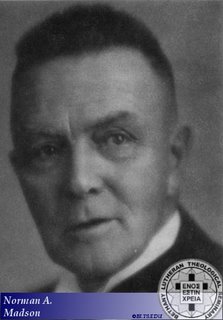
The Reverend Professor Norman A. Madson
Excerpt from his address to the 75th Anniversary of the Synodical Conference held in Milwaukee, Wisconsin on August 10, 1948
Fellow redeemed, grace be unto you and peace, from God our Father, and from the Lord Jesus Christ. Amen.
Though it be not the same text with which the beloved Walther greeted our sainted fathers when our Synodical Conference first convened in this very city three-score and sixteen years ago, we have no other aim nor holier desire than had that fearless confessor of the faith, when he is his ex corde prayer pleaded with the Father: "Forsake us not, but grant us now and evermore, as oft as we foregather, Thy gracious presence, and sustain us, for without Thee we can do nothing but err, sin and destroy Thy work."
Well might we have chosen the selfsame text: "Take heed unto thyself, and unto the doctrine; continue in them: for in doing this thou shalt both save thyself, and then that hear thee, 1 Timothy 4:16, stressing, as he did, the fact that "the holy apostle does not say: "Take heed unto the chief doctrines,' but: "Take heed unto the doctrine,' - everything which is taught in God's word." But while the text be different, the tenor of our anniversary address will be the same. In fact, were we not to stress the absolute need of purity of doctrine, all doctrines, and the unequivocal acceptance of the same within our brotherhood, our very existence as a Synodical Conference would no longer be justified. For our founding fathers made that clear, from the very day of its inception, that the Conference desired to retain unsullied and inviolate as its highest good and most precious pearl, doctrine pure, as found in God's verbally inspired word and our treasured Confessions based thereon. And they pledged one another their sacred word of honor that they would fight shoulder to shoulder in contending for the faith which was once delivered unto the saints, be their enemy "Rationalism, Unionism, Indifferentism, or Sentimentalism."
This will involve us in stark realism, to be sure. But there is no higher realism that of our Christian religion. It must ever be frank as it is fearless. It has little room for diplomatic double-talk as it s Founder had patience with the hypocritical church leaders of His day. And we would most certainly violate a rule of all true Lutheran preaching, were we to address you as though nothing had happened during these three quarters of a century to disturb our sacred alliance.
We must as Lutheran Christians face facts, no matter how unpleasant the task may become. For God wants us to be honest with Him, with ourselves, as well as with our fellowmen. Wishful thinking and unsubstantiated claims are not going to solve our problem any more than will the delusion that salvation may be had by believing a lie. It is as true today as it was on yon day when Paul first penned it: "We can do nothing against the truth, but for the truth." 2 Corinthians 13:8.
What then is our problem? In brief, it is this: Shall we continue in the paths our fathers trod, calling all manner of Unionism a sin, which robs the inviolate word of its majesty and saving grace, leaving ultimately all who practice it in the Slough of Despond? Or shall ours be a new course? Have we erred in marking and avoiding those who are indifferent to the love of pure doctrine, and who have placed in its stead a would-be love of men which is as shallow as it is powerless to save? Are we guilty of "spiritual standpatism" when we refuse to go forward at men's behest, or is there such a thing as pleasing God by refusing to go up hence if God's gracious presence go not with us? Well, our text gives the answer. It is on the basis of this more sure word of prophecy and by the guidance of the Holy Spirit that we shall briefly discuss:
1. First of all, it needs to realize anew, in these days of rampant Unionism, that not all forward movement means progress.
There are times when "they also serve who only stand and wait." And what is the occasion for their waiting? Isaiah answers: "But they that wait upon the Lord shall renew their strength; they shall mount up with wings as eagles; they shall run, and not be weary; and they shall walk, and not faint." Isaiah 40:31. There is a man-made busyness which is as far removed from the youthful Nazarene's being about His Father's business as utter frustration is removed from Jehovah's quiet command, "Be still, and know that I am God." Psalm 46:10
Now, we can sympathize with those who are anxious to stave off the threats of a mighty Assyria by making alliances with that bruised reed Egypt, even as our hearts went our is commiseration for a Chamberlain at Munich. But the policy of appeasement with those who have , to begin with, broken faith with God is as futile as it is wicked. To lean upon such a bruised reed will be as sure to pierce the hand today as in the days of an Hezekiah.
There is a feverish anxiety among pseudo-Lutherans to join hands with all who bear the Lutheran name, regardless of what their attitude toward doctrine may be, which borders on ecclesiastical hysteria. In order to make an impact on a distraught and jittery world, an imposing "Lutheran World Federation" was set up in Lund, Sweden, last year which was to be the mightiest voice which has been heard since the days of Martin Luther. But what was it which sounded forth from Anders Nygren's committee on doctrine at that Lund assembly?
"The Gospel is so exceedingly rich that no one section of the Church can claim to have fully and exhaustively comprehended all its wealth. One church has grasped more of it, another less. One has penetrated to the heart of it, while another has remained more on the circumference. One has grasped one aspect and another another. In this respect the churches can learn from each other and help each other to reach a simpler, richer and deeper understanding of the Gospel."
At first blush that may seem to be a most humble confession. But let us analyze it. If no church can claim to have fully and exhaustively comprehended all of the Gospel, where does that leave Paul, who declares to the Ephesian elders that he had "not shunned to declare unto them all the counsel of God"? Acts 20:27 It would not leave him in the Ananias Club, would it not? And since the various churches are to render reciprocal help in arriving at a simpler, richer and deeper understanding of the Gospel, can y you tell me how one who is still out in the periphery is going to help the person who already is at the heart and center of the Gospel to a deeper understanding of it? If no one can lay claim to having all of the Gospel, how then could Paul pronounce his "anathema sit" upon anyone who preached unto the Galatians? Supposed that the other person proclaimed that bit of the Gospel which Paul had failed to preach, since he could not, according to Nygren, possibly have all of it, should he then have as his reward for his labors: "Let him be accursed"? Galatians 1:8.
But there is more to that doctrinal statement at Lund which had as its superscription: Confessing the Truth in a confused World." "Christ's Church on earth is divided into a multiplicity of separate churches. The reason for this is not to be found simply in the superabundant riches of the Gospel, but also in human sin. " That is the first time we have ever heard the Gospel of Christ blamed, in part at least, for the disunity of the Church.
But the Lundsians go on:
"Consequently, the prayer of our Lord, 'Ut omnes unum sint' (that they all may be one), constitutes a call to repentance for all churches, that puts them under a vital obligation to strive for the realization of unity."
You will here note that they fail, as the Unionist is wont to do, to quote the complete utterance of our Lord in this matter. He does not merely say, "Ut omnes unum sint," but immediately adds: "Sicut tu Pater in me, et ego in te" (even as Thou Father, in me, and I in Thee). We must not make Christ out to be a Unionist. His desire and prayer is, that there may be perfect unity, as that which existed between Him and the Father.
And as for repentance, are we to repent of the fact that we have (as have our true fathers in Christ before us) claimed that we did have the full truth of the Gospel? There are many sins which all of us shall have to repent of, yes, every day of our life. But God forbid that we should have to offer the fifth petition after we have been obedient to the apostolic admonition: "If any man speak, let him speak as the oracles of God." 1 Peter 4:11
But then comes the closing statement of that Lundensian paragraph:
"No church, however, must let itself be led by its concern for unity to surrender anything of the truth that has been entrusted to it."
If the Lund theologians had taken that statement seriously they would not be wending their way to that Babel of clerical confusion convening at Amsterdam this very month. They would then, rather than chant the modernist's battle-cry, "Vorwarts nach Amsterdam," take to heart Jeremiah's serious admonition: "Stand ye in the ways, and see," praying with Eberhard Fischer in one of your treasured German hymns:
Lehr' uns nach deiner Art im Tempel, nicht im Winkel!
Behut' vor Aergernis, vor Spaltung, die uns trennt;
Erhalte rein und ganz dein Wort and Sakrament!"
Which might be rendered freely:
Hypocrisy e'er shunning,
Teach us to speak as Christ,
Who spurned all human cunning.
O keep us from offense,
Which falsehood e'er has sent,
Preserve unto us pure
Thy word and sacrament!"
Points two and three to follow.
Saturday, October 28, 2006
Thursday, October 19, 2006
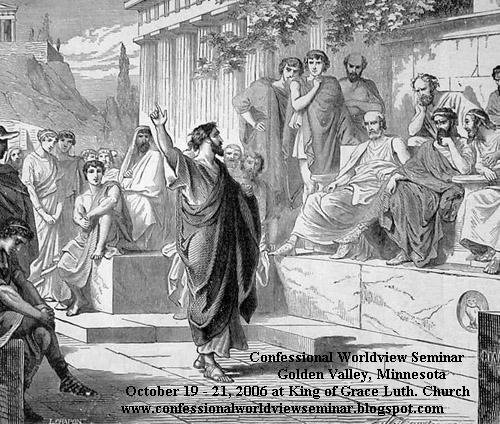
From the Confessional Worldview Seminar...
I just got home from the seminar. I snuck out early, after cleaning the kitchen, to try to get to bed early...but ended up watching the end of game 7 of the Mets vs the Cardinals. Oh well!
Tonight, I listened to Prof. Lyle W. Lange speak on what is the Confessional Lutheran Worldview. Here are the main points he covered tonight:
We live in a global society with a multitude of worldviews: religious (Christian, Pseudo-Christian, Non-Christian), political, cultural, philosophical and ethical.
There is no one universal worldview held by all who call themselves Christian.
Consider:
- Confessional Lutheran - focuses on Christ and His saving work; emphasizes importance of properly using law and gospel, stresses the importance of the means of grace; teaches scripture alone, grace alone, faith alone.
- Liberal Lutheran - has adopted the higher-critical approach to the Bible; pays lip service to the Lutheran Confessions; more concerned with outward union than with doctrinal unity.
- Roman Catholic - stresses the authority of the church to establish doctrine; focuses on seven sacraments to assist people to work out their own salvation; rejects the three solas of scripture and Confessional Lutheranism.
- Orthodox - ultimate goal is deification of man; places authority of the church over authority of the Bible.
- Calvinistic - focuses on the sovereignity of God; teaches Bible is a manual for holy living to glorify God; teaches there is no doctrine of Scripture which is unreasonable; TULIP.
- Arminian/Wesleyan - teaches prevenient grace; focuses on holiness of living; Wesley's four fundamental theological priniciples: universal salvation, free salvation, full salvation and sure salvation; teaches the second grace sets one on the road to perfection.
CARDINALS JUST WON THE PENANT!!!!!
- Holiness/Pentecostal - emphasizes holiness of living; teaches that the second grace gives instantaneous perfection, after which a person may expect the third blessing of speaking in tongues and performing miracles.
- Fundamentalism - reaction to 20th century Liberalism; goal was to preserve the fundamentals of Christianity; teaches that America is God's chosen nation; seeks to get the state to enforce Christian values.
- Evangelicalism - rooted in 17th century Pietism, 18th century Methodism and 19th century Revivalism. Focuses on law over gospel. Means of grace are mere commands Christ said we should do.
What is a biblical Christian (Confessional Lutheran) worldview?
- Centered on Jesus Christ and His redemptive work and grounded in scripture.
A biblical Christian worldview can be known only though the proper use of the law and the gospel.
- The law is that divine doctrine of Scripture which tells us how we are to be (perfect), what we are to do and not to do, that we haven't met the standard God demands and that we deserve to be punished for our disobedience.
- The gospel is that divine doctrine of Scripture which tells us what God has done for our salvation (what has already been done), what God does for our salvation now, and what God will do for us after this life.
Revelation: the law is known to all people by nature and the gospel is known only by revelation from God.
Message: the law tells what God commands us to do and the gospel tells us what God has done for our salvation through Jesus Christ.
The way in which promises are made: all the promises of the law are conditional and all the promises of the gospel are unconditional.
Purpose: The purpose of the law is to convict sinners of their guilt before God and the purpose of the gospel is to give sinners the forgiveness won for them by Christ.
Effect: The law will produce terrors of conscience when it does its work and the gospel will produce faith, love, peace, joy and hope.
Ability to do what is asked: The law drives and condemns; it does not ever motivate to do what is asked. The gospel gives us the desire and ability to do what is asked of us (believe, be baptized, take and eat, rejoice).
For whom each is intended: The law is to be preached to secure sinners (Gal. 5:21) and the gospel is to be proclaimed to sinners (Mt 9:2)
Part II tomorrow morning...
Thursday, October 05, 2006
The Confessional Worldview Seminar is coming soon!
If you have been thinking that you really should attend the 2006 Confessional Worldview Seminar, YOU ARE CORRECT. Where else, for such a low price, can hear, learn from and nosh with six of the best Confessional Lutheran minds in modern times? The worldview seminar is a "free" conference which means that all Lutheran synods and any Christian can meet and discuss the state of confessional Lutheran Christian practice today.
Listen to KKMS for new ads that have been purchased for the seminar. Also, plans are underway to have Craig Parton make a guest radio appearance again. I will post the link when it is official.
If there is anything that is keeping you from attending this event, please do not hestitate to contact me or Pastor Brooks. We will do whatever we can to help you attend (no, we probably won't pay for your airfare, but we'll do just about anything else.) A sitter at a low cost? A free cup of Starbucks espresso each morning? Transportation while in town? A place to stay because a hotel is just out of the question...even the very affordable, but clean Red Roof Inn? Ask! Please come!
Friday, September 29, 2006
News on the Confessional Worldview Seminar
Exciting News! The registration deadline for the 2006 Confessional Worldview Seminar has been extended to October 12th. Also, listen for radio ads on KKMS 980. You can register online here.
Sunday, September 24, 2006
Lutheran Carnival XXXIII
September has always been my favorite month. It is the month of my birthday, which mostly likely caused me to rejoice when I was younger. Nowadays, I cringe at the actual number of my birthdays, but I still love September. Why? Falling leaves, the start of school, cool nights and shortening days, the first chance to put on a sweater since spring, chrysanthemums, my big red sugar maple tree, squirrels busily burying their nuts. What isn't there to like about September? Of course, I haven't asked any 9/11 survivors if they love September. Nor my dear sister-in-law who just lost her mother on 9/11, just nine days after her own birthday. Nor the family who just lost their ten year old daughter in the Rogers tornado. But for now, I love September. And I love blogs!
One of my favorite ELS blogger, Norman Teigen, wrapped up his series on his take of the history of the ELS. His thoughts are his own, of course, but he has experienced life in the ELS from a unique viewpoint - both by family ties and by the events of his generation. See parts I, II, III, IV, V, VI. Norman Teigen is one of my favorite people. Not only is he a fellow church member, but he's also an interesting person. I love his blog! He takes the vocation of blog-keeping even more seriously than I do (at least he posts every day). He and my hubby talk after church until my kids have to pull dad away, out of the building and toward the car. Norman and Rob ususally talk about sports: Iowa v. Minnesota, the Vikings, the Twins. Talking to people after church is one of my favorite things about church and Norman is a good person to talk to.
Onto the rest of the bloggers that I haven't yet had the pleasure of meeting in person. Everyone's favorite aardvark has a blog, Aardvark Alley . The ol' Aard playfully invoked the noted author's greatest work in providing a title for Dante Alighieri: Classic Comedian. His commemorative post touches upon Dante's importance both in the Church and for Western liturature and summarizes most of his important works, including the three volumes of the Divine Comedy. Cyprian of Carthage, Bishop and Martyr, is certainly a lesser-known hero of the early Christian Church. Because of that, Aardvark Alley tries to show his influence on Christian theology and practice as well as noting some areas where Saint Cyprian's teachings were not followed by the majority of orthodox Christendom.
A dear friend of the Aardvark, Pastor Snyder, of Ask the Pastor , gets a wide variety of questions but this was a first. A man wanted to know, Can a Christian Be a Comic Book Author? Pastor Snyder responds by talking about truth revealed in fiction as he leads his readers to examine how they could live out the Faith in this and other vocations. A serious topic that Christians often ignore rather than face is the Imprecatory Psalms. Ask the Pastor confronts these harsh songs of the Old Testament through Praying Evil upon Our Enemies. Pastor Snyder says that there are proper times, ways, and attitudes for Christians to join voices in these requests for divine vengeance. However, he also reminds us that the full harshness of God's curse fell squarely upon His Son in order to save sinful, accursed mankind.
GHP's recent Luther Library review of Caitlin Flanagan's To Hell with All That: Loving and Loathing Our Inner Housewife touches upon several of the book's strengths and shortcomings. While sincerely recommending this work, he also comments on some of the weaknesses he perceives and also gently inserts a bit of his own thinking without letting it get in the way of encouraging others to read it for themselves.
After a very blessed experience at the Image of God Conference, the Rebellious Pastor's Wife contemplates a topic not addressed there in her post, One Thing Missing. Another blogging pastor's wife, Kelly of Kelly's Blog, contributes two related posts, Youth - not a "tribe apart" , a contemplation of being a youth leader, her own experiences with youth group hopping and where strong cetechesis fits into the picture, and More Youth Thoughts While Cruising the Cemetery, thoughts on the nature of youth groups spurred by a wander through the town cemetery.
Ritewinger at Theocon discusses, in Seeds of the Sower, the lack of Law in the "Sinner's Prayer" and in crusade conversion.
Everyone's favorite British blog-keeper, John H. of Confessing Evangelical cites, in Run away! Run away!, a superb post by Internet Monk, Michael Spencer, as well as a stirring quotation from CH Spurgeon, each reinforcing the message that adultery is a Really Bad Idea - one which should be obvious, but which, sadly, bears frequent repetition. John H. also offers, A Dangerous Element. Continuing John H's tendency to post non-Lutherans saying very Lutheran-sounding things, here is a glorious quotation from Martyn Lloyd-Jones on how true Gospel preaching will always be accused of antinomianism.
Resident referree of the Confessional Lutheran blogosphere, Dan at Necessary Roughness points us to his developing series on the Divine Service. He's got seven posts in the series already! One of my favorite blog-keeping Lutheran moms, Mutti Beck of Beckfest, has begun a series entitled Hymn I Love. She has begun with Salvation Has Come Unto Us.
It has been a pleasure to edit this 33rd issue of the Lutheran Carnival. Thanks to all those who submitted posts or allowed me to borrow posts. If you weren't in this issue, please consider joining in next time.