A man I never knew died last week. His wife taught my children. His children and my children are all classmates. But, for some reason, I never met him in the two years since we joined their church. I learned a little more about Butch today.
Today, my son's hockey team played against his daughter's hockey team in her club's spring hockey tournament. It was the championship match. Why did she play? She was the only goalie left for the team and she's a fierce competitor. It probably never occurred to her not to play. The family left the rink after the game to shower Sophie up and go to the reviewal. He has been the hockey association president since 2002. That told me a lot about him. My guess is that he didn't even have to tell his daughter that it was OK to help her team out on the day before his funeral.
I also found his picture in a very recent (2-17-05) issue of Let's Play Hockey. In today's city newspaper, I learned even more:
Butch, age 53, passed away March 16, 2005. Butch was born in 1951 in Melrose, MN to Agnes and Cyril. He was raised in Freeport, MN or as he liked to refer to it "Lake Wobegon". He attended St. Cloud State and the University of Minnesota to receive his Masters in Electrical Engineering. In 1986, he married Jean, in Pinecreek, MN. He was a long time employee of Medtronic, Inc where he was a Technical Fellow and Distinguished Engineer. He was president of the hockey asociation from 2002 to present. Butch is survived by his wife, Jean; and daughters, Tess and Sophie.
Butch was gifted with tremendous energy and drive and couldn't resist a project whether at work, for a friend or one of his own. He tackled them with great gusto and followed them to completion. As far as we know the only project left unfinished was his retirement home, but we know that God had a better retirement plan for Butch than any we could have come up with.
Butch was diagnosed with untreatable cancer very few weeks ago. Since that time, the 7th grade class has been practicing a song to sing for Butch's funeral. I'm having a hard time imagining how I will keep my composure tomorrow when I hear the sweet sounds of 13 year old voices singing to the family of their sweet Sophie and to the glory of God.
Sunday, March 20, 2005


Thursday, March 17, 2005
Hymn: Abide With Me

Journalistic Jargon: A Hymn for Holy Week Meditation
Erica has done a good job in posting on my new favorite hymn, Abide With Me. We have been singing it at each Lenten service. The slow, melodic hymn causes me to reflect on my life and my faith. It seems as though many people know the various parts: bass, alto, etc. Each time I sing it, I tell myself that I want to able to sing or at least hum it to myself...or have my children sing it in my ear. There...I made myself cry writing that just now. The beauty of raising my kids in such a wonderful church that teaches us such great hymns is so that we can all turn to hymns at various points in life.
Abide With Me
Abide with me, fast falls the eventide.
The darkness deepens; Lord, with me abide.
When other helpers fail and comforts flee,
Help of the helpless, oh, abide with me. I
need thy presence ev'ry passing hour;
What but thy grace can foil the tempter's pow'r?
Who like thyself my guide and stay can be?
Through cloud and sunshine, oh, abide with me.
Swift to its close ebbs out life's little day;
Earth's joys grow dim, its glories pass away;
Change and decay in all around I see;
O thou who changest not, abide with me.
I fear no foe with thee at hand to bless;
Ills have no weight, and tears no bitterness.
Where is death's sting? Where, grave, thy victory?
I triumph still if thou abide with me!
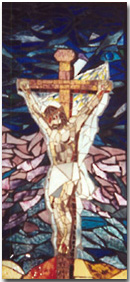
This is the verse I want to know as I go to Jesus:
Hold thou thy cross before my closing eyes,
Shine through the gloom, and point me to the skies;
Heav'n's morning breaks, and earth's vain shadows flee;
In life, in death, O Lord, abide with me.
ELS Hymnal #561
LW #490
Is it in your hymnal?

Saturday, March 12, 2005
How to become a Christian
I recently read the following question and answer on the WELS Q&A site. I thought the responder did an excellent job of explaining how one comes to faith in Christ Jesus. The person writing in with a question does not explain how she was "raised WELS", but was not a believer. As a newcomer to confessional Lutheranism, I can't imagine how someone could receive faith at baptism, hear God's Word presented in church and at home, study for three years in a rigorous catechism program and proclaim to the congregation on your confirmation day your faith in Christ Jesus. That is what it would mean to me to be "raised WELS". Her question illustrates Chris Jones' post on the importance of catechising the parents along with baptizing the baby.
Question:
I have been studying the biblical reasons to baptize/not baptize infants. Being raised in the WELS, I was not a believer. Later in life after many trials, God touched my heart, and I gave my life to Jesus. I was babtized as an infant, but when I truly came to know Jesus as my savior, I wanted to be obedient and publicly repent and confess Christ, and I was baptized. As an infant I didn't get to do that.
In many verses, the word "repent" comes before "baptize". The two always seem to go together. In fact it seems that if one has not repented one should not be baptized. I am now married to a man who loves the Lord too, and we are studying to know what the Word says. Yes, it says to baptize all nations, and yes we are sinful from conception, but how can an infant be repentant until it is more mature and understands? Is a baptism really valid without being repentant? And wouldn't repentance indicate that the Holy Spirit has already done a work in the person's heart. Can a baby really be saved by a work of the parents, though the Word is clear that we are not saved by works? Has God in Scripture given babies any other provision?
Answer:
The emphasis is not on what parents or others are doing in Baptism. The emphasis is on what God is doing, on what he has promised, and on what we receive by his grace in Baptism. People are not saved by my work when I tell them that Jesus died to save them from their sins. Rather the Holy Spirit uses that message to work faith in their hearts. In the same way babies are not saved by some law work of their parents when their parents have them baptized. Rather the parents are simply using the means of grace given to them, trusting that the Holy Spirit will work through baptism as Scripture promises.
You are making a couple of assumptions that are not warranted. First of all, “repent” and “baptize” do not always appear together. In fact, in the Great Commission the command to baptize even comes before the command to teach. Jesus says, “Go and make disciples of all nations, baptizing them in the name of the Father and of the Son and of the Holy Spirit, and teaching them to obey everything I have commanded you” (Matthew 18:19-20).
Secondly, repentance is not a decision we make on our own. Repentance is something that God works in our hearts through his law and gospel. Both adults and infants are by nature spiritually dead in their transgressions and sins (Ephesians 2:1-5) and have no ability to please God in any way (Romans 8:7-8). The Holy Spirit must work repentance in the heart of both adults and babies. Since coming to faith is not a decision on our part but something that the Holy Spirit works in us, it is no greater miracle for him to bring a baby to faith than to bring an adult to faith.
You are looking at baptism as a legal requirement by which you show your love and obedience to God. In baptism, however, we do not do something for God, rather he does something for us and in us. He works to either create or to strengthen faith. It is true that neither baptism nor the proclamation of the gospel will benefit anyone apart from faith. However, through the proclamation of the gospel and through baptism the Holy Spirit works faith. The means of grace have the power to create the faith they require.
Do you doubt that babies can believe? St. Paul writes to Timothy, “from infancy you have known the Holy Scriptures which are able to make you wise for salvation through faith in Christ Jesus” (2 Timothy 3:15).
Luke records, “People were also bring babies to Jesus to have him touch them. When the disciples saw this, they rebuked them. But Jesus called the children to him and said, ‘Let the little children come to me, and do not hinder them, for the kingdom of heaven belongs to such as these. I tell you the truth, anyone who will not receive the kingdom of heaven like a little child will never enter it’” (Luke 18:15-17).
The only way anyone can enter the kingdom of heaven is through faith. Jesus not only is indicating that little children can believe, he is telling us that adults need to become like children, approaching him in child-like faith. Both Paul and Luke use a Greek word that means infant, a baby that must be carried. They are not speaking about children who have reached some sort of age of accountability (a concept that has no scriptural warrant). I might not understand exactly how babies can believe but that does not mean that they cannot believe, particularly when Scripture teaches that they can. If people fail to bring children to baptism and the means of grace, they are in fact hindering the children from coming to Jesus.
Let me summarize:The forgiveness of sins, life, and salvation are received by faith alone (John 3:16-18, Ephesians 2:8-9). The Holy Spirit creates and strengthens faith through the means of grace, the gospel in Word and Sacrament (Romans 10:11-17, Titus 3:4-7, Acts 2:38-39). The forgiveness of sins is therefore always received by faith and faith is created and strengthened only by the Holy Spirit working through Word and Sacrament. The gospel promise of forgiveness offered and proclaimed in Word and Sacrament has the Holy Spirit's power to create or strengthen the very faith that receives the forgiveness that is promised (Romans 1:16-17).
Through baptism the Holy Spirit works to create faith or to strengthen faith. As Paul writes to Titus, “But when the kindness and love of God our Savior appeared, he saved us, not because of righteous things we had done, but because of his mercy. He saved us through the washing of rebirth and renewal by the Holy Spirit, whom he poured out generously through Jesus Christ our Savior, so that having been justified by his grace we might become heirs having the hope of eternal life” (Titus 3:4-7). St. Peter explains baptism in this way, “In it (Noah's ark) only a few people, eight in all, were saved through water, and this water symbolizes baptism that now saves you also--not the removal of dirt from the body but the pledge of a good conscience toward God. It saves you by the resurrection of Jesus Christ” (1 Peter 3:20-21).
Baptism saves because through baptism the Holy Spirit works faith and brings forgiveness of sins, life and salvation. As Peter told the crowd on Pentecost, “Repent and be baptized, every one of you, in the name of Jesus Christ for the forgiveness of your sins. And you will receive the gift of the Holy Spirit. The promise is for you and your children” (Acts 2:38-39). Please note that children are included in the command and promise Peter speaks about.
The Great Commission is a general command-– “Therefore go and make disciples of all nations, baptizing them in the name of the Father and of the Son and of the Holy Spirit” (Matthew 28:19; see also Mark 16:15-16). General commands must be taking generally unless Scripture limits the command in some way. Babies are also included in this general command. If someone would say that infants are not specifically mentioned in the Great Commission, I would answer that no particular group is mentioned whether women or teenagers or old men or young ladies or Americans, Germans, Chinese, Africans, or the British. The Great Commission includes all of these groups.
Scripture, however, not only does not exclude infants from baptism but also indicates that they need to be baptized because they are conceived and born in sin. They need to be born again to enter the kingdom of God (Psalm 51:5, John 3:5-6). Through baptism the Holy Spirit works to create or strengthen faith and brings the gifts of forgiveness of sins, life, and salvation (Titus, 3:4-7, 1 Peter 3:21, Acts 2:38-39).
For more information on infant baptism you might want to read Baptized into God's Family: The Doctrine of Infant Baptism for Today by A. Andrew Das and Baptism: My Adoption into God's Family by Prof. Gaylin R. Schmeling. You might also want to look at Conversion: Not by My Own Choosing by Prof. John M. Brenner. The latter two books are part of the People's Bible Teachings Series. All three books are available from Northwestern Publishing House - www.nph.net
Question:
I have been studying the biblical reasons to baptize/not baptize infants. Being raised in the WELS, I was not a believer. Later in life after many trials, God touched my heart, and I gave my life to Jesus. I was babtized as an infant, but when I truly came to know Jesus as my savior, I wanted to be obedient and publicly repent and confess Christ, and I was baptized. As an infant I didn't get to do that.
In many verses, the word "repent" comes before "baptize". The two always seem to go together. In fact it seems that if one has not repented one should not be baptized. I am now married to a man who loves the Lord too, and we are studying to know what the Word says. Yes, it says to baptize all nations, and yes we are sinful from conception, but how can an infant be repentant until it is more mature and understands? Is a baptism really valid without being repentant? And wouldn't repentance indicate that the Holy Spirit has already done a work in the person's heart. Can a baby really be saved by a work of the parents, though the Word is clear that we are not saved by works? Has God in Scripture given babies any other provision?
Answer:
The emphasis is not on what parents or others are doing in Baptism. The emphasis is on what God is doing, on what he has promised, and on what we receive by his grace in Baptism. People are not saved by my work when I tell them that Jesus died to save them from their sins. Rather the Holy Spirit uses that message to work faith in their hearts. In the same way babies are not saved by some law work of their parents when their parents have them baptized. Rather the parents are simply using the means of grace given to them, trusting that the Holy Spirit will work through baptism as Scripture promises.
You are making a couple of assumptions that are not warranted. First of all, “repent” and “baptize” do not always appear together. In fact, in the Great Commission the command to baptize even comes before the command to teach. Jesus says, “Go and make disciples of all nations, baptizing them in the name of the Father and of the Son and of the Holy Spirit, and teaching them to obey everything I have commanded you” (Matthew 18:19-20).
Secondly, repentance is not a decision we make on our own. Repentance is something that God works in our hearts through his law and gospel. Both adults and infants are by nature spiritually dead in their transgressions and sins (Ephesians 2:1-5) and have no ability to please God in any way (Romans 8:7-8). The Holy Spirit must work repentance in the heart of both adults and babies. Since coming to faith is not a decision on our part but something that the Holy Spirit works in us, it is no greater miracle for him to bring a baby to faith than to bring an adult to faith.
You are looking at baptism as a legal requirement by which you show your love and obedience to God. In baptism, however, we do not do something for God, rather he does something for us and in us. He works to either create or to strengthen faith. It is true that neither baptism nor the proclamation of the gospel will benefit anyone apart from faith. However, through the proclamation of the gospel and through baptism the Holy Spirit works faith. The means of grace have the power to create the faith they require.
Do you doubt that babies can believe? St. Paul writes to Timothy, “from infancy you have known the Holy Scriptures which are able to make you wise for salvation through faith in Christ Jesus” (2 Timothy 3:15).
Luke records, “People were also bring babies to Jesus to have him touch them. When the disciples saw this, they rebuked them. But Jesus called the children to him and said, ‘Let the little children come to me, and do not hinder them, for the kingdom of heaven belongs to such as these. I tell you the truth, anyone who will not receive the kingdom of heaven like a little child will never enter it’” (Luke 18:15-17).
The only way anyone can enter the kingdom of heaven is through faith. Jesus not only is indicating that little children can believe, he is telling us that adults need to become like children, approaching him in child-like faith. Both Paul and Luke use a Greek word that means infant, a baby that must be carried. They are not speaking about children who have reached some sort of age of accountability (a concept that has no scriptural warrant). I might not understand exactly how babies can believe but that does not mean that they cannot believe, particularly when Scripture teaches that they can. If people fail to bring children to baptism and the means of grace, they are in fact hindering the children from coming to Jesus.
Let me summarize:The forgiveness of sins, life, and salvation are received by faith alone (John 3:16-18, Ephesians 2:8-9). The Holy Spirit creates and strengthens faith through the means of grace, the gospel in Word and Sacrament (Romans 10:11-17, Titus 3:4-7, Acts 2:38-39). The forgiveness of sins is therefore always received by faith and faith is created and strengthened only by the Holy Spirit working through Word and Sacrament. The gospel promise of forgiveness offered and proclaimed in Word and Sacrament has the Holy Spirit's power to create or strengthen the very faith that receives the forgiveness that is promised (Romans 1:16-17).
Through baptism the Holy Spirit works to create faith or to strengthen faith. As Paul writes to Titus, “But when the kindness and love of God our Savior appeared, he saved us, not because of righteous things we had done, but because of his mercy. He saved us through the washing of rebirth and renewal by the Holy Spirit, whom he poured out generously through Jesus Christ our Savior, so that having been justified by his grace we might become heirs having the hope of eternal life” (Titus 3:4-7). St. Peter explains baptism in this way, “In it (Noah's ark) only a few people, eight in all, were saved through water, and this water symbolizes baptism that now saves you also--not the removal of dirt from the body but the pledge of a good conscience toward God. It saves you by the resurrection of Jesus Christ” (1 Peter 3:20-21).
Baptism saves because through baptism the Holy Spirit works faith and brings forgiveness of sins, life and salvation. As Peter told the crowd on Pentecost, “Repent and be baptized, every one of you, in the name of Jesus Christ for the forgiveness of your sins. And you will receive the gift of the Holy Spirit. The promise is for you and your children” (Acts 2:38-39). Please note that children are included in the command and promise Peter speaks about.
The Great Commission is a general command-– “Therefore go and make disciples of all nations, baptizing them in the name of the Father and of the Son and of the Holy Spirit” (Matthew 28:19; see also Mark 16:15-16). General commands must be taking generally unless Scripture limits the command in some way. Babies are also included in this general command. If someone would say that infants are not specifically mentioned in the Great Commission, I would answer that no particular group is mentioned whether women or teenagers or old men or young ladies or Americans, Germans, Chinese, Africans, or the British. The Great Commission includes all of these groups.
Scripture, however, not only does not exclude infants from baptism but also indicates that they need to be baptized because they are conceived and born in sin. They need to be born again to enter the kingdom of God (Psalm 51:5, John 3:5-6). Through baptism the Holy Spirit works to create or strengthen faith and brings the gifts of forgiveness of sins, life, and salvation (Titus, 3:4-7, 1 Peter 3:21, Acts 2:38-39).
For more information on infant baptism you might want to read Baptized into God's Family: The Doctrine of Infant Baptism for Today by A. Andrew Das and Baptism: My Adoption into God's Family by Prof. Gaylin R. Schmeling. You might also want to look at Conversion: Not by My Own Choosing by Prof. John M. Brenner. The latter two books are part of the People's Bible Teachings Series. All three books are available from Northwestern Publishing House - www.nph.net
Friday, March 11, 2005
Pax Domini — An Introduction to the Lutheran Faith
I was directed to Pax Domini by ____________. In the post, Why Lutheran?, Tom Johnson writes:
Baptized and confirmed in a conservative Presbyterian church, I was taught that the Bible is the inspired Word of God. It is why I didn't go to a liberal Presbyterian seminary. Dallas Theological Seminary had the best reputation among those I knew and respected. And, to this day, I am very thankful for my education there and the rigorous commitment to Bible knowledge and the biblical languages. But it was during my time there that I began to ask a question I never thought I would ask: What is the Gospel? One professor taught that the Gospel cannot be summed up by a "formula" or a creed. The Gospel is one's understanding that leads to salvation. Whatever moves the human will is Gospel—and what moves some may not move others. This teaching disturbed me and forced me to search deeper into the Bible...
He goes on to write about the difficulties a starting a church within the PCA. Church planters gave him advise that had nothing to do with preaching the gospel:
Several of them recommended that I stop using a bulletin and "liturgy." They told me I should stop using the piano in worship and start using a guitar. They advised that I wear a golf-shirt instead of a suit and tie. They recommended "praise songs" instead of traditional hymns. They were telling me that I needed to give the people in El Paso "a worship experience" that would lead to successful numerical growth. I was shocked. I felt as if I was hearing the same teaching I had heard years earlier: a person's understanding or experience is more important than the objective truth of the Gospel.
Thankfully, those in El Paso supported my conviction that if God wanted a church, He would build it by His Word and Sacraments. And two years later, our church did become a self-governing church and financially sound. Throughout this time, I enjoyed the support and counsel of a friend in Austin, Texas. He was the chief musician at a Presbyterian church there and had helped me with music and liturgy. I was floored when he told me he was going to seminary to become a Lutheran pastor. He recommended that I read Spirituality of the Cross and helped introduce me to Lutheranism.
Be sure to read the whole article, espeically the ending paragaph that begins:
"Why did I become Lutheran? By the grace of God. In Lutheranism, my mind is now free to marvel at God's truth... My faith has been set free to believe that God is doing extraordinary things through otherwise ordinary things—the spoken word, water, bread and wine."
I could have written that! What a great testimony Tom Johnson gives us.
Baptized and confirmed in a conservative Presbyterian church, I was taught that the Bible is the inspired Word of God. It is why I didn't go to a liberal Presbyterian seminary. Dallas Theological Seminary had the best reputation among those I knew and respected. And, to this day, I am very thankful for my education there and the rigorous commitment to Bible knowledge and the biblical languages. But it was during my time there that I began to ask a question I never thought I would ask: What is the Gospel? One professor taught that the Gospel cannot be summed up by a "formula" or a creed. The Gospel is one's understanding that leads to salvation. Whatever moves the human will is Gospel—and what moves some may not move others. This teaching disturbed me and forced me to search deeper into the Bible...
He goes on to write about the difficulties a starting a church within the PCA. Church planters gave him advise that had nothing to do with preaching the gospel:
Several of them recommended that I stop using a bulletin and "liturgy." They told me I should stop using the piano in worship and start using a guitar. They advised that I wear a golf-shirt instead of a suit and tie. They recommended "praise songs" instead of traditional hymns. They were telling me that I needed to give the people in El Paso "a worship experience" that would lead to successful numerical growth. I was shocked. I felt as if I was hearing the same teaching I had heard years earlier: a person's understanding or experience is more important than the objective truth of the Gospel.
Thankfully, those in El Paso supported my conviction that if God wanted a church, He would build it by His Word and Sacraments. And two years later, our church did become a self-governing church and financially sound. Throughout this time, I enjoyed the support and counsel of a friend in Austin, Texas. He was the chief musician at a Presbyterian church there and had helped me with music and liturgy. I was floored when he told me he was going to seminary to become a Lutheran pastor. He recommended that I read Spirituality of the Cross and helped introduce me to Lutheranism.
Be sure to read the whole article, espeically the ending paragaph that begins:
"Why did I become Lutheran? By the grace of God. In Lutheranism, my mind is now free to marvel at God's truth... My faith has been set free to believe that God is doing extraordinary things through otherwise ordinary things—the spoken word, water, bread and wine."
I could have written that! What a great testimony Tom Johnson gives us.
Tuesday, March 08, 2005
Be strong in this grace: God reaches out to us! Part 2
Part I: Popular explanations concerning our natural human condition and what does the Bible say about our natural human condition?
Part II: Three Answers to our natural human condition
Calvinism
The five points of Calvinism are: 1. Total Depravity; 2. Unconditional Election; 3. Limited Atonement; 4. Irresistible Grace; 5. Perseverance of the Saints. Calvinism restricts saving grace to the elect. The sins of the elect are forgiven when God brings them to faith. The implications of Calvinism leave one wondering: "Can I find evidence of faith to be sure I am one of God's elect?" To answer that, a person has to look within his own heart.
Arminianism
The five points of Arminianism are: 1. Predestination in view of faith (conditional election); 2. Atonement for all people; 3. Free will enables a person to cooperate in his conversion; 4. Grace can be resisted; 5. A believer may fall from grace. Arminianism extends saving grace to all on condition of faith. The sins of a believer are forgiven when he decides to receive Jesus into his heart. The implications of Arminianism cause one to ask, "Am I obedient to the gospel (as evidence of having made my decision for Christ)?" To answer that, a person has to look within his own heart.
Lutheranism
God's grace extends to all, unconditionally. The sins of all people were forgiven when Jesus died on the cross. The implications of Lutheranism cause a person to ask, "Has God done all that needs to be done to restore me to right standing with him?" To answer that, the person looks to God's Word to read "God so loved the world" and " God was reconciling the world to himself in Christ". God directs us to look, not into our hearts, but into His Word for certainty.
Each of these three systems has important implications with regard to how a person understands the gospel. Both Calvinism and Arminianism direct a person to look in to his or her own heart for the answer to the question about where one stands with God. The Lutheran understanding of the gospel, on the other hand, teaches us to look away from our hearts and to focus only on the promises that God has made to us in Christ. The focus of our faith is never subjective (inward). It is always objective (outward). This difference has far-reaching consequences on our outlook, our motivation for faithfully serving the Lord, and on the way we worship God in our liturgy and our hymns.
Next...Part III: Some thoughts from Walther and Senkbeil
Part II: Three Answers to our natural human condition
Calvinism
The five points of Calvinism are: 1. Total Depravity; 2. Unconditional Election; 3. Limited Atonement; 4. Irresistible Grace; 5. Perseverance of the Saints. Calvinism restricts saving grace to the elect. The sins of the elect are forgiven when God brings them to faith. The implications of Calvinism leave one wondering: "Can I find evidence of faith to be sure I am one of God's elect?" To answer that, a person has to look within his own heart.
Arminianism
The five points of Arminianism are: 1. Predestination in view of faith (conditional election); 2. Atonement for all people; 3. Free will enables a person to cooperate in his conversion; 4. Grace can be resisted; 5. A believer may fall from grace. Arminianism extends saving grace to all on condition of faith. The sins of a believer are forgiven when he decides to receive Jesus into his heart. The implications of Arminianism cause one to ask, "Am I obedient to the gospel (as evidence of having made my decision for Christ)?" To answer that, a person has to look within his own heart.
Lutheranism
God's grace extends to all, unconditionally. The sins of all people were forgiven when Jesus died on the cross. The implications of Lutheranism cause a person to ask, "Has God done all that needs to be done to restore me to right standing with him?" To answer that, the person looks to God's Word to read "God so loved the world" and " God was reconciling the world to himself in Christ". God directs us to look, not into our hearts, but into His Word for certainty.
Each of these three systems has important implications with regard to how a person understands the gospel. Both Calvinism and Arminianism direct a person to look in to his or her own heart for the answer to the question about where one stands with God. The Lutheran understanding of the gospel, on the other hand, teaches us to look away from our hearts and to focus only on the promises that God has made to us in Christ. The focus of our faith is never subjective (inward). It is always objective (outward). This difference has far-reaching consequences on our outlook, our motivation for faithfully serving the Lord, and on the way we worship God in our liturgy and our hymns.
Next...Part III: Some thoughts from Walther and Senkbeil
Worthy Woman: on the BTK Killer
Worthy Woman writes her observations on the BTK Killer.
" It won't be long until I start getting these two questions:
1. This guy is Lutheran, aren't you Lutheran too?
2. What kind of person is a murderer like that, and what kind of religion permits that kind of thing.It would be real easy to distance myself from the BTK killer.
Technically, he DOES belong to a different branch of Lutheran teaching. That doesn't get to the heart of the matter, but does go back to a conversation I had with "Texas Easy Rider" at my church several years ago..." Read on
" It won't be long until I start getting these two questions:
1. This guy is Lutheran, aren't you Lutheran too?
2. What kind of person is a murderer like that, and what kind of religion permits that kind of thing.It would be real easy to distance myself from the BTK killer.
Technically, he DOES belong to a different branch of Lutheran teaching. That doesn't get to the heart of the matter, but does go back to a conversation I had with "Texas Easy Rider" at my church several years ago..." Read on
Blogotional: How Do We Evangelize The Hostile?
I thought this was a good post:Blogotional: How Do We Evangelize The Hostile?
Chris Jones: Do We Have A "Right" To Baptism?
Here is Chris Jones' excellent post from 9-19-02, which he mentioned earlier on my post about the strange court case of baptism. Chris brings out the heart of the discussion: help and encourage the parents to create a Christian household for the baptized baby to come home to! I've put the whole post here, because it is such a great post. Be sure to read his simple theological and pastoral principles near the end of the post.
Do We Have A "Right" To Baptism?
There's an interesting dustup going on at the Catholic Heart, Mind, and Strength weblog about under what circumstances (if any) a priest should refuse a parent's request to baptize a baby. HMS contributor Greg Popcak started it (not knowing the powderkeg he was touching off) by suggesting that the Church should have higher expectations of her members. Greg started with the general idea (he called it the Mercedes principle) that if something costs you a lot, you'll value it more and take better care of it. Applying that to Christianity, Greg says
... if we wish to evangelize in an effective way, we cannot water things down. In fact, we have to raise the bar. ... The evangelistic message needs to be, "Yes, come as you are, but be prepared to give everything you are in service of the gospel" This is the Mercedes Principle and it results in strong growth with strong committment.
Welborn (of In Between Naps fame) countered that the pastoral strictness that Greg was recommending often has the effect of driving marginal Catholics away from the Church:
you know, believe it or not, many of the people come to church seeking answers and meaning are coming out of very messy, complicated personal situations. Sometimes the Mercedes principle can be used to discourage these people, rather than bring them out of their messes. We can risk giving the impression that God is only for the perfect, and until you have reached that exalted state - don't bother.
and she brought up the specific situation about baptism:
I say this as a former parish minister who worked all day and night with people who were creeping back into church, sometimes after years or decades out, only to have their heads and souls reeled around for them by a priest, other parish minister or legalistic volunteer who ... wouldn't let a couple get their baby baptized until their marriage was validated in the Church. Never mind that the woman was married to a non-Catholic man unwilling and uncomprehending as to why his first marriage in the Methodist church needed annulling by the Catholic Church, and that getting this couple to the point where both could see the importance of that might take a while...And so the baby went unbaptized.
I agree with Greg that baptism in that situation is being treated as a "get out of hell free" card, when it should represent a "take up your Cross and follow Me" card.The problem with infant baptism without the Christian household is that the child will end up living in this fallen world without proper evangelization, catechesis, and consistent use of the means of grace. What are his chances of successfully following the way of salvation?
So what is a pastor to do? It seems to me that, given that infant baptism is theologically predicated on the existence of a genuinely Christian household, the pastor's first goal is not to baptize the child, but to create that household. In other words, to evangelize and catechize the parents. The parents, after all, are the primary evangelists to the child; and they cannot pass on what they have not got.
Do We Have A "Right" To Baptism?
There's an interesting dustup going on at the Catholic Heart, Mind, and Strength weblog about under what circumstances (if any) a priest should refuse a parent's request to baptize a baby. HMS contributor Greg Popcak started it (not knowing the powderkeg he was touching off) by suggesting that the Church should have higher expectations of her members. Greg started with the general idea (he called it the Mercedes principle) that if something costs you a lot, you'll value it more and take better care of it. Applying that to Christianity, Greg says
... if we wish to evangelize in an effective way, we cannot water things down. In fact, we have to raise the bar. ... The evangelistic message needs to be, "Yes, come as you are, but be prepared to give everything you are in service of the gospel" This is the Mercedes Principle and it results in strong growth with strong committment.
Welborn (of In Between Naps fame) countered that the pastoral strictness that Greg was recommending often has the effect of driving marginal Catholics away from the Church:
you know, believe it or not, many of the people come to church seeking answers and meaning are coming out of very messy, complicated personal situations. Sometimes the Mercedes principle can be used to discourage these people, rather than bring them out of their messes. We can risk giving the impression that God is only for the perfect, and until you have reached that exalted state - don't bother.
and she brought up the specific situation about baptism:
I say this as a former parish minister who worked all day and night with people who were creeping back into church, sometimes after years or decades out, only to have their heads and souls reeled around for them by a priest, other parish minister or legalistic volunteer who ... wouldn't let a couple get their baby baptized until their marriage was validated in the Church. Never mind that the woman was married to a non-Catholic man unwilling and uncomprehending as to why his first marriage in the Methodist church needed annulling by the Catholic Church, and that getting this couple to the point where both could see the importance of that might take a while...And so the baby went unbaptized.
Well, after that it was off to the races. I recommend you go over to HMS and read the whole thing. The two camps seem to be (1) if they want to be in the Church, make sure they're in it for the long haul - no cheap grace; and (2) get them in the door by any fair means, and trust that baptismal grace will do its work in the long run.
I have some sympathy for both sides in this debate. Theologically I think Popcak has the better position; but though he acknowledges the need for pastoral sensitivities, he doesn't give us an idea of how that would work in practice, which leaves us thinking that he just thinks the priests should be more hardass.
What I saw as missing from the debate are some simple theological and pastoral principles:
- Despite the fact that, numerically, most baptisms are infant baptisms, theologically and liturgically the norm is adult baptism. The baptismal liturgy makes it clear that baptism is predicated on the new Christian's free and conscious confession of faith in Jesus Christ. The normative pattern for becoming a Christian is (1) hearing the proclamation of the Gospel; (2) believing in the Gospel; (3) catechesis; (4) entering the Church through Holy Baptism; and (5) participating in the full sacramental life of the Church.
Infant baptism, at first glance, seems to stand this pattern on its head. Baptism comes first, not fourth; evangelization and catechesis are all mixed up together; participation in the sacraments (confession and communion) comes in middle childhood; and the personal confession of faith in Jesus Christ comes whenever it comes (if ever). One can see where the Baptists are coming from. But the key that makes infant baptism make sense is that the child is born into a household where the Christian faith is being lived in a serious, consistent way. The theory is that in a genuinely Christian household, evangelization and catechesis will like the air the child breathes. If the child will not, in fact, be raised in such a household, baptizing the child is certainly valid, but pastorally questionable.
I agree with Greg that baptism in that situation is being treated as a "get out of hell free" card, when it should represent a "take up your Cross and follow Me" card.The problem with infant baptism without the Christian household is that the child will end up living in this fallen world without proper evangelization, catechesis, and consistent use of the means of grace. What are his chances of successfully following the way of salvation?
So what is a pastor to do? It seems to me that, given that infant baptism is theologically predicated on the existence of a genuinely Christian household, the pastor's first goal is not to baptize the child, but to create that household. In other words, to evangelize and catechize the parents. The parents, after all, are the primary evangelists to the child; and they cannot pass on what they have not got.
Monday, March 07, 2005
Be strong in this grace: God reaches out to us! Part 1
One of our pastors did a fine job of teaching on the topic of sanctificaton yesterday in Sunday morning Bible Study. He resourced the book, Sanctification: Christ in Action, NPH: Milwaukee, 1989) by Harold L. Senkbeil. According to the NPH site, this book "offers a critical, yet sympathetic analysis of the Evangelical movement's impact on Lutheranism. Examines the historical roots of Evangelicalism; analyzes one of America's most popular Evangelical authors, Charles Swindol; and proposes a new Lutheran initiative in the face of the Evangelical challenge. I'm ordering it today!
Part I:
Popular explanations concerning our natural human condition
"Mankind has the potential for good."
"Mankind is innocent/good by nature."
"Mankind by nature is sinful and spiritually is dead, unable to do anything positive before God, for self or others, not for life nor salvation."
As you read each of the above popular explanations, ask yourself these questions:
1. Who embraces this explanation?
2 What does baptism do in this system?
What does the Bible say about our natural human condition?
When God created man, he made him in the likeness of God. He created then male and female and blessed them. And when they were created, he called them "man". When Adam had lived 130 years, he had a son in his own likenss, in his own image; and he named him Seth." Genesis 5:1-3
" The LORD saw how great man's wickedness on the earth had become, and that every inclination of the thoughts of his heart was only evil all the time, " Genesis 6:5
"Surely I was sinful at birth, sinful from the time my mother conceived me, " Psalm 51:5
"For from within, out of men's hearts, come evil thoughts, sexual immorality, theft, murder, adultery, greed malice, deceit, lewdness, envy, slander, arrogance and folly. All these evils come from inside and make a man 'unclean', " Mark 7:21-22
"Flesh gives birth to flesh." John 3:6
"Jesus replied, 'I tell you the truth, everyone who sins is a slave to sin," John 8:34
"I know that nothing good lives in me, that is, in my sinful nature. For I have the desire to do what is good, but I cannot carry it out." Romans 7:18
"...the sinful mind is hostile to God. It does not submit to God's law, nor can it do so." Romans 8:7
"There is no difference, for all have sinned and fall short of the glory of God." Romans 3:23
"The man without the Spirit does not accept the things that come from the Spirit of God, for they are foolishness to him, and he cannot understand them, because they are spiritually discerned." 1 Corinthians 2:14
"As for you, you were dead in your transgressions and sins...we were by nature objects of wrath." Ephesians 2:1,3
"If we claim to be without sin, we deceive ourselves and the truth is not in us." 1 John 1:8
"He who does what is sinful is of the devil." 1 John 3:8
Part I:
Popular explanations concerning our natural human condition
"Mankind has the potential for good."
"Mankind is innocent/good by nature."
"Mankind by nature is sinful and spiritually is dead, unable to do anything positive before God, for self or others, not for life nor salvation."
As you read each of the above popular explanations, ask yourself these questions:
1. Who embraces this explanation?
2 What does baptism do in this system?
What does the Bible say about our natural human condition?
When God created man, he made him in the likeness of God. He created then male and female and blessed them. And when they were created, he called them "man". When Adam had lived 130 years, he had a son in his own likenss, in his own image; and he named him Seth." Genesis 5:1-3
" The LORD saw how great man's wickedness on the earth had become, and that every inclination of the thoughts of his heart was only evil all the time, " Genesis 6:5
"Surely I was sinful at birth, sinful from the time my mother conceived me, " Psalm 51:5
"For from within, out of men's hearts, come evil thoughts, sexual immorality, theft, murder, adultery, greed malice, deceit, lewdness, envy, slander, arrogance and folly. All these evils come from inside and make a man 'unclean', " Mark 7:21-22
"Flesh gives birth to flesh." John 3:6
"Jesus replied, 'I tell you the truth, everyone who sins is a slave to sin," John 8:34
"I know that nothing good lives in me, that is, in my sinful nature. For I have the desire to do what is good, but I cannot carry it out." Romans 7:18
"...the sinful mind is hostile to God. It does not submit to God's law, nor can it do so." Romans 8:7
"There is no difference, for all have sinned and fall short of the glory of God." Romans 3:23
"The man without the Spirit does not accept the things that come from the Spirit of God, for they are foolishness to him, and he cannot understand them, because they are spiritually discerned." 1 Corinthians 2:14
"As for you, you were dead in your transgressions and sins...we were by nature objects of wrath." Ephesians 2:1,3
"If we claim to be without sin, we deceive ourselves and the truth is not in us." 1 John 1:8
"He who does what is sinful is of the devil." 1 John 3:8
Sunday, March 06, 2005
Update on "Is Christianity Broken?"
I've been watching Cerulean Sanctum for comments to Dan's post, "Is Christianity Broken?". Dan did add his comments to my response post, clarifying his point. Tonight I was surprised to read a voice from my past in the comments section of his blog tonight. It is an anonymous comment, but I know that voice way too well. The comments are not reflective of Dan's excellent and helpful blog. I don't speak of the anonymous person, but of the evil influencing him/her. It is the voice of Satan telling saved Christians they still aren't good enough for heaven, that they haven't done enough yet to please God. The voice that denies scripture by saying that the Holy Spirit is something that you must be filled with AFTER "accepting" Jesus into your heart. That voice that confuses Christians into believing that they can acheive some god-like state here on earth. I am so thankful to have walked away from that perversion of Christianity!
"Christianity in the modern western world isn't broken, it has failed and continues to fail. God has not failed us, WE have failed God. Most people have no interest in overcoming sin. They do not want to know what dying to self means. In short, they do not want to be filled with the Holy Spirit. This cuts across ALL groups and denominations. These are diseases called self and flesh and pride. They have infected every Christian group, whether charismatic, evangelical, fundmentalist or any other. Some of the groups that claim to be Full Gospel are the worst. I beleive only a small group of people in the United States (Maybe one percent of the whole population, at best) have any interest in obeying Jesus. They are not a part of any single group or denomination. They are the only reason God has not already destroyed this country. Everyone else just makes excuses. Jesus will reward those who OVERCOME SIN."
I hope that no one decides to accuse me of denying that there is any victory over sin through Jesus. There certainly is! That's not what the anonymous comments are speaking about. Do you think I'm overreacting? It is interesting that our Bible Study this morning was on sanctification. I will be posting on that topic this week. Our pastor gave an excellent lesson on that important topic. How do we know we are saved and going to heaven? The Bible tells us so!
"Christianity in the modern western world isn't broken, it has failed and continues to fail. God has not failed us, WE have failed God. Most people have no interest in overcoming sin. They do not want to know what dying to self means. In short, they do not want to be filled with the Holy Spirit. This cuts across ALL groups and denominations. These are diseases called self and flesh and pride. They have infected every Christian group, whether charismatic, evangelical, fundmentalist or any other. Some of the groups that claim to be Full Gospel are the worst. I beleive only a small group of people in the United States (Maybe one percent of the whole population, at best) have any interest in obeying Jesus. They are not a part of any single group or denomination. They are the only reason God has not already destroyed this country. Everyone else just makes excuses. Jesus will reward those who OVERCOME SIN."
I hope that no one decides to accuse me of denying that there is any victory over sin through Jesus. There certainly is! That's not what the anonymous comments are speaking about. Do you think I'm overreacting? It is interesting that our Bible Study this morning was on sanctification. I will be posting on that topic this week. Our pastor gave an excellent lesson on that important topic. How do we know we are saved and going to heaven? The Bible tells us so!
Friday, March 04, 2005
Cerulean Sanctum asks: "Is Christianity broken?"
Dan of Cerulean Sanctum, after a morning's reading of various Christian blogs asks a great question, "Is Christianity broken?"
I've been using Bloglines to read the feeds from about fifty Christian blogs. The service works well and allows a person a quick way of scanning updated feeds. I can read through those fifty blogs as they post in less than fifteen minutes. It's almost like reading through a copy of Christianity Today, except with a far looser editorial standard. And that's a problem.
Since 2001, I've had a blog up. Cerulean Sanctum came about in late 2003 because I saw a need that was going unfilled, a blog that called people back to the heart of the first century Church. I've considered this blog to be a ministry for me; I've received many letters over the last eighteen months from people who have been blessed by this blog.
But now as I read all over the blogosphere, I wonder if we Christian bloggers are actually doing a disservice to people, especially to those who are struggling in the faith or are considering the claims of Christ for the first time.
My reasoning? Well, as I go through my list of fifty blogs, I often leave them feeling confused, angry, depressed, and just about every feeling but the one the Lord wants to cultivate most in us, joyful. This is not to say that there are no Christian blogs that are edifying. But as I read the blogs, see the dissension, note the snarky comments left, and take in some of the more extreme ideas out there, I am left with only one question, Is Christianity broken?
It's hard to escape that impression after a few visits to popular Christian blogs: See list here.
After a while you can't avoid the question. The blogs beg for it. The conclusion seems inescapable. Even writing about this seems to only add fuel to "Is Christianity broken?" If a cross-sectional reading of popular Christian blogs is any indication, the answer must be "Yes."
So on this Friday morning I'm wondering if those of us who blog are only making the Christian walk harder for people rather than easier. This weekend I plan on taking some time to ponder this question. I don't know what this means for this blog, but I'd like to hear what others think about how we Christian bloggers are portraying Christianity to the world. Truthfully, we have an enormous burden in an age when ideas are so readily presentable to the entire planet via the Internet. Maybe we just need to tone down our rhetoric and be a little less dogmatic in some of our thinking. Or maybe all we need is to simply shut up and listen for a change.
Dan asked for comments and I had lots to say. So much, in fact, that I decided to post my comments (and more) here. It's a good post and good questions, Dan. You've given me much to think about here. First of all I would like to offer that Christianity isn't broken at all. Jesus Christ is the same yesterday, today and forever. People are broken. We are all sinners who fall short of the glory of God. Christians remain sinners to their last day on earth, and often succomb to temptation...especially when they imagine that they've been a Christian for so long that they might just be immune to sin (Bill Bright's famous comments come to mind). Blogs are online journals, not poorly edited versions of Christianity today as you aptly noted. It is easy to think of blogs as "gospel", but they are not.
This new technology has enabled individuals to each publish their own household magazine. Very unedited, too. Do any of you have teens whose friends have Xanga journals? A few of them are good, most are really bad. I have to sit with my teen and point out that she can choose not to look at certain ones. Another example... in your town, are all stores good and helpful ones? No. There are churches, grocery stores, clothing stores, pharmacies and porn shops all in the same town. You and your family go the helpful stores and avoid the bad ones. Blogs are the same way; there are good ones and not so good ones. Not every blog that calls itself Christian will be a helpful blog to other Christians. Sometimes I stumble onto a Christian blog that is obviously a very personal view into someone's distorted life and I move on. Same with books and magazines...and that's been true for years. We have to discern whether someone is trying to be uplifting to others or not. And yes, we should all be aware that non-believers might be reading our blogs. Non-believers might be watching us at the hockey rink or at school or at the grocery store (perhaps a more sobering thought than merely reading our anonymous blogs).
Rather than be saddened by the inevitable sin nature of my fellow Christians, bloggers and otherwise, I think we should instead try to encourage and comment on good and helpful posts and contemplate this admonition by Craig Parton:
"Luther said the Christian life is one of continual repentance, and that every Christian is no more than one day old. Adam still rears his head, the flesh is still at war. One day we will enter into a final rest with our Lord Christ in whom is true RedemptiIon and Sanctification, the forgiveness of our daily trespasses."
It is in this contemplation of our own sin nature and through our only hope through Jesus Christ that we can fix our broken blogs and be joyful. Only when we are strong in the grace that is Christ Jesus can we truly be joyful.
I've been using Bloglines to read the feeds from about fifty Christian blogs. The service works well and allows a person a quick way of scanning updated feeds. I can read through those fifty blogs as they post in less than fifteen minutes. It's almost like reading through a copy of Christianity Today, except with a far looser editorial standard. And that's a problem.
Since 2001, I've had a blog up. Cerulean Sanctum came about in late 2003 because I saw a need that was going unfilled, a blog that called people back to the heart of the first century Church. I've considered this blog to be a ministry for me; I've received many letters over the last eighteen months from people who have been blessed by this blog.
But now as I read all over the blogosphere, I wonder if we Christian bloggers are actually doing a disservice to people, especially to those who are struggling in the faith or are considering the claims of Christ for the first time.
My reasoning? Well, as I go through my list of fifty blogs, I often leave them feeling confused, angry, depressed, and just about every feeling but the one the Lord wants to cultivate most in us, joyful. This is not to say that there are no Christian blogs that are edifying. But as I read the blogs, see the dissension, note the snarky comments left, and take in some of the more extreme ideas out there, I am left with only one question, Is Christianity broken?
It's hard to escape that impression after a few visits to popular Christian blogs: See list here.
After a while you can't avoid the question. The blogs beg for it. The conclusion seems inescapable. Even writing about this seems to only add fuel to "Is Christianity broken?" If a cross-sectional reading of popular Christian blogs is any indication, the answer must be "Yes."
So on this Friday morning I'm wondering if those of us who blog are only making the Christian walk harder for people rather than easier. This weekend I plan on taking some time to ponder this question. I don't know what this means for this blog, but I'd like to hear what others think about how we Christian bloggers are portraying Christianity to the world. Truthfully, we have an enormous burden in an age when ideas are so readily presentable to the entire planet via the Internet. Maybe we just need to tone down our rhetoric and be a little less dogmatic in some of our thinking. Or maybe all we need is to simply shut up and listen for a change.
Dan asked for comments and I had lots to say. So much, in fact, that I decided to post my comments (and more) here. It's a good post and good questions, Dan. You've given me much to think about here. First of all I would like to offer that Christianity isn't broken at all. Jesus Christ is the same yesterday, today and forever. People are broken. We are all sinners who fall short of the glory of God. Christians remain sinners to their last day on earth, and often succomb to temptation...especially when they imagine that they've been a Christian for so long that they might just be immune to sin (Bill Bright's famous comments come to mind). Blogs are online journals, not poorly edited versions of Christianity today as you aptly noted. It is easy to think of blogs as "gospel", but they are not.
This new technology has enabled individuals to each publish their own household magazine. Very unedited, too. Do any of you have teens whose friends have Xanga journals? A few of them are good, most are really bad. I have to sit with my teen and point out that she can choose not to look at certain ones. Another example... in your town, are all stores good and helpful ones? No. There are churches, grocery stores, clothing stores, pharmacies and porn shops all in the same town. You and your family go the helpful stores and avoid the bad ones. Blogs are the same way; there are good ones and not so good ones. Not every blog that calls itself Christian will be a helpful blog to other Christians. Sometimes I stumble onto a Christian blog that is obviously a very personal view into someone's distorted life and I move on. Same with books and magazines...and that's been true for years. We have to discern whether someone is trying to be uplifting to others or not. And yes, we should all be aware that non-believers might be reading our blogs. Non-believers might be watching us at the hockey rink or at school or at the grocery store (perhaps a more sobering thought than merely reading our anonymous blogs).
Rather than be saddened by the inevitable sin nature of my fellow Christians, bloggers and otherwise, I think we should instead try to encourage and comment on good and helpful posts and contemplate this admonition by Craig Parton:
"Luther said the Christian life is one of continual repentance, and that every Christian is no more than one day old. Adam still rears his head, the flesh is still at war. One day we will enter into a final rest with our Lord Christ in whom is true RedemptiIon and Sanctification, the forgiveness of our daily trespasses."
It is in this contemplation of our own sin nature and through our only hope through Jesus Christ that we can fix our broken blogs and be joyful. Only when we are strong in the grace that is Christ Jesus can we truly be joyful.
Wednesday, March 02, 2005
Ecumenism on trial!
Ted Olsen of Christianity's Today's weblog posts on a very strange case involving divorced parents fighting over the baptism of their child. Poor kid. Her divorced Christian parents can't even agree that they worship the same God and that God isn't hindered by their fighting over her baptism. One would wonder, though, if their fighting has drowned out the proclamation of the gospel to her.
Custody battles are almost invariably messy, so be patient with this story. Jana Hicks grew up Catholic, but married David Hicks in a Presbyterian church. Eventually, the two started attending an evangelical church, then an Assemblies of God congregation. In 1998, David and Jana split, but by then they had a daughter (identified only by the initial "M" in court documents). Custody was shared, with David Hicks getting the girl three out of four weekends. Most weekends, M went to First Assembly of God in Hermitage, Pennsylvania. That fourth weekend, it was off to a Roman Catholic parish with her mom, Jana.
In 2001, Jana and M started attending St. Sergious Russian Orthodox Church in Parma, Ohio. Last year, Jana decided to remarry, this time to a Russian Orthodox man. And she wanted M to be baptized in that church. But David opposed the baptism.
"This will be now the third religion introduced into [M's] life, and her being baptized in the Orthodox Church, ummm, I oppose that," David explained. "I don't think that that should happen at this time. I think she should grow up, and at her age, when she's old enough, she can make her own decision."
Ted Olsen comments:
"The Assemblies of God and the Russian Orthodox Church stand together, however, against the Superior Court's apparent belief that baptism is just one more aspect of religious exposure. In fact, the churches would see this as the turning point in M's spiritual development up to this point. For the Russian Orthodox, this is the point at which M becomes a real Christian, the point at which she is received into the Church.
For the Assembly of God, M's baptism into a church that rejects the doctrine of justification by faith alone and new birth through the Word of God alone is serious business ...Of course, the Assemblies of God isn't too reluctant to rebaptize, so David's church may just teach her that the Orthodox ceremony isn't the final word."
Does anyone want to bet that little M takes her lesson to a next step and leaves the church at age 18, figuring no one has the answer. Her parents sure haven't provided her with spiritual training.
Ted Olsen telling plays his cards in his final remarks on the case. He's an evangelical and he believes that all should just agree to disagree. He is for ecumenicalism, even to the point of abandoning long-held doctrine of each church.
On one hand, Weblog doesn't want state courts making judgments where religious doctrine comes into play. Some here at CT think the courts should have nothing whatsoever to do with matters of religious doctrine, but Weblog isn't entirely convinced. The baptism may significantly change David Hicks's relationship with his daughter, and courts do have some leeway to exercise the wisdom of Solomon on such matters (not to suggest baptizing only half of M). Jurisdiction aside, is Jana's brinksmanship on this point even necessary? After all, it's not a sin to put off baptism in the Russian Orthodox Church until age 13 (Orthodox saints Basil the Great and Gregory of Nazianzus both put off baptism until their 20s despite having Christian parents; Tertullian even criticized infant baptism). (Sure it is, Mr. Olsen. It is a sin to withhold the saving waters of grace from children. God creates a seed of faith at baptism. He said he does. It is a sin.) As Weblog said earlier, it's messy. But if this is precipitated more by Jana Hicks wanting to please the new man in her life than it is about the nature of baptism and conversion, Weblog expects that even the Russians would be saddened.
What an interesting court case!!! Ecumenism on trial!
Custody battles are almost invariably messy, so be patient with this story. Jana Hicks grew up Catholic, but married David Hicks in a Presbyterian church. Eventually, the two started attending an evangelical church, then an Assemblies of God congregation. In 1998, David and Jana split, but by then they had a daughter (identified only by the initial "M" in court documents). Custody was shared, with David Hicks getting the girl three out of four weekends. Most weekends, M went to First Assembly of God in Hermitage, Pennsylvania. That fourth weekend, it was off to a Roman Catholic parish with her mom, Jana.
In 2001, Jana and M started attending St. Sergious Russian Orthodox Church in Parma, Ohio. Last year, Jana decided to remarry, this time to a Russian Orthodox man. And she wanted M to be baptized in that church. But David opposed the baptism.
"This will be now the third religion introduced into [M's] life, and her being baptized in the Orthodox Church, ummm, I oppose that," David explained. "I don't think that that should happen at this time. I think she should grow up, and at her age, when she's old enough, she can make her own decision."
Ted Olsen comments:
"The Assemblies of God and the Russian Orthodox Church stand together, however, against the Superior Court's apparent belief that baptism is just one more aspect of religious exposure. In fact, the churches would see this as the turning point in M's spiritual development up to this point. For the Russian Orthodox, this is the point at which M becomes a real Christian, the point at which she is received into the Church.
For the Assembly of God, M's baptism into a church that rejects the doctrine of justification by faith alone and new birth through the Word of God alone is serious business ...Of course, the Assemblies of God isn't too reluctant to rebaptize, so David's church may just teach her that the Orthodox ceremony isn't the final word."
Does anyone want to bet that little M takes her lesson to a next step and leaves the church at age 18, figuring no one has the answer. Her parents sure haven't provided her with spiritual training.
Ted Olsen telling plays his cards in his final remarks on the case. He's an evangelical and he believes that all should just agree to disagree. He is for ecumenicalism, even to the point of abandoning long-held doctrine of each church.
On one hand, Weblog doesn't want state courts making judgments where religious doctrine comes into play. Some here at CT think the courts should have nothing whatsoever to do with matters of religious doctrine, but Weblog isn't entirely convinced. The baptism may significantly change David Hicks's relationship with his daughter, and courts do have some leeway to exercise the wisdom of Solomon on such matters (not to suggest baptizing only half of M). Jurisdiction aside, is Jana's brinksmanship on this point even necessary? After all, it's not a sin to put off baptism in the Russian Orthodox Church until age 13 (Orthodox saints Basil the Great and Gregory of Nazianzus both put off baptism until their 20s despite having Christian parents; Tertullian even criticized infant baptism). (Sure it is, Mr. Olsen. It is a sin to withhold the saving waters of grace from children. God creates a seed of faith at baptism. He said he does. It is a sin.) As Weblog said earlier, it's messy. But if this is precipitated more by Jana Hicks wanting to please the new man in her life than it is about the nature of baptism and conversion, Weblog expects that even the Russians would be saddened.
What an interesting court case!!! Ecumenism on trial!
Tuesday, March 01, 2005
By grace alone, by faith alone, by Word alone - that's what I like about our church! - Part III of my faith journey
Below is a post I originally wrote one week and one day after beginning my blog. New readers have recently discovered it and have added comments, so I am updating it and posting it again.
Original post on Kiihnworld on June 8, 2004
One reason I began this weblog was to begin to put into words my thoughts and experiences in the Christian faith. In particular, I'm trying to write my story of going from being raised a mainstream lutheran to becoming an evangelical who eventually returned to her ELCA church (along with many other evangelicals who were given free reign to change the church) and then finally found a home in the Evangelical Lutheran Synod as a confessional lutheran. I've already written about being raised mainstream lutheran and becoming an evangelical. Today, with the help of a friend, I was able to put together the third part of my journey: going from the ELCA to the ELS. The middle part of my story covers twenty years, so I'll need some more time to work on that post.
It has been very difficult to verbalize my feelings towards the changing ELCA. It complicates my task to learn that the changes in the ELCA go beyond me and my life time:back many, many generations over more than a century and a half. The current situation in the ELCA is depressing. In fact, it is beyond depressing to live firsthand in the expansive moral morass. For me, words cannot describe the absolute state of confusion which is glorified there. I personally experienced incorporation of the false teachings of Robert Schuller , switching from saved by grace through baptism to decision theology (ie. use of the Alpha program for confirmation in place of Luther's small catechism and using similiar curricula for Sunday School lessons), abandoning formal confirmation classes because kids and their families complained it was too boring, loss of the liturgy for hand-clapping, emotional performances and meaningless songs, the impending vote next year to ordain and bless practicing homosexuals, etc. I had known for five years that I had to leave, but I kept thinking that I owed it to my home church to stay and try to be a positive influence.
Although it was hard to leave after 30 years of membership at my home church, I did it to protect my own salvation and for the benefit of my children. I now experience much joy at the biblical truths preached and practiced at confessional lutheran congregations, such as King of Grace. I know, after 20 years of searching through churches, that there is no perfect church and never will be on this earth. I was attracted to King of Grace and confessional lutheranism because the Word is faithfully preached and taught. It's strength is turning people to God's Word. I have confidence that Scripture will be the final word on changes made in the ELS. It's grace alone, faith alone, scripture alone and Christ alone - that's what I like about our church. I feel such freedom in the Evangelical Lutheran Synod and at King of Grace: freedom that comes from the peace of mind knowing that the Word is being clearly taught to me and my family, not on somebody's whim or interpretation. I know that my husband and I will grow old in this church and see our grandchildren baptized and confirmed at this church.
Since I am an avid fan of the Q&A section of the WELS website (see link below), I am aware of the many divisions in the more conservative Lutheran synods. I don't pretend to understand them and, in fact, I think that the arguers should realize that there are many newcomers to confessional lutheranism who have very little idea what all the fighting is about between WELS/ELS and LC/MS, etc. Not to belittle the arguments, since they surely stem from legitimate complaints, but God has obviously brought many new people into the church since then. I hope to see more evangelicals turn to confessional lutheranism. I also pray that long-standing members are always so patient with those of us relearning scriptural truths. So far, so good!
***In true lutheran fashion, there are even arguments about whether there are three, four or five solas! I know that there are five original solas, but only three are considered supremely important: Grace, faith and scripture. Gee, that leaves out Christ and God. That doesn't make sense. I'll leave that explanation to a more knowledgeable person than me to comment on that.
Three solas: Sola Gratia (grace alone), Sola Fide (faith alone), Sola Scriptura (scripture alone)
Five solas: Sola Fide (faith alone), Sola Gratia (grace alone), Solus Christus (Christ alone), Sola Scriptura (Scripture alone) and Soli Deo Gloria (to God alone be glory).
Original comments fromKiihnworld post on 6/8/04
they call him Tim said...
Thanks again for a helpful insight into your faith journey. I sometimes get confused over the disagreements between church bodies too. In a “jestful” sense, the Southern Baptists say that they use arguments and fights to “grow the Kingdom” through new church plants. It’s a sad commentary on people, but maybe God does use our failings in understanding Him properly to reach out beyond ourselves. Just a thought. It’s amazing to see the proliferation of Baptist churches in the South, one on every block.
they call him Tim said...
Aren't there five solas?
TKls2myhrt said...
In true lutheran fashion, there are even arguments about whether there are three, four or five solas! I know that there are five original solas, but only three are considered supremely important: Grace, faith and scripture. Gee, that leaves out Christ and God. That doesn't make sense. I'll leave that explanation to a more knowledgeable person than me to comment on that.Three solas: Sola Gratia (grace alone), Sola Fide (faith alone), Sola Scriptura (scripture alone)Five solas: Sola Fide (faith alone), Sola Gratia (grace alone), Solus Christus (Christ alone), Sola Scriptura (Scripture alone) and Soli Deo Gloria (to God alone be glory).
Swansmith said...
To me, who grew up Methodist/Independent/sort of Baptist and finally Evangelical Covenant, sola means one. ;) At least, that is what my studies of Spanish throughout high school and college taught me.But I am interested in learning more about Lutherans and doctrinal issues. And I can sing you a Spanish song--solamente in Cristo, solamente in el... (only in Christ, only in Him)
Original post on Kiihnworld on June 8, 2004
One reason I began this weblog was to begin to put into words my thoughts and experiences in the Christian faith. In particular, I'm trying to write my story of going from being raised a mainstream lutheran to becoming an evangelical who eventually returned to her ELCA church (along with many other evangelicals who were given free reign to change the church) and then finally found a home in the Evangelical Lutheran Synod as a confessional lutheran. I've already written about being raised mainstream lutheran and becoming an evangelical. Today, with the help of a friend, I was able to put together the third part of my journey: going from the ELCA to the ELS. The middle part of my story covers twenty years, so I'll need some more time to work on that post.
It has been very difficult to verbalize my feelings towards the changing ELCA. It complicates my task to learn that the changes in the ELCA go beyond me and my life time:back many, many generations over more than a century and a half. The current situation in the ELCA is depressing. In fact, it is beyond depressing to live firsthand in the expansive moral morass. For me, words cannot describe the absolute state of confusion which is glorified there. I personally experienced incorporation of the false teachings of Robert Schuller , switching from saved by grace through baptism to decision theology (ie. use of the Alpha program for confirmation in place of Luther's small catechism and using similiar curricula for Sunday School lessons), abandoning formal confirmation classes because kids and their families complained it was too boring, loss of the liturgy for hand-clapping, emotional performances and meaningless songs, the impending vote next year to ordain and bless practicing homosexuals, etc. I had known for five years that I had to leave, but I kept thinking that I owed it to my home church to stay and try to be a positive influence.
Although it was hard to leave after 30 years of membership at my home church, I did it to protect my own salvation and for the benefit of my children. I now experience much joy at the biblical truths preached and practiced at confessional lutheran congregations, such as King of Grace. I know, after 20 years of searching through churches, that there is no perfect church and never will be on this earth. I was attracted to King of Grace and confessional lutheranism because the Word is faithfully preached and taught. It's strength is turning people to God's Word. I have confidence that Scripture will be the final word on changes made in the ELS. It's grace alone, faith alone, scripture alone and Christ alone - that's what I like about our church. I feel such freedom in the Evangelical Lutheran Synod and at King of Grace: freedom that comes from the peace of mind knowing that the Word is being clearly taught to me and my family, not on somebody's whim or interpretation. I know that my husband and I will grow old in this church and see our grandchildren baptized and confirmed at this church.
Since I am an avid fan of the Q&A section of the WELS website (see link below), I am aware of the many divisions in the more conservative Lutheran synods. I don't pretend to understand them and, in fact, I think that the arguers should realize that there are many newcomers to confessional lutheranism who have very little idea what all the fighting is about between WELS/ELS and LC/MS, etc. Not to belittle the arguments, since they surely stem from legitimate complaints, but God has obviously brought many new people into the church since then. I hope to see more evangelicals turn to confessional lutheranism. I also pray that long-standing members are always so patient with those of us relearning scriptural truths. So far, so good!
***In true lutheran fashion, there are even arguments about whether there are three, four or five solas! I know that there are five original solas, but only three are considered supremely important: Grace, faith and scripture. Gee, that leaves out Christ and God. That doesn't make sense. I'll leave that explanation to a more knowledgeable person than me to comment on that.
Three solas: Sola Gratia (grace alone), Sola Fide (faith alone), Sola Scriptura (scripture alone)
Five solas: Sola Fide (faith alone), Sola Gratia (grace alone), Solus Christus (Christ alone), Sola Scriptura (Scripture alone) and Soli Deo Gloria (to God alone be glory).
Original comments fromKiihnworld post on 6/8/04
they call him Tim said...
Thanks again for a helpful insight into your faith journey. I sometimes get confused over the disagreements between church bodies too. In a “jestful” sense, the Southern Baptists say that they use arguments and fights to “grow the Kingdom” through new church plants. It’s a sad commentary on people, but maybe God does use our failings in understanding Him properly to reach out beyond ourselves. Just a thought. It’s amazing to see the proliferation of Baptist churches in the South, one on every block.
they call him Tim said...
Aren't there five solas?
TKls2myhrt said...
In true lutheran fashion, there are even arguments about whether there are three, four or five solas! I know that there are five original solas, but only three are considered supremely important: Grace, faith and scripture. Gee, that leaves out Christ and God. That doesn't make sense. I'll leave that explanation to a more knowledgeable person than me to comment on that.Three solas: Sola Gratia (grace alone), Sola Fide (faith alone), Sola Scriptura (scripture alone)Five solas: Sola Fide (faith alone), Sola Gratia (grace alone), Solus Christus (Christ alone), Sola Scriptura (Scripture alone) and Soli Deo Gloria (to God alone be glory).
Swansmith said...
To me, who grew up Methodist/Independent/sort of Baptist and finally Evangelical Covenant, sola means one. ;) At least, that is what my studies of Spanish throughout high school and college taught me.But I am interested in learning more about Lutherans and doctrinal issues. And I can sing you a Spanish song--solamente in Cristo, solamente in el... (only in Christ, only in Him)
Be strong in this grace: Faith is not a conscious decision of the will
Faith is not a conscious decision of the will. A recent WELS Q & A post on faith features a truly beautiful response. God is so much more powerful and able to create faith in a person than your ability to make a “decision” to follow Christ. God can create that faith through the proclamation of His Word and through baptism. This post also touches on a difficult subject of the faith of an unborn baby. Through this discussion, some beautiful scriptural truths are covered.
Q: “Can a fetus have faith in the womb. I heard that without Baptism a baby/fetus wouldn't be able to have faith because it is too young to understand about Jesus.”
A: Your question deals with a number of issues. The first would be the matter of faith. What is it? Faith is not a conscious decision of the will. Saving faith is something that takes what God offers, in this case, the forgiveness of sins through Jesus Christ. Strictly speaking, it is not something inside of us but something that reaches out and takes what is outside of us--the gospel. We know that infants can have faith because the Bible tells us they can. In Matthew 18:6 Jesus speaks about "these little ones who believe in me." This term would not only include young children and toddlers but also infants as Luke 18:15,16 would reveal.
You also ask, "Can a fetus have faith." We know that this is possible from the example of John the Baptist (Luke 1:44). However, John was an exceptional situation. He was set apart as the one who would announce the Savior's birth. To say that God always works faith in the unborn in this manner would be drawing more than we can from this account. The difficult situation about the unborn is that God has not given us a clear means of grace for them. Baptism is for those who are born. The Lord's Supper is for those who can examine themselves. And the Word of God is preached to those who can comprehend a language. We want to be careful that we don't turn God's Word into a magical means that can work faith in those who do not comprehend a language. The spiritual life of the unborn and the eternal fate of those who die before birth is not addressed in Scripture. Since God remains silent on the issue, we need to do the same.
Q: “Can a fetus have faith in the womb. I heard that without Baptism a baby/fetus wouldn't be able to have faith because it is too young to understand about Jesus.”
A: Your question deals with a number of issues. The first would be the matter of faith. What is it? Faith is not a conscious decision of the will. Saving faith is something that takes what God offers, in this case, the forgiveness of sins through Jesus Christ. Strictly speaking, it is not something inside of us but something that reaches out and takes what is outside of us--the gospel. We know that infants can have faith because the Bible tells us they can. In Matthew 18:6 Jesus speaks about "these little ones who believe in me." This term would not only include young children and toddlers but also infants as Luke 18:15,16 would reveal.
You also ask, "Can a fetus have faith." We know that this is possible from the example of John the Baptist (Luke 1:44). However, John was an exceptional situation. He was set apart as the one who would announce the Savior's birth. To say that God always works faith in the unborn in this manner would be drawing more than we can from this account. The difficult situation about the unborn is that God has not given us a clear means of grace for them. Baptism is for those who are born. The Lord's Supper is for those who can examine themselves. And the Word of God is preached to those who can comprehend a language. We want to be careful that we don't turn God's Word into a magical means that can work faith in those who do not comprehend a language. The spiritual life of the unborn and the eternal fate of those who die before birth is not addressed in Scripture. Since God remains silent on the issue, we need to do the same.
Monday, February 28, 2005
How does one switch from the very thing that I am so excited to find?
This post on Here We Stand and Bob Waters commentary really caught my attention. I normally don't comment on a person's private choices, but Dave H. posted on his move himself at Here We Stand, inviting comments.
I don't know much about Anglicanism, although I've learned a lot in the past two years. After spending twenty years adrift in Christianity before discovering a home in confessional Lutheranism, it is incomprehensible to imagine someone leaving. Unless, as Bob suggests, he was never really a confessional Lutheran. I wish Dave H. well...I wish him a deeper understanding of how God saved him and the incredible love He has for. And how we can never, ever atone for our condition of sin. It's just already been taken care of. That's it. Anything else we do is out of deep and uttter gratitude for that gift.
I don't know much about Anglicanism, although I've learned a lot in the past two years. After spending twenty years adrift in Christianity before discovering a home in confessional Lutheranism, it is incomprehensible to imagine someone leaving. Unless, as Bob suggests, he was never really a confessional Lutheran. I wish Dave H. well...I wish him a deeper understanding of how God saved him and the incredible love He has for. And how we can never, ever atone for our condition of sin. It's just already been taken care of. That's it. Anything else we do is out of deep and uttter gratitude for that gift.
Wednesday, February 23, 2005
Newsletter from my old church - a contest!
I still receive the newsletter from our former church, suburban ELCA mega-church. I have good reasons for receiving it and reading it - my parents still belong there and I do care about the souls in that church. Usually, I don't find anything more bothersome than the things that caused me to pick my teen-aged children up in my arms and carry them out of there. This week, however, I was bothered by this letter from the pastor. Of course, this church continues to do many good things, some of which are very scriptural. Can you guess my concerns? More importantly, can you guess the sentence that I found sadly hilarious and extremely ironic?
Dear Friends,
Wow! When I think of all that has happened in the last couple weeks, it is mind boggling. A couple thousand people here for Ash Wednesday. Twelve hundred for supper. One hundred and seventy people at the Family Fun Time at (a local indoor waterslide park). Since then, we've gotten to know the Syro-Phoenecian Woman at last week's Lenten service. Then, we had tons of kids here for the TEC (Teens Encounter Christ) weekend. And, now we're getting ready to hear from the Rich Young Ruler at this week's Lenten service. I get tired just thinking about all that's happening. In addition to all of the special events, we have over a hundred people involved in Alpha, hundreds of kids in (Sunday School program), people meeting for Bible studies, support groups and all of the rest. In the midst of that we had 56 people get together for an absolutely great event in (warm sunny destination), gathering some of our “snow birds” together for an update on all that's happening at (ELCA mega-church). (Last week I told you there were only 40. Sorry about that). Thank you, thank you, thank you to the countless volunteers that make all of this possible.
This weekend we have a great opportunity at (ELCA mega-church). On Saturday night at 7:00, (ELCA mega-church) is host to (an inner city program). This great ecumenical program of worship has been meeting in different churches around the city for the last several years. We've wanted to host them before, but it hasn't worked out. This Saturday night, our choir will help to host and will perform throughout the first half of the program. (Joe Singer) and his wonderful musicians will perform throughout the evening. You've been hearing many of his songs the last couple weeks, and if you were able to be in church on Sunday you got to see him in person. It's going to be a great event. Hope you can come.
After hearing from the Rich Young Ruler at Lenten services this week, the theme of this weekend's services is “All American Religion.” We'll examine the kind of faith experiences that are so common in America today but bear little resemblance to Biblical faith. I think you'll find the topic fascinating and encouraging. Have a great week. See you in church.
Your Friend and Pastor,
XXX
Dear Friends,
Wow! When I think of all that has happened in the last couple weeks, it is mind boggling. A couple thousand people here for Ash Wednesday. Twelve hundred for supper. One hundred and seventy people at the Family Fun Time at (a local indoor waterslide park). Since then, we've gotten to know the Syro-Phoenecian Woman at last week's Lenten service. Then, we had tons of kids here for the TEC (Teens Encounter Christ) weekend. And, now we're getting ready to hear from the Rich Young Ruler at this week's Lenten service. I get tired just thinking about all that's happening. In addition to all of the special events, we have over a hundred people involved in Alpha, hundreds of kids in (Sunday School program), people meeting for Bible studies, support groups and all of the rest. In the midst of that we had 56 people get together for an absolutely great event in (warm sunny destination), gathering some of our “snow birds” together for an update on all that's happening at (ELCA mega-church). (Last week I told you there were only 40. Sorry about that). Thank you, thank you, thank you to the countless volunteers that make all of this possible.
This weekend we have a great opportunity at (ELCA mega-church). On Saturday night at 7:00, (ELCA mega-church) is host to (an inner city program). This great ecumenical program of worship has been meeting in different churches around the city for the last several years. We've wanted to host them before, but it hasn't worked out. This Saturday night, our choir will help to host and will perform throughout the first half of the program. (Joe Singer) and his wonderful musicians will perform throughout the evening. You've been hearing many of his songs the last couple weeks, and if you were able to be in church on Sunday you got to see him in person. It's going to be a great event. Hope you can come.
After hearing from the Rich Young Ruler at Lenten services this week, the theme of this weekend's services is “All American Religion.” We'll examine the kind of faith experiences that are so common in America today but bear little resemblance to Biblical faith. I think you'll find the topic fascinating and encouraging. Have a great week. See you in church.
Your Friend and Pastor,
XXX
Scary test
I just took the strangest quiz. It is given by Worldview Weekend Seminars. The quiz was fairly simple, although a little long. I scored well as a Biblical Worldview Thinker, but I was disturbed by the evaluation of my individual answers. Although I was given a choice of "no opinion", "tend to agree" and "tend to disagree", selecting these answers actually count against your score. You must only mark "Strongly Disagree" or "Strongly Agree". I am all for a biblical worldview, but this group seems to give the impression that individual thought is wrong and should be punished. I recommend the Confessional Christian Worldview Seminar as a much more gospel-based educational program. Those teachers aren't afraid to let you think on your own.
Your classification is: Strong Biblical Worldview Thinker
Congratulations You Are A Strong Biblical Worldview Thinker.
Your score is: 136 points of 170 possible, 80%
Scoring/Ratings Chart
Strong Biblical Worldview Thinker
75% - 100%
Moderate Biblical Worldview Thinker
50% - 74%
Secular Humanist Worldview Thinker
25% - 49%
Socialist Worldview Thinker
0% - 24%
Communist/Marxist/Socialist/Secular Humanist Worldview Thinker
under 0%
Here's the interesting kicker:
To improve your biblical worldview or that of your teen we recommend the following things:
1. Attend a Worldview Weekend near you. www.worldviewweekend.com
2. Read these books:
Mind Seige by Dr. Tim LaHaye and Dr. David Noebel God & Government I, II, and III by Gary DeMar No Retreasts, No Reserves, No Regreats, by numerous authors Original Intent by David Barton Reasons for Believeing By Frank Harber The Battle For Truth, by David Noebel Revised and Expanded Answers Book by Ken Ham Thinking Straight in a Crooked World by Gary DeMar
3. Then retake the test and see what improvements you or your teen have made.
4. Study the following list for your "wrong" answers.
Your classification is: Strong Biblical Worldview Thinker
Congratulations You Are A Strong Biblical Worldview Thinker.
Your score is: 136 points of 170 possible, 80%
Scoring/Ratings Chart
Strong Biblical Worldview Thinker
75% - 100%
Moderate Biblical Worldview Thinker
50% - 74%
Secular Humanist Worldview Thinker
25% - 49%
Socialist Worldview Thinker
0% - 24%
Communist/Marxist/Socialist/Secular Humanist Worldview Thinker
under 0%
Here's the interesting kicker:
To improve your biblical worldview or that of your teen we recommend the following things:
1. Attend a Worldview Weekend near you. www.worldviewweekend.com
2. Read these books:
Mind Seige by Dr. Tim LaHaye and Dr. David Noebel God & Government I, II, and III by Gary DeMar No Retreasts, No Reserves, No Regreats, by numerous authors Original Intent by David Barton Reasons for Believeing By Frank Harber The Battle For Truth, by David Noebel Revised and Expanded Answers Book by Ken Ham Thinking Straight in a Crooked World by Gary DeMar
3. Then retake the test and see what improvements you or your teen have made.
4. Study the following list for your "wrong" answers.
Tuesday, February 22, 2005
Happy Baptism Anniversary!
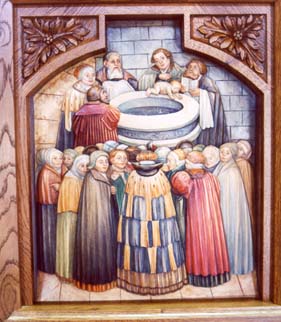
God's saving grace is available to all people.

Five years ago, on February 20th, my children were baptized. This is a day for rejoicing and I was careful to remind them of the importance of the day. On that day, Erik and Kristiana:
became disciples of Jesus Christ;
were born again of water and the Spirit;
had their sins forgiven and washed away;
were baptized into Christ, into His death and resurrection;
became new creations;
put on Christ;
were cleansed and sanctified by the washing of water with the word; and
were saved by the washing of regeneration and renewal by the Holy Spirit.
In a word, they were saved.
(This list was lovingly compiled by John H. of Confessing Evangelical in commemoration of his son's baptism recently.)
The funniest thing of all is that God accomplished all this and I didn't even fully believe it at the time. I was beginning to suspect that God had more power than I had realized, but scripture wouldn't fully convict me for a couple more years.
My kids' baptism day also has special meaning for me. It is a day of joy, certainly...but it is also a day of shame for me. It is a day that forces me to remember my sin in withholding God's power from my children. Despite their requests and admonitions from my husband, mother, mother-in-law and my pastor, I kept them from the saving waters of Holy Baptism.
I had struggled with the purpose of baptism for 20 years! Since my own weak christian training didn't teach me that we are powerless to choose faith apart from the Holy Spirit and that Jesus commanded baptism of all people without mention of age, I hesitated to baptize my own children. I rationalized that even though I was baptised, my own faith didn't mature until I was 20 years old. My wish for mature faith for my children led me to the wrong conclusion that I should have my children wait for baptism until they made their own profession of faith. Thankfully, I did not neglect teaching them God's word and soon I realized that they were Christians through the power of God's Word.
Then it became a game of "Well, when are they old enough to be baptized?". Obviously, that method never gives an answer because children are still children and their faith will never seem mature for years to come. At what point can any of us say about ourselves or our children that faith is now mature and the person is ready for baptism? In those twenty years (before and after having children) of church searching, NO pastor (ELCA, independent, Baptist, Evan. Free, Assemblies of God, Methodist, Covenant, CMA, LCMS) ever told me what the bible truly says about baptism. In fact, pastors in each of these denominations commended me for waiting until my children were ready, that baptism was merely symbolic. During our adult catechism at our new church, I was overwhelmed with my enormous sense of guilt at keeping my children from holy baptism. I did repent of my sin and asked my husband's forgiveness, but I still can't believe how misguided I was.
Now, five years later we just rejoice in the day. In fact, we rejoice in our baptisms every day. That is the true beauty and purpose of baptism, to be remembered and lived in every moment of our lives.
Saturday, February 19, 2005
Evangelism must begin in my home

Evangelism Begins at Home
Teaching God's Word Begins at Home
This means that Evangelism ~ spreading Good News about Jesus ~ begins at home! The Lord, through Moses, encourages us to teach His Truth to our children:
"Impress them on your children. Talk about them when you sit at home and when you walk along the road, when you lie down and when you get up" (Deuteronomy 6:7)
As Christian fathers and mothers do this, impressing on their children God's message of sin and grace, the Holy Spirit works through that message, and their children are blessed with repentance, faith and salvation in Christ. Yet, as Christian parents seek to instruct their children in God's Word faithfully, they face many challenges.
The Challenges
First among the challenges is our own sin and weakness. To be blunt, the sin that lives in every Christian parent's flesh, the Old Adam, hates God's Word. It does not want to hear, read or teach about Jesus. This is the basic reason all fathers and mothers fall short of impressing God's Word on their children as they should. Sin also tempts parents to allow the bustle of daily life to choke out family time spent in God's Word.
"I have a house to clean."
"I have to give the kids their baths."
"I'm just too tired."
"The children have too much homework."
The list is long.
The other challenge to evangelism in the home is the sin of our children. Sin is just as strong in them as it is in us. This is why our children frequently need to be encouraged to make use of daily devotion time and regular church attendance.
If Evangelism in the Home is Lacking
A lack of evangelism in the home is harmful, not only to our children, but also to the broader effort of the church to go into the entire world with the Good News. Christian parents can fall into the trap of getting so wrapped up in "doing evangelism" to save the world that their children, their first evangelism responsibility, are left behind. How does this affect the children? Their faith does not receive the nourishment it needs in order to mature. They can also begin to feel like leftovers. How does it affect the broader mission of the church? Let's put it this way: how sad if we Christians of the Evangelical Lutheran Synod became known for losing our own children in our zeal to evangelize the world!
The Blessings
We Christians of the ELS have been blessed to hear and learn and believe the pure Good News message of the Bible. Jesus lived a perfect life, (including a perfect life of evangelism) to fulfill everything we have left unfulfilled in our sinful lives. Jesus died an atoning death for all our sins (including the sins we have committed by failing to evangelize our children well). By Word and Baptism, the Holy Spirit has given us faith to trust in Christ. Through this faith we are clothed with Christ and receive forgiveness. This is salvation for us sinners, full and free! It is also the lifeblood to a healthy and balanced approach to evangelism. So it is essential that we Christian parents remain in God's Word and baptism day by day, so that faith grows, confidence of salvation remains firm, and love for our children increases. In this, our love and hunger for teaching them about Jesus increases! In faith and love we don't see this as something that keeps us from doing real evangelism; rather we recognize it is the starting point for all evangelism! Certainly the concern we have for those inside our homes will be evident to those we seek to reach outside our homes - in the small towns, suburbs, and cities of our country.
written by Matthew Crick, pastor of Faith Lutheran Church in San Antoinio, Texas and published in the January 2005 issue of the Lutheran Sentinel
Thursday, February 17, 2005
Manila Drive: The Semi-Pelagian Narrower Catechism
I know this is supposed to be funny, but parts of this make me sad - reminding me of a time when I believed some of these points. For example, all of these points. Manila Drive: The Semi-Pelagian Narrower Catechism
Sunday, February 13, 2005
Beggars All: Survey: Where Does Evangelicalism Come From?
I forgot to link to this! This Beggars All post, Survey: Where Does Evangelicalism Come From?was the impetus for Theology Geek's history of evangelicalism post that I linked to yesterday.
Fascinating autobiography...
For those of you who aren't already following, Hapax Legomena has posted his third installment of his spiritual autobiography. Fascinating is an understated term to use. I see that BHT has been discussing it, as well.
Saturday, February 12, 2005
Ash Wednesday and hyposcrisy?
I was frustrated, yet intrigued, earlier this week by a thread of conversation over at Bunnie's blog. Following Bunnie's post about Ash Wednesday, a frequent commenter (who happens to be Baptist) made this comment:
"Just be sure to act like a Christian while you're wearing your ashes! In elementary school, our bus was hit by a parishoner on Ash Wednesday. He walked all around his car, investigate the damage & swearing at the bus driver (it wasn't her fault). Great testimony to the driver and to all of us kids. "
Glen Piper was on the ball to add:
"Well, he certainly showed that he was a sinner, and Church was a good place for him to have been. Hopefully the realization of what he did brought home the lesson of the need for penitential mediation during Lent.
That incident sounds like a good illustration of the importance of the Ash Wednesday -> Lent -> Good Friday -> Easter progression.
And that's not a bad lesson for the kids to have learned (even if it might have only been fully learned in hindsight).
And someone else added: "Nobody is perfect."
I was intrigued by the initial comment and the following comments. I felt I could see a clear picture developing of a person who thinks that their witness is the most important thing versus what I see as a more biblical approach - recognizing your utter need for a Savior, cling to the cross as your only hope and go forward from that point. Maybe the difference seems small? I think the comments from Bunnie's post clearly illustrated that there is a difference in how you view your salvation. Here are more comments:
I added:
"Glen, Good point. That bus incident is a perfect illustration of how Satan waits to trip us up, especially when we fall into Satan's trap of thinking we can "Act like a Christian", even while wearing ashes.
"Acting" like a Christian does no good, is impossible and is offensive to God UNLESS you are acting solely of utter, deep and profound love and gratitude for being saved by grace by God from the fires of hell."
The original commenter attempts again to make her case:
"I certainly didn't mean to imply that those who practice Ash Wednesday are any more imperfect than the rest of us imperfect sinners.
All I meant was, if you are publicly identifying yourself as a Christian, ask God to help you be a good witness. This applies whether you have a John 3:16 bumper sticker, a Jesus Died for You t-shirt, verses posted in your cubicle at the office... or ashes on your forehead. Yes, we're all sinners - but it doesn't do much for the "all Christians are hypocrites" mentality of the unsaved when they don't see that Christ can make a practical difference in our lives.
The next response:
"All Christians ARE hypocrites. What I mean is, they are human. That should be the appealing characteristic, that we can be human and holy at the same time. Acting good has nothing to do with Christ and everything to do with ME. Because of Christ's love we should WANT to be better people, but we don't. The beautiful thing about christianity is that Christ died for you despite who you are or will become. That is how you should proclaim Christianity, NOT "look at me I transformed my life". Christianity is not a lifestyle, it IS life"
The commenter's third and final attempt to clarify and make her point:
Any good thing I do is not done by me, but by the Spirit that dwells within me. HOWEVER, any bad thing that I do is done by me, because I have usurped the Spirit's control in my life. It is clearly God's will that the Spirit will have 100% control in my life, 100% of the time. Obviously, I still have a sin nature, so that ain't happening.
Yes, when I sin it is an opportunity for God's grace to be shown extended to me, a pitiful sinner. But sinning should never be my goal, and it is never a good thing, even if it does demonstrate God's grace.
Romans 6:1-2 "What shall we say then? Are we to continue in sin so that grace may increase? May it never be! How shall we who died to sin still live in it?"
I found this all to be a very interesting exchange. I can't say that I disagreed with anything she said. Since both points are contained in scripture, the two must co- exist. God's word does say that we can do nothing outside of Christ, but it also says "Are we to continue in sin, so that grace may increase?" I have been taught that Romans 6:1-2 refers to deliberately sinning and claiming it doesn't matter because you are already saved. As someone recently wrote somewhere in the blogosphere, Lutherans do tend to react negatively to pietistic practices because they have tended to fall prey to the philosophy over the years.
In a related post, Focal Point by Theology Geek puts it very simply:
The focus of my theology and practice is:
(Gal 6:14 ESV)But far be it from me to boast except in the cross of our Lord Jesus Christ, by which the world has been crucified to me, and I to the world. This is it.
My mission statement, motto, slogan, etc from this point on will be,
“Adopted, Forgiven, and Loved. By Christ alone, through no works of my own”
When it all comes down to it, what else is there?
"Just be sure to act like a Christian while you're wearing your ashes! In elementary school, our bus was hit by a parishoner on Ash Wednesday. He walked all around his car, investigate the damage & swearing at the bus driver (it wasn't her fault). Great testimony to the driver and to all of us kids. "
Glen Piper was on the ball to add:
"Well, he certainly showed that he was a sinner, and Church was a good place for him to have been. Hopefully the realization of what he did brought home the lesson of the need for penitential mediation during Lent.
That incident sounds like a good illustration of the importance of the Ash Wednesday -> Lent -> Good Friday -> Easter progression.
And that's not a bad lesson for the kids to have learned (even if it might have only been fully learned in hindsight).
And someone else added: "Nobody is perfect."
I was intrigued by the initial comment and the following comments. I felt I could see a clear picture developing of a person who thinks that their witness is the most important thing versus what I see as a more biblical approach - recognizing your utter need for a Savior, cling to the cross as your only hope and go forward from that point. Maybe the difference seems small? I think the comments from Bunnie's post clearly illustrated that there is a difference in how you view your salvation. Here are more comments:
I added:
"Glen, Good point. That bus incident is a perfect illustration of how Satan waits to trip us up, especially when we fall into Satan's trap of thinking we can "Act like a Christian", even while wearing ashes.
"Acting" like a Christian does no good, is impossible and is offensive to God UNLESS you are acting solely of utter, deep and profound love and gratitude for being saved by grace by God from the fires of hell."
The original commenter attempts again to make her case:
"I certainly didn't mean to imply that those who practice Ash Wednesday are any more imperfect than the rest of us imperfect sinners.
All I meant was, if you are publicly identifying yourself as a Christian, ask God to help you be a good witness. This applies whether you have a John 3:16 bumper sticker, a Jesus Died for You t-shirt, verses posted in your cubicle at the office... or ashes on your forehead. Yes, we're all sinners - but it doesn't do much for the "all Christians are hypocrites" mentality of the unsaved when they don't see that Christ can make a practical difference in our lives.
The next response:
"All Christians ARE hypocrites. What I mean is, they are human. That should be the appealing characteristic, that we can be human and holy at the same time. Acting good has nothing to do with Christ and everything to do with ME. Because of Christ's love we should WANT to be better people, but we don't. The beautiful thing about christianity is that Christ died for you despite who you are or will become. That is how you should proclaim Christianity, NOT "look at me I transformed my life". Christianity is not a lifestyle, it IS life"
The commenter's third and final attempt to clarify and make her point:
Any good thing I do is not done by me, but by the Spirit that dwells within me. HOWEVER, any bad thing that I do is done by me, because I have usurped the Spirit's control in my life. It is clearly God's will that the Spirit will have 100% control in my life, 100% of the time. Obviously, I still have a sin nature, so that ain't happening.
Yes, when I sin it is an opportunity for God's grace to be shown extended to me, a pitiful sinner. But sinning should never be my goal, and it is never a good thing, even if it does demonstrate God's grace.
Romans 6:1-2 "What shall we say then? Are we to continue in sin so that grace may increase? May it never be! How shall we who died to sin still live in it?"
I found this all to be a very interesting exchange. I can't say that I disagreed with anything she said. Since both points are contained in scripture, the two must co- exist. God's word does say that we can do nothing outside of Christ, but it also says "Are we to continue in sin, so that grace may increase?" I have been taught that Romans 6:1-2 refers to deliberately sinning and claiming it doesn't matter because you are already saved. As someone recently wrote somewhere in the blogosphere, Lutherans do tend to react negatively to pietistic practices because they have tended to fall prey to the philosophy over the years.
In a related post, Focal Point by Theology Geek puts it very simply:
The focus of my theology and practice is:
(Gal 6:14 ESV)But far be it from me to boast except in the cross of our Lord Jesus Christ, by which the world has been crucified to me, and I to the world. This is it.
My mission statement, motto, slogan, etc from this point on will be,
“Adopted, Forgiven, and Loved. By Christ alone, through no works of my own”
When it all comes down to it, what else is there?
History of Evangelicalism
Theology Geek posted this week on a brief history of evangelicalism in America.
Thursday, February 10, 2005
Church Voices on biblical names people DON'T use for baby names
Tim Reed of Church Voices posts this funny commentary:
The scriptures are filled with such disreputable people. The kinds of people your momma warned you about. So, without further ado I present to you my favorite people your momma warned you about from scripture.
Wednesday, February 09, 2005
Cerulean Sanctum: I want to be a clone
Dan E. of Cerulean Sanctum wrote this back on 11-12-04, but it's new to me and I thought others might enjoy it, too. It certainly echos concerns I had just a couple of years ago, both in church and as I listened to Christian radio.
Dan writes:
"Is it just me or has nearly every church in this country been cloned? In the last few months, my wife and I have visited about a half-dozen different churches. Just a decade ago, the differences between those churches in their musical choices, sermon styles, liturgy choices (including no liturgy at all), and the like would have been profoundly different. Even their emphases on particular doctrinal aspects of Christianity would have been prominently on display during a worship service, and uniquely geared to the denominational beliefs of the church. Today, though, it doesn't matter if you go to a Free Methodist, Friends, Vineyard, Baptist, Pentecostal, Presbyterian, or any other denomination because what they show you on Sundays and through the week is identical. Say what you will about the worth of denominational factionalism, but if our churches are all aspiring to a lowest common denominator sameness, is that an improvement?
Now you can make a claim for ecumenism here, but I think it goes far beyond that. Evangelicalism is enmeshed in the church growth movement to such a degree that denominations are jettisoning their cores in order to embrace the flavor of the week. I continue to be astonished at the rate with which The Willow Creek Association is consuming churches, asking them to ascribe to Willow Creek's ministry models without question. But is anyone asking the pivotal question: What if Willow Creek's ministry model and philosophies are wrong? read on...
These were my same questions about two years ago. I was in an ELCA mega-church which was rapidly (and still is) throwing out Luther's reminders of what the Bible teachers for complete opposite doctrine. My point isn't to argue doctrine, but to ask the same questions. Why are we changing and what are we changing to? It was very unsettling to watch infant baptism being downplayed, formal confirmation and spiritual education programs chucked for "Wednesday Night Live", confirmation rites replaced with Affirmation of Baptism services, Lutheran curriculum thrown out for Baptist curriculum, pastors arguing over doctrine, hymns for praise choruses, liturgy for testimonies, etc... Of course, on top of that there was the whole anti-American, pro-choice, pro blessing of same-s#x marriages... I was very quickly an evangelical Lutheran without a church home. But not for too long :)
Dan writes:
"Is it just me or has nearly every church in this country been cloned? In the last few months, my wife and I have visited about a half-dozen different churches. Just a decade ago, the differences between those churches in their musical choices, sermon styles, liturgy choices (including no liturgy at all), and the like would have been profoundly different. Even their emphases on particular doctrinal aspects of Christianity would have been prominently on display during a worship service, and uniquely geared to the denominational beliefs of the church. Today, though, it doesn't matter if you go to a Free Methodist, Friends, Vineyard, Baptist, Pentecostal, Presbyterian, or any other denomination because what they show you on Sundays and through the week is identical. Say what you will about the worth of denominational factionalism, but if our churches are all aspiring to a lowest common denominator sameness, is that an improvement?
Now you can make a claim for ecumenism here, but I think it goes far beyond that. Evangelicalism is enmeshed in the church growth movement to such a degree that denominations are jettisoning their cores in order to embrace the flavor of the week. I continue to be astonished at the rate with which The Willow Creek Association is consuming churches, asking them to ascribe to Willow Creek's ministry models without question. But is anyone asking the pivotal question: What if Willow Creek's ministry model and philosophies are wrong? read on...
These were my same questions about two years ago. I was in an ELCA mega-church which was rapidly (and still is) throwing out Luther's reminders of what the Bible teachers for complete opposite doctrine. My point isn't to argue doctrine, but to ask the same questions. Why are we changing and what are we changing to? It was very unsettling to watch infant baptism being downplayed, formal confirmation and spiritual education programs chucked for "Wednesday Night Live", confirmation rites replaced with Affirmation of Baptism services, Lutheran curriculum thrown out for Baptist curriculum, pastors arguing over doctrine, hymns for praise choruses, liturgy for testimonies, etc... Of course, on top of that there was the whole anti-American, pro-choice, pro blessing of same-s#x marriages... I was very quickly an evangelical Lutheran without a church home. But not for too long :)
Old Solar now has a blog! Introducing Daylight
Old Solar Magazine now has a blog! This is very exciting news and I look forward to checking it each day!
Old Solar Magazine
Daylight blog
Old Solar Magazine
Daylight blog
Monday, February 07, 2005
What attracted you to Confessional Lutheranism?
A friend alerted me to this interesting post on Phoenix Preacher blog. Phoenix Preacher seems to be identifying problems with Calvary Chapel. I am not familiar with that movement, but I know of a couple who was involved. Phoenix Preacher has posted an interesting question: he has asked for input from former evangelicals who have turned to confessional Lutheran churches:
Pastor Michael Newnham: Questions For Our Lutheran Friend
Check out this link and comment, if you have something to say. I'd love it if you copy your comment and leave it here, too. Or I could compile comments and forward them to the pastor. As of today, there is one lengthy and interesting comment by a former evangelical turned Lutheran. That commenter is a friend of mine! He writes:
"My path from Calvary Chapel to Lutheranism occurred about 3 years ago. We were involved in a start-up Calvary for about 3-4 years before that. My wife was raised Lutheran but like many, became involved in a parachurch group, InterVarsity, during college. Most of our last 25-30 years were spent in various evangelical churches, including CC. I first realized Lutheranism had something to offer after ordering tapes from a Lutheran theological radio show called “Issues, Etc.” from St. Louis (www.issuesetc.org). They interviewed a Christian apologist who came out of the extreme charismatic movement, which we also did. After that, I started listening to the archived radio shows. The stuff about baptism and the sacraments turned me off. But as I kept reading, I realized the riches of Lutheranism..." keep reading
Pastor Michael Newnham: Questions For Our Lutheran Friend
Check out this link and comment, if you have something to say. I'd love it if you copy your comment and leave it here, too. Or I could compile comments and forward them to the pastor. As of today, there is one lengthy and interesting comment by a former evangelical turned Lutheran. That commenter is a friend of mine! He writes:
"My path from Calvary Chapel to Lutheranism occurred about 3 years ago. We were involved in a start-up Calvary for about 3-4 years before that. My wife was raised Lutheran but like many, became involved in a parachurch group, InterVarsity, during college. Most of our last 25-30 years were spent in various evangelical churches, including CC. I first realized Lutheranism had something to offer after ordering tapes from a Lutheran theological radio show called “Issues, Etc.” from St. Louis (www.issuesetc.org). They interviewed a Christian apologist who came out of the extreme charismatic movement, which we also did. After that, I started listening to the archived radio shows. The stuff about baptism and the sacraments turned me off. But as I kept reading, I realized the riches of Lutheranism..." keep reading
Friday, February 04, 2005
Pastor Paul McCain: Confessions of a back-slider
This story is guaranteed to give you goosebumps!
"After my spiritual rebirth at the wobbly age of 14--amid the cultural wasteland of the 1970s--I clung to such distinctions as if my life depended on it. The Jesus Movement was in high gear and I relished using the lingo that identified me as a participant. When we approved of something, we'd say, "What a blessing!" or "Praise God." When we told each other goodbye, we'd invoke, "God bless."
I even enjoyed that word backslider--taken from Proverbs 14:14: "The backslider in heart shall be filled with his own ways." We had other words for those ex-Christians: they were "strays," and "exes," and "prodigals," and "blotmarks." That last epithet is taken from Revelations 3:5, in which the apostle John describes a vision of Jesus, who says, "He that overcometh, the same will be clothed in white raiment; and I will not blot out his name from the Book of Life."
The message was clear: to "walk with the Lord" and then slide back from salvation was to embrace a fate even more fiery than the one awaiting those who'd never been saved in the first place."Update: Be sure to catch JS Bangs comments on this article at Hapax Legomena.
Postmodern Communion Service
Communion Service ala Emergent Church Movement
Paradoxology reports on Emergent '05:
Tonight's General Session was excellent. It all began with the worship team from Church of the Apostles leading us in an amazing Eucharistic service that focused on the Transfiguration. The liturgy they crafted included ancient elements re-cast in song and prayer and testimony, and climaxed with everyone partaking of Holy Communion together.
I'm not making any kind of judgment or statement, other than I think that all Christians should learn about the postmodern church movement.
Early Church Fathers on Infant Baptism
Hat tip to U.T. Brito of Ad Majorem Dei Gloriam blog for a link to this piece at Reformation Today entitled Patristic Testimony to the Scriptural Doctrine and Practice of Baptizing Infants into the Christian Faith and Church.
CrossWise: Quote Box
Thanks to Glen at Territorial Bloggings for his post on CrossWise Magazine's Quote Box. Here's two excerpts:
From 2-4-05
Some Christian teachers among us unwittingly encourage us to read our Bibles apart from Christ. They look to the Bible primarily as a source of advice for practical living. They may tell members to open the Bible randomly, and to "let God speak" through the words on that page. But while God does speak to all people through Holy Scripture, it is important to remember what He is saying. Jesus told us Himself: the Holy Scriptures "testify about me." (John 5:39)
When we open our Bibles, may God show us Christ at the center. When we read or hear Christian teaching -- in books or even from our own church's pulpit -- may God give us the wisdom to discern whether Christ is front and center. And if Christ is not at the center, may God give us the courage to speak the truth in love, gently pointing our brothers and sisters back to the True Foundation of the faith: Christ Jesus and His work on the cross.
From 2-3-05
No matter how ridiculous it sometimes seems, the Word of God accomplishes what God wants. When Simeon saw Jesus, he spoke words that were ridicuous on their face. Simeon called Jesus his "salvation"--a light for the Gentiles and the glory of Israel. To those without faith, it must have seemed insane.
But Martin Luther points out that God's Word is not effective merely when it seems reasonable. Whether we think God's Word makes sense or not, it is still powerful to do what God desires--'the Word of God must produce results,' Luther says. In this case, Luther points out that Mary and Joseph did believe, though most in the temple scoffed.
Our sinfulness naturally inclines us to doubt the power of God's Word. We sometimes wonder whether proclaiming God's Law and Gospel are enough--especially in today's world. In fact, many churches, with the best of intentions, have taken steps to water down God's Word in an effort to reach out to unbelievers. There is a movement among many of America's largest churches -- even some Lutheran ones -- to move or remove crosses, out of fear that the bloody message of Christ's crucifixion will be too harsh for modern, unbelieving ears. Sermons speak less and less of Christ's actions, and more and more of Christians' actions. The powerful Word of God is set aside for the practical word of man.
From 2-4-05
Some Christian teachers among us unwittingly encourage us to read our Bibles apart from Christ. They look to the Bible primarily as a source of advice for practical living. They may tell members to open the Bible randomly, and to "let God speak" through the words on that page. But while God does speak to all people through Holy Scripture, it is important to remember what He is saying. Jesus told us Himself: the Holy Scriptures "testify about me." (John 5:39)
When we open our Bibles, may God show us Christ at the center. When we read or hear Christian teaching -- in books or even from our own church's pulpit -- may God give us the wisdom to discern whether Christ is front and center. And if Christ is not at the center, may God give us the courage to speak the truth in love, gently pointing our brothers and sisters back to the True Foundation of the faith: Christ Jesus and His work on the cross.
From 2-3-05
No matter how ridiculous it sometimes seems, the Word of God accomplishes what God wants. When Simeon saw Jesus, he spoke words that were ridicuous on their face. Simeon called Jesus his "salvation"--a light for the Gentiles and the glory of Israel. To those without faith, it must have seemed insane.
But Martin Luther points out that God's Word is not effective merely when it seems reasonable. Whether we think God's Word makes sense or not, it is still powerful to do what God desires--'the Word of God must produce results,' Luther says. In this case, Luther points out that Mary and Joseph did believe, though most in the temple scoffed.
Our sinfulness naturally inclines us to doubt the power of God's Word. We sometimes wonder whether proclaiming God's Law and Gospel are enough--especially in today's world. In fact, many churches, with the best of intentions, have taken steps to water down God's Word in an effort to reach out to unbelievers. There is a movement among many of America's largest churches -- even some Lutheran ones -- to move or remove crosses, out of fear that the bloody message of Christ's crucifixion will be too harsh for modern, unbelieving ears. Sermons speak less and less of Christ's actions, and more and more of Christians' actions. The powerful Word of God is set aside for the practical word of man.
Thursday, February 03, 2005
My thoughts on Joel Osteen
The current swarm descending on Joel Osteen is not surprising. It is our human nature to attack each other, I think. The criticism headed his way is not surprising; he deserves it. He seems to have removed the gospel from his teachings and people are finally getting up their nerve to call him on it. What I find interesting in the Osteen bashing is that whenever people start to discuss doctrine (the keeping of Jesus' teachings), the accusers say that is not part of the discussion. Start here with iMonk's post. Note the drift into doctrine by several wordy commenters (I think One Salient Oversight has some great points and look forward to his upcoming blog, but then note iMonk's response to the shift to doctrine:
Oversight--- I appreciate the post and the info, but I am not looking to argue with Pelagians or Pentecostals or Arminians. I am not arguing Calvinism with non-Calvinists. I accept the Christian profession of non-Calvinists.
My issue with Osteen is the Gospel itself. Not some version of the Gospel.
He adds later:
I agree with you, but I hope you can see that my appeal to evangelical bloggers is not for the sake of defending reformed creeds vs Pentecostal creeds.
It's simply identifying Osteen as what he is: A non-evangelical with a non-Christian message. In fact, I don't want to discuss that statement of faith, because it implies Osteen is doing theology. He's not. LISTEN TO HIM. There is no Gospel and no theology. He's Oprah. He's Tony Robbins.
Now, on one hand I understand that iMonk is trying to keep the conversation focused on what he wants to discuss - Osteen- but look at what is happening: the pointing out of a false teacher leads automatically to discussion of doctrine. iMonk appears to be hindering a healthy discussion.
Doctrine: Something taught; a teaching. From the Latin word doctrna meaning doctor or teacher. The keeping of Jesus' teachings is doctrine.
Again, this is human nature. Wanting to point out the stick in someone else's eye, but not see the plank in your own eye. Hey, that sounds like something Jesus said! ;)
Oversight--- I appreciate the post and the info, but I am not looking to argue with Pelagians or Pentecostals or Arminians. I am not arguing Calvinism with non-Calvinists. I accept the Christian profession of non-Calvinists.
My issue with Osteen is the Gospel itself. Not some version of the Gospel.
He adds later:
I agree with you, but I hope you can see that my appeal to evangelical bloggers is not for the sake of defending reformed creeds vs Pentecostal creeds.
It's simply identifying Osteen as what he is: A non-evangelical with a non-Christian message. In fact, I don't want to discuss that statement of faith, because it implies Osteen is doing theology. He's not. LISTEN TO HIM. There is no Gospel and no theology. He's Oprah. He's Tony Robbins.
Now, on one hand I understand that iMonk is trying to keep the conversation focused on what he wants to discuss - Osteen- but look at what is happening: the pointing out of a false teacher leads automatically to discussion of doctrine. iMonk appears to be hindering a healthy discussion.
Doctrine: Something taught; a teaching. From the Latin word doctrna meaning doctor or teacher. The keeping of Jesus' teachings is doctrine.
Again, this is human nature. Wanting to point out the stick in someone else's eye, but not see the plank in your own eye. Hey, that sounds like something Jesus said! ;)
The Next Reformation by Carl Raschke
Has anyone read the book, The Next Reformation, by Carl Raschke? The subtitle is Why Evangelicals Must Embrace Postmodernity
My church just finished a Wednesday class series on the seduction of Chrisitianity and we spent one whole evening discussing the postmodern movement in the church. The crux of the discussion was not slamming postmodernism, but recognizing and understanding the movement.
Here is what Discerning Reader has to say about the book:
Postmodernism has become a four-letter word among many evangelicals. It has been blamed for every malaise of contemporary society and vilified as the greatest threat to contemporary Christian faith. In The Next Reformation, Carl Raschke acquaints readers with what postmodernism really is, and more importantly, what it is not. He argues that evangelical Christianity has allied itself with non-Christian philosophies, including rationalism and evidentialism, and suggests that breaking this alliance and embracing postmodernism may allow evangelical Christianity to flourish once again as a progressive rather than reactionary force in the present-day world.
Raschke begins with a detailed analysis of the current state of postmodernism and evangelical thought. He provides a background to the controversy, revealing what the term has meant in different contexts and how it relates to contemporary evangelicalism. He describes the development of postmodernism, explores the writings of early postmodernist thinkers, and examines how postmodernist thought has influenced contemporary theology from Derridian deconstruction to Radical Orthodoxy.
Raschke then reveals the opportunities postmodernism brings to Christian faith. He examines how postmodern perspectives bring new meaning to the doctrines of faith alone and sola scriptura, illustrating how these doctrines can be revived by means of postmodern language and philosophy. Raschke goes on to explore how postmodern views of hierarchy and organization could alter the structure of the church toward the Reformation theme of the priesthood of all believers.
I'm thinking it might be a good book to read, but was wondering if anyone had read it and could recommend it to me.
My church just finished a Wednesday class series on the seduction of Chrisitianity and we spent one whole evening discussing the postmodern movement in the church. The crux of the discussion was not slamming postmodernism, but recognizing and understanding the movement.
Here is what Discerning Reader has to say about the book:
Postmodernism has become a four-letter word among many evangelicals. It has been blamed for every malaise of contemporary society and vilified as the greatest threat to contemporary Christian faith. In The Next Reformation, Carl Raschke acquaints readers with what postmodernism really is, and more importantly, what it is not. He argues that evangelical Christianity has allied itself with non-Christian philosophies, including rationalism and evidentialism, and suggests that breaking this alliance and embracing postmodernism may allow evangelical Christianity to flourish once again as a progressive rather than reactionary force in the present-day world.
Raschke begins with a detailed analysis of the current state of postmodernism and evangelical thought. He provides a background to the controversy, revealing what the term has meant in different contexts and how it relates to contemporary evangelicalism. He describes the development of postmodernism, explores the writings of early postmodernist thinkers, and examines how postmodernist thought has influenced contemporary theology from Derridian deconstruction to Radical Orthodoxy.
Raschke then reveals the opportunities postmodernism brings to Christian faith. He examines how postmodern perspectives bring new meaning to the doctrines of faith alone and sola scriptura, illustrating how these doctrines can be revived by means of postmodern language and philosophy. Raschke goes on to explore how postmodern views of hierarchy and organization could alter the structure of the church toward the Reformation theme of the priesthood of all believers.
I'm thinking it might be a good book to read, but was wondering if anyone had read it and could recommend it to me.
Wednesday, February 02, 2005
More reasons to keep Jesus teachings...
But there were also false prophets among the people, just as there will be false teachers among you. They will secretly introduce destructive heresies, even denying the sovereign Lord who bought them-bringing swift destruction upon themselves. many will follow their shameful ways and will bring the way of truth into disrepute. In their greed these teachers will exploit you with stories they have made up. Their condemnation has long been hanging over them and their destruction has not been sleeping....These men are springs without water and mists driven by a storm...For they mouth empty, boastful words and by appealing to the lustful desires of sinful human nature they entice people who are just escaping from those who live in error.
2Peter2
Keep this verse handy if you like to watching television preachers.
2Peter2
Keep this verse handy if you like to watching television preachers.
Victory in Jesus?
Lately, the hymn with the refrain, "Victory in Jesus, my Savior for ever" has been going through my head. I have been thinking that the words are not very scriptural or at least not very balanced. I have sung this song so many times!
I heard an old, old story,
Chorus
The chorus is etched in my mind, unfortunately. I say unfortunately, because I associate the song with the emphasis on the one-time and your done style of conversion and the resulting emphasis on holy living going forward. If you haven't been in a church like that (there are many) you'll have to trust me when I tell you the setting this song is sung. It is sung as if to build up our strength to continue to try and live a Christian life. It fails in that your spirit is deflating the second you commit another sin - probably before you get to the parking lot for most humans. In this song is missing a verse about how we remain sinners our whole lives and can't possible attain holiness on this earth. The fact that we are so totally dependant on Christ for our salvation is where true encouragement, peace and hope comes from.
For indeed He was crucified because of weakness,
JS writes...
I’ve heard a lot of people talk about identity in Christ, and usually this is couple with the idea that we are “more than conquerors through Christ". The victorious life that we are supposed to live through Christ is one of strength, confidence, joy, etc. For some people this teaching might be a source of encouragement, but for me the effect is the exact opposite–it depresses me and makes me angry. Why? Keep reading...
Words and Music by E.M. Bartlett© 1939
Based on 1 Corinthians 15:57
"But thanks be to God,
which giveth us the victory
through our Lord Jesus Christ."
I heard an old, old story,
How a Savior came from glory,
How He gave His life on Calvary
To save a wretch like me;
I heard about His groaning,
Of His precious blood's atoning,
Then I repented of my sins
And won the victory.
Chorus
O victory in Jesus,My Savior, forever.
He sought me and bought meWith His redeeming blood;
He loved me ere I knew Him
And all my love is due Him,
He plunged me to victory,
Beneath the cleansing flood.
The chorus is etched in my mind, unfortunately. I say unfortunately, because I associate the song with the emphasis on the one-time and your done style of conversion and the resulting emphasis on holy living going forward. If you haven't been in a church like that (there are many) you'll have to trust me when I tell you the setting this song is sung. It is sung as if to build up our strength to continue to try and live a Christian life. It fails in that your spirit is deflating the second you commit another sin - probably before you get to the parking lot for most humans. In this song is missing a verse about how we remain sinners our whole lives and can't possible attain holiness on this earth. The fact that we are so totally dependant on Christ for our salvation is where true encouragement, peace and hope comes from.
Today, Hapax Legomena posts encouragingly on what victory in Christ truly is and what it is not.
For indeed He was crucified because of weakness,
yet He lives because of the power of God.
For we also are weak in Him,
yet we shall live with Him
because of the power of God
directed toward you.
2 Cor 13:4
JS writes...
I’ve heard a lot of people talk about identity in Christ, and usually this is couple with the idea that we are “more than conquerors through Christ". The victorious life that we are supposed to live through Christ is one of strength, confidence, joy, etc. For some people this teaching might be a source of encouragement, but for me the effect is the exact opposite–it depresses me and makes me angry. Why? Keep reading...
Subscribe to:
Posts (Atom)