I still receive the newsletter from our former church, suburban ELCA mega-church. I have good reasons for receiving it and reading it - my parents still belong there and I do care about the souls in that church. Usually, I don't find anything more bothersome than the things that caused me to pick my teen-aged children up in my arms and carry them out of there. This week, however, I was bothered by this letter from the pastor. Of course, this church continues to do many good things, some of which are very scriptural. Can you guess my concerns? More importantly, can you guess the sentence that I found sadly hilarious and extremely ironic?
Dear Friends,
Wow! When I think of all that has happened in the last couple weeks, it is mind boggling. A couple thousand people here for Ash Wednesday. Twelve hundred for supper. One hundred and seventy people at the Family Fun Time at (a local indoor waterslide park). Since then, we've gotten to know the Syro-Phoenecian Woman at last week's Lenten service. Then, we had tons of kids here for the TEC (Teens Encounter Christ) weekend. And, now we're getting ready to hear from the Rich Young Ruler at this week's Lenten service. I get tired just thinking about all that's happening. In addition to all of the special events, we have over a hundred people involved in Alpha, hundreds of kids in (Sunday School program), people meeting for Bible studies, support groups and all of the rest. In the midst of that we had 56 people get together for an absolutely great event in (warm sunny destination), gathering some of our “snow birds” together for an update on all that's happening at (ELCA mega-church). (Last week I told you there were only 40. Sorry about that). Thank you, thank you, thank you to the countless volunteers that make all of this possible.
This weekend we have a great opportunity at (ELCA mega-church). On Saturday night at 7:00, (ELCA mega-church) is host to (an inner city program). This great ecumenical program of worship has been meeting in different churches around the city for the last several years. We've wanted to host them before, but it hasn't worked out. This Saturday night, our choir will help to host and will perform throughout the first half of the program. (Joe Singer) and his wonderful musicians will perform throughout the evening. You've been hearing many of his songs the last couple weeks, and if you were able to be in church on Sunday you got to see him in person. It's going to be a great event. Hope you can come.
After hearing from the Rich Young Ruler at Lenten services this week, the theme of this weekend's services is “All American Religion.” We'll examine the kind of faith experiences that are so common in America today but bear little resemblance to Biblical faith. I think you'll find the topic fascinating and encouraging. Have a great week. See you in church.
Your Friend and Pastor,
XXX
Wednesday, February 23, 2005


Scary test
I just took the strangest quiz. It is given by Worldview Weekend Seminars. The quiz was fairly simple, although a little long. I scored well as a Biblical Worldview Thinker, but I was disturbed by the evaluation of my individual answers. Although I was given a choice of "no opinion", "tend to agree" and "tend to disagree", selecting these answers actually count against your score. You must only mark "Strongly Disagree" or "Strongly Agree". I am all for a biblical worldview, but this group seems to give the impression that individual thought is wrong and should be punished. I recommend the Confessional Christian Worldview Seminar as a much more gospel-based educational program. Those teachers aren't afraid to let you think on your own.
Your classification is: Strong Biblical Worldview Thinker
Congratulations You Are A Strong Biblical Worldview Thinker.
Your score is: 136 points of 170 possible, 80%
Scoring/Ratings Chart
Strong Biblical Worldview Thinker
75% - 100%
Moderate Biblical Worldview Thinker
50% - 74%
Secular Humanist Worldview Thinker
25% - 49%
Socialist Worldview Thinker
0% - 24%
Communist/Marxist/Socialist/Secular Humanist Worldview Thinker
under 0%
Here's the interesting kicker:
To improve your biblical worldview or that of your teen we recommend the following things:
1. Attend a Worldview Weekend near you. www.worldviewweekend.com
2. Read these books:
Mind Seige by Dr. Tim LaHaye and Dr. David Noebel God & Government I, II, and III by Gary DeMar No Retreasts, No Reserves, No Regreats, by numerous authors Original Intent by David Barton Reasons for Believeing By Frank Harber The Battle For Truth, by David Noebel Revised and Expanded Answers Book by Ken Ham Thinking Straight in a Crooked World by Gary DeMar
3. Then retake the test and see what improvements you or your teen have made.
4. Study the following list for your "wrong" answers.
Your classification is: Strong Biblical Worldview Thinker
Congratulations You Are A Strong Biblical Worldview Thinker.
Your score is: 136 points of 170 possible, 80%
Scoring/Ratings Chart
Strong Biblical Worldview Thinker
75% - 100%
Moderate Biblical Worldview Thinker
50% - 74%
Secular Humanist Worldview Thinker
25% - 49%
Socialist Worldview Thinker
0% - 24%
Communist/Marxist/Socialist/Secular Humanist Worldview Thinker
under 0%
Here's the interesting kicker:
To improve your biblical worldview or that of your teen we recommend the following things:
1. Attend a Worldview Weekend near you. www.worldviewweekend.com
2. Read these books:
Mind Seige by Dr. Tim LaHaye and Dr. David Noebel God & Government I, II, and III by Gary DeMar No Retreasts, No Reserves, No Regreats, by numerous authors Original Intent by David Barton Reasons for Believeing By Frank Harber The Battle For Truth, by David Noebel Revised and Expanded Answers Book by Ken Ham Thinking Straight in a Crooked World by Gary DeMar
3. Then retake the test and see what improvements you or your teen have made.
4. Study the following list for your "wrong" answers.
Tuesday, February 22, 2005
Happy Baptism Anniversary!
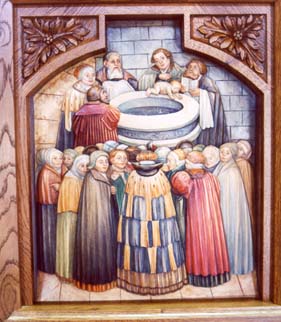
God's saving grace is available to all people.

Five years ago, on February 20th, my children were baptized. This is a day for rejoicing and I was careful to remind them of the importance of the day. On that day, Erik and Kristiana:
became disciples of Jesus Christ;
were born again of water and the Spirit;
had their sins forgiven and washed away;
were baptized into Christ, into His death and resurrection;
became new creations;
put on Christ;
were cleansed and sanctified by the washing of water with the word; and
were saved by the washing of regeneration and renewal by the Holy Spirit.
In a word, they were saved.
(This list was lovingly compiled by John H. of Confessing Evangelical in commemoration of his son's baptism recently.)
The funniest thing of all is that God accomplished all this and I didn't even fully believe it at the time. I was beginning to suspect that God had more power than I had realized, but scripture wouldn't fully convict me for a couple more years.
My kids' baptism day also has special meaning for me. It is a day of joy, certainly...but it is also a day of shame for me. It is a day that forces me to remember my sin in withholding God's power from my children. Despite their requests and admonitions from my husband, mother, mother-in-law and my pastor, I kept them from the saving waters of Holy Baptism.
I had struggled with the purpose of baptism for 20 years! Since my own weak christian training didn't teach me that we are powerless to choose faith apart from the Holy Spirit and that Jesus commanded baptism of all people without mention of age, I hesitated to baptize my own children. I rationalized that even though I was baptised, my own faith didn't mature until I was 20 years old. My wish for mature faith for my children led me to the wrong conclusion that I should have my children wait for baptism until they made their own profession of faith. Thankfully, I did not neglect teaching them God's word and soon I realized that they were Christians through the power of God's Word.
Then it became a game of "Well, when are they old enough to be baptized?". Obviously, that method never gives an answer because children are still children and their faith will never seem mature for years to come. At what point can any of us say about ourselves or our children that faith is now mature and the person is ready for baptism? In those twenty years (before and after having children) of church searching, NO pastor (ELCA, independent, Baptist, Evan. Free, Assemblies of God, Methodist, Covenant, CMA, LCMS) ever told me what the bible truly says about baptism. In fact, pastors in each of these denominations commended me for waiting until my children were ready, that baptism was merely symbolic. During our adult catechism at our new church, I was overwhelmed with my enormous sense of guilt at keeping my children from holy baptism. I did repent of my sin and asked my husband's forgiveness, but I still can't believe how misguided I was.
Now, five years later we just rejoice in the day. In fact, we rejoice in our baptisms every day. That is the true beauty and purpose of baptism, to be remembered and lived in every moment of our lives.
Saturday, February 19, 2005
Evangelism must begin in my home

Evangelism Begins at Home
Teaching God's Word Begins at Home
This means that Evangelism ~ spreading Good News about Jesus ~ begins at home! The Lord, through Moses, encourages us to teach His Truth to our children:
"Impress them on your children. Talk about them when you sit at home and when you walk along the road, when you lie down and when you get up" (Deuteronomy 6:7)
As Christian fathers and mothers do this, impressing on their children God's message of sin and grace, the Holy Spirit works through that message, and their children are blessed with repentance, faith and salvation in Christ. Yet, as Christian parents seek to instruct their children in God's Word faithfully, they face many challenges.
The Challenges
First among the challenges is our own sin and weakness. To be blunt, the sin that lives in every Christian parent's flesh, the Old Adam, hates God's Word. It does not want to hear, read or teach about Jesus. This is the basic reason all fathers and mothers fall short of impressing God's Word on their children as they should. Sin also tempts parents to allow the bustle of daily life to choke out family time spent in God's Word.
"I have a house to clean."
"I have to give the kids their baths."
"I'm just too tired."
"The children have too much homework."
The list is long.
The other challenge to evangelism in the home is the sin of our children. Sin is just as strong in them as it is in us. This is why our children frequently need to be encouraged to make use of daily devotion time and regular church attendance.
If Evangelism in the Home is Lacking
A lack of evangelism in the home is harmful, not only to our children, but also to the broader effort of the church to go into the entire world with the Good News. Christian parents can fall into the trap of getting so wrapped up in "doing evangelism" to save the world that their children, their first evangelism responsibility, are left behind. How does this affect the children? Their faith does not receive the nourishment it needs in order to mature. They can also begin to feel like leftovers. How does it affect the broader mission of the church? Let's put it this way: how sad if we Christians of the Evangelical Lutheran Synod became known for losing our own children in our zeal to evangelize the world!
The Blessings
We Christians of the ELS have been blessed to hear and learn and believe the pure Good News message of the Bible. Jesus lived a perfect life, (including a perfect life of evangelism) to fulfill everything we have left unfulfilled in our sinful lives. Jesus died an atoning death for all our sins (including the sins we have committed by failing to evangelize our children well). By Word and Baptism, the Holy Spirit has given us faith to trust in Christ. Through this faith we are clothed with Christ and receive forgiveness. This is salvation for us sinners, full and free! It is also the lifeblood to a healthy and balanced approach to evangelism. So it is essential that we Christian parents remain in God's Word and baptism day by day, so that faith grows, confidence of salvation remains firm, and love for our children increases. In this, our love and hunger for teaching them about Jesus increases! In faith and love we don't see this as something that keeps us from doing real evangelism; rather we recognize it is the starting point for all evangelism! Certainly the concern we have for those inside our homes will be evident to those we seek to reach outside our homes - in the small towns, suburbs, and cities of our country.
written by Matthew Crick, pastor of Faith Lutheran Church in San Antoinio, Texas and published in the January 2005 issue of the Lutheran Sentinel
Thursday, February 17, 2005
Manila Drive: The Semi-Pelagian Narrower Catechism
I know this is supposed to be funny, but parts of this make me sad - reminding me of a time when I believed some of these points. For example, all of these points. Manila Drive: The Semi-Pelagian Narrower Catechism
Sunday, February 13, 2005
Beggars All: Survey: Where Does Evangelicalism Come From?
I forgot to link to this! This Beggars All post, Survey: Where Does Evangelicalism Come From?was the impetus for Theology Geek's history of evangelicalism post that I linked to yesterday.
Fascinating autobiography...
For those of you who aren't already following, Hapax Legomena has posted his third installment of his spiritual autobiography. Fascinating is an understated term to use. I see that BHT has been discussing it, as well.
Saturday, February 12, 2005
Ash Wednesday and hyposcrisy?
I was frustrated, yet intrigued, earlier this week by a thread of conversation over at Bunnie's blog. Following Bunnie's post about Ash Wednesday, a frequent commenter (who happens to be Baptist) made this comment:
"Just be sure to act like a Christian while you're wearing your ashes! In elementary school, our bus was hit by a parishoner on Ash Wednesday. He walked all around his car, investigate the damage & swearing at the bus driver (it wasn't her fault). Great testimony to the driver and to all of us kids. "
Glen Piper was on the ball to add:
"Well, he certainly showed that he was a sinner, and Church was a good place for him to have been. Hopefully the realization of what he did brought home the lesson of the need for penitential mediation during Lent.
That incident sounds like a good illustration of the importance of the Ash Wednesday -> Lent -> Good Friday -> Easter progression.
And that's not a bad lesson for the kids to have learned (even if it might have only been fully learned in hindsight).
And someone else added: "Nobody is perfect."
I was intrigued by the initial comment and the following comments. I felt I could see a clear picture developing of a person who thinks that their witness is the most important thing versus what I see as a more biblical approach - recognizing your utter need for a Savior, cling to the cross as your only hope and go forward from that point. Maybe the difference seems small? I think the comments from Bunnie's post clearly illustrated that there is a difference in how you view your salvation. Here are more comments:
I added:
"Glen, Good point. That bus incident is a perfect illustration of how Satan waits to trip us up, especially when we fall into Satan's trap of thinking we can "Act like a Christian", even while wearing ashes.
"Acting" like a Christian does no good, is impossible and is offensive to God UNLESS you are acting solely of utter, deep and profound love and gratitude for being saved by grace by God from the fires of hell."
The original commenter attempts again to make her case:
"I certainly didn't mean to imply that those who practice Ash Wednesday are any more imperfect than the rest of us imperfect sinners.
All I meant was, if you are publicly identifying yourself as a Christian, ask God to help you be a good witness. This applies whether you have a John 3:16 bumper sticker, a Jesus Died for You t-shirt, verses posted in your cubicle at the office... or ashes on your forehead. Yes, we're all sinners - but it doesn't do much for the "all Christians are hypocrites" mentality of the unsaved when they don't see that Christ can make a practical difference in our lives.
The next response:
"All Christians ARE hypocrites. What I mean is, they are human. That should be the appealing characteristic, that we can be human and holy at the same time. Acting good has nothing to do with Christ and everything to do with ME. Because of Christ's love we should WANT to be better people, but we don't. The beautiful thing about christianity is that Christ died for you despite who you are or will become. That is how you should proclaim Christianity, NOT "look at me I transformed my life". Christianity is not a lifestyle, it IS life"
The commenter's third and final attempt to clarify and make her point:
Any good thing I do is not done by me, but by the Spirit that dwells within me. HOWEVER, any bad thing that I do is done by me, because I have usurped the Spirit's control in my life. It is clearly God's will that the Spirit will have 100% control in my life, 100% of the time. Obviously, I still have a sin nature, so that ain't happening.
Yes, when I sin it is an opportunity for God's grace to be shown extended to me, a pitiful sinner. But sinning should never be my goal, and it is never a good thing, even if it does demonstrate God's grace.
Romans 6:1-2 "What shall we say then? Are we to continue in sin so that grace may increase? May it never be! How shall we who died to sin still live in it?"
I found this all to be a very interesting exchange. I can't say that I disagreed with anything she said. Since both points are contained in scripture, the two must co- exist. God's word does say that we can do nothing outside of Christ, but it also says "Are we to continue in sin, so that grace may increase?" I have been taught that Romans 6:1-2 refers to deliberately sinning and claiming it doesn't matter because you are already saved. As someone recently wrote somewhere in the blogosphere, Lutherans do tend to react negatively to pietistic practices because they have tended to fall prey to the philosophy over the years.
In a related post, Focal Point by Theology Geek puts it very simply:
The focus of my theology and practice is:
(Gal 6:14 ESV)But far be it from me to boast except in the cross of our Lord Jesus Christ, by which the world has been crucified to me, and I to the world. This is it.
My mission statement, motto, slogan, etc from this point on will be,
“Adopted, Forgiven, and Loved. By Christ alone, through no works of my own”
When it all comes down to it, what else is there?
"Just be sure to act like a Christian while you're wearing your ashes! In elementary school, our bus was hit by a parishoner on Ash Wednesday. He walked all around his car, investigate the damage & swearing at the bus driver (it wasn't her fault). Great testimony to the driver and to all of us kids. "
Glen Piper was on the ball to add:
"Well, he certainly showed that he was a sinner, and Church was a good place for him to have been. Hopefully the realization of what he did brought home the lesson of the need for penitential mediation during Lent.
That incident sounds like a good illustration of the importance of the Ash Wednesday -> Lent -> Good Friday -> Easter progression.
And that's not a bad lesson for the kids to have learned (even if it might have only been fully learned in hindsight).
And someone else added: "Nobody is perfect."
I was intrigued by the initial comment and the following comments. I felt I could see a clear picture developing of a person who thinks that their witness is the most important thing versus what I see as a more biblical approach - recognizing your utter need for a Savior, cling to the cross as your only hope and go forward from that point. Maybe the difference seems small? I think the comments from Bunnie's post clearly illustrated that there is a difference in how you view your salvation. Here are more comments:
I added:
"Glen, Good point. That bus incident is a perfect illustration of how Satan waits to trip us up, especially when we fall into Satan's trap of thinking we can "Act like a Christian", even while wearing ashes.
"Acting" like a Christian does no good, is impossible and is offensive to God UNLESS you are acting solely of utter, deep and profound love and gratitude for being saved by grace by God from the fires of hell."
The original commenter attempts again to make her case:
"I certainly didn't mean to imply that those who practice Ash Wednesday are any more imperfect than the rest of us imperfect sinners.
All I meant was, if you are publicly identifying yourself as a Christian, ask God to help you be a good witness. This applies whether you have a John 3:16 bumper sticker, a Jesus Died for You t-shirt, verses posted in your cubicle at the office... or ashes on your forehead. Yes, we're all sinners - but it doesn't do much for the "all Christians are hypocrites" mentality of the unsaved when they don't see that Christ can make a practical difference in our lives.
The next response:
"All Christians ARE hypocrites. What I mean is, they are human. That should be the appealing characteristic, that we can be human and holy at the same time. Acting good has nothing to do with Christ and everything to do with ME. Because of Christ's love we should WANT to be better people, but we don't. The beautiful thing about christianity is that Christ died for you despite who you are or will become. That is how you should proclaim Christianity, NOT "look at me I transformed my life". Christianity is not a lifestyle, it IS life"
The commenter's third and final attempt to clarify and make her point:
Any good thing I do is not done by me, but by the Spirit that dwells within me. HOWEVER, any bad thing that I do is done by me, because I have usurped the Spirit's control in my life. It is clearly God's will that the Spirit will have 100% control in my life, 100% of the time. Obviously, I still have a sin nature, so that ain't happening.
Yes, when I sin it is an opportunity for God's grace to be shown extended to me, a pitiful sinner. But sinning should never be my goal, and it is never a good thing, even if it does demonstrate God's grace.
Romans 6:1-2 "What shall we say then? Are we to continue in sin so that grace may increase? May it never be! How shall we who died to sin still live in it?"
I found this all to be a very interesting exchange. I can't say that I disagreed with anything she said. Since both points are contained in scripture, the two must co- exist. God's word does say that we can do nothing outside of Christ, but it also says "Are we to continue in sin, so that grace may increase?" I have been taught that Romans 6:1-2 refers to deliberately sinning and claiming it doesn't matter because you are already saved. As someone recently wrote somewhere in the blogosphere, Lutherans do tend to react negatively to pietistic practices because they have tended to fall prey to the philosophy over the years.
In a related post, Focal Point by Theology Geek puts it very simply:
The focus of my theology and practice is:
(Gal 6:14 ESV)But far be it from me to boast except in the cross of our Lord Jesus Christ, by which the world has been crucified to me, and I to the world. This is it.
My mission statement, motto, slogan, etc from this point on will be,
“Adopted, Forgiven, and Loved. By Christ alone, through no works of my own”
When it all comes down to it, what else is there?
History of Evangelicalism
Theology Geek posted this week on a brief history of evangelicalism in America.
Thursday, February 10, 2005
Church Voices on biblical names people DON'T use for baby names
Tim Reed of Church Voices posts this funny commentary:
The scriptures are filled with such disreputable people. The kinds of people your momma warned you about. So, without further ado I present to you my favorite people your momma warned you about from scripture.
Wednesday, February 09, 2005
Cerulean Sanctum: I want to be a clone
Dan E. of Cerulean Sanctum wrote this back on 11-12-04, but it's new to me and I thought others might enjoy it, too. It certainly echos concerns I had just a couple of years ago, both in church and as I listened to Christian radio.
Dan writes:
"Is it just me or has nearly every church in this country been cloned? In the last few months, my wife and I have visited about a half-dozen different churches. Just a decade ago, the differences between those churches in their musical choices, sermon styles, liturgy choices (including no liturgy at all), and the like would have been profoundly different. Even their emphases on particular doctrinal aspects of Christianity would have been prominently on display during a worship service, and uniquely geared to the denominational beliefs of the church. Today, though, it doesn't matter if you go to a Free Methodist, Friends, Vineyard, Baptist, Pentecostal, Presbyterian, or any other denomination because what they show you on Sundays and through the week is identical. Say what you will about the worth of denominational factionalism, but if our churches are all aspiring to a lowest common denominator sameness, is that an improvement?
Now you can make a claim for ecumenism here, but I think it goes far beyond that. Evangelicalism is enmeshed in the church growth movement to such a degree that denominations are jettisoning their cores in order to embrace the flavor of the week. I continue to be astonished at the rate with which The Willow Creek Association is consuming churches, asking them to ascribe to Willow Creek's ministry models without question. But is anyone asking the pivotal question: What if Willow Creek's ministry model and philosophies are wrong? read on...
These were my same questions about two years ago. I was in an ELCA mega-church which was rapidly (and still is) throwing out Luther's reminders of what the Bible teachers for complete opposite doctrine. My point isn't to argue doctrine, but to ask the same questions. Why are we changing and what are we changing to? It was very unsettling to watch infant baptism being downplayed, formal confirmation and spiritual education programs chucked for "Wednesday Night Live", confirmation rites replaced with Affirmation of Baptism services, Lutheran curriculum thrown out for Baptist curriculum, pastors arguing over doctrine, hymns for praise choruses, liturgy for testimonies, etc... Of course, on top of that there was the whole anti-American, pro-choice, pro blessing of same-s#x marriages... I was very quickly an evangelical Lutheran without a church home. But not for too long :)
Dan writes:
"Is it just me or has nearly every church in this country been cloned? In the last few months, my wife and I have visited about a half-dozen different churches. Just a decade ago, the differences between those churches in their musical choices, sermon styles, liturgy choices (including no liturgy at all), and the like would have been profoundly different. Even their emphases on particular doctrinal aspects of Christianity would have been prominently on display during a worship service, and uniquely geared to the denominational beliefs of the church. Today, though, it doesn't matter if you go to a Free Methodist, Friends, Vineyard, Baptist, Pentecostal, Presbyterian, or any other denomination because what they show you on Sundays and through the week is identical. Say what you will about the worth of denominational factionalism, but if our churches are all aspiring to a lowest common denominator sameness, is that an improvement?
Now you can make a claim for ecumenism here, but I think it goes far beyond that. Evangelicalism is enmeshed in the church growth movement to such a degree that denominations are jettisoning their cores in order to embrace the flavor of the week. I continue to be astonished at the rate with which The Willow Creek Association is consuming churches, asking them to ascribe to Willow Creek's ministry models without question. But is anyone asking the pivotal question: What if Willow Creek's ministry model and philosophies are wrong? read on...
These were my same questions about two years ago. I was in an ELCA mega-church which was rapidly (and still is) throwing out Luther's reminders of what the Bible teachers for complete opposite doctrine. My point isn't to argue doctrine, but to ask the same questions. Why are we changing and what are we changing to? It was very unsettling to watch infant baptism being downplayed, formal confirmation and spiritual education programs chucked for "Wednesday Night Live", confirmation rites replaced with Affirmation of Baptism services, Lutheran curriculum thrown out for Baptist curriculum, pastors arguing over doctrine, hymns for praise choruses, liturgy for testimonies, etc... Of course, on top of that there was the whole anti-American, pro-choice, pro blessing of same-s#x marriages... I was very quickly an evangelical Lutheran without a church home. But not for too long :)
Old Solar now has a blog! Introducing Daylight
Old Solar Magazine now has a blog! This is very exciting news and I look forward to checking it each day!
Old Solar Magazine
Daylight blog
Old Solar Magazine
Daylight blog
Monday, February 07, 2005
What attracted you to Confessional Lutheranism?
A friend alerted me to this interesting post on Phoenix Preacher blog. Phoenix Preacher seems to be identifying problems with Calvary Chapel. I am not familiar with that movement, but I know of a couple who was involved. Phoenix Preacher has posted an interesting question: he has asked for input from former evangelicals who have turned to confessional Lutheran churches:
Pastor Michael Newnham: Questions For Our Lutheran Friend
Check out this link and comment, if you have something to say. I'd love it if you copy your comment and leave it here, too. Or I could compile comments and forward them to the pastor. As of today, there is one lengthy and interesting comment by a former evangelical turned Lutheran. That commenter is a friend of mine! He writes:
"My path from Calvary Chapel to Lutheranism occurred about 3 years ago. We were involved in a start-up Calvary for about 3-4 years before that. My wife was raised Lutheran but like many, became involved in a parachurch group, InterVarsity, during college. Most of our last 25-30 years were spent in various evangelical churches, including CC. I first realized Lutheranism had something to offer after ordering tapes from a Lutheran theological radio show called “Issues, Etc.” from St. Louis (www.issuesetc.org). They interviewed a Christian apologist who came out of the extreme charismatic movement, which we also did. After that, I started listening to the archived radio shows. The stuff about baptism and the sacraments turned me off. But as I kept reading, I realized the riches of Lutheranism..." keep reading
Pastor Michael Newnham: Questions For Our Lutheran Friend
Check out this link and comment, if you have something to say. I'd love it if you copy your comment and leave it here, too. Or I could compile comments and forward them to the pastor. As of today, there is one lengthy and interesting comment by a former evangelical turned Lutheran. That commenter is a friend of mine! He writes:
"My path from Calvary Chapel to Lutheranism occurred about 3 years ago. We were involved in a start-up Calvary for about 3-4 years before that. My wife was raised Lutheran but like many, became involved in a parachurch group, InterVarsity, during college. Most of our last 25-30 years were spent in various evangelical churches, including CC. I first realized Lutheranism had something to offer after ordering tapes from a Lutheran theological radio show called “Issues, Etc.” from St. Louis (www.issuesetc.org). They interviewed a Christian apologist who came out of the extreme charismatic movement, which we also did. After that, I started listening to the archived radio shows. The stuff about baptism and the sacraments turned me off. But as I kept reading, I realized the riches of Lutheranism..." keep reading
Friday, February 04, 2005
Pastor Paul McCain: Confessions of a back-slider
This story is guaranteed to give you goosebumps!
"After my spiritual rebirth at the wobbly age of 14--amid the cultural wasteland of the 1970s--I clung to such distinctions as if my life depended on it. The Jesus Movement was in high gear and I relished using the lingo that identified me as a participant. When we approved of something, we'd say, "What a blessing!" or "Praise God." When we told each other goodbye, we'd invoke, "God bless."
I even enjoyed that word backslider--taken from Proverbs 14:14: "The backslider in heart shall be filled with his own ways." We had other words for those ex-Christians: they were "strays," and "exes," and "prodigals," and "blotmarks." That last epithet is taken from Revelations 3:5, in which the apostle John describes a vision of Jesus, who says, "He that overcometh, the same will be clothed in white raiment; and I will not blot out his name from the Book of Life."
The message was clear: to "walk with the Lord" and then slide back from salvation was to embrace a fate even more fiery than the one awaiting those who'd never been saved in the first place."Update: Be sure to catch JS Bangs comments on this article at Hapax Legomena.
Postmodern Communion Service
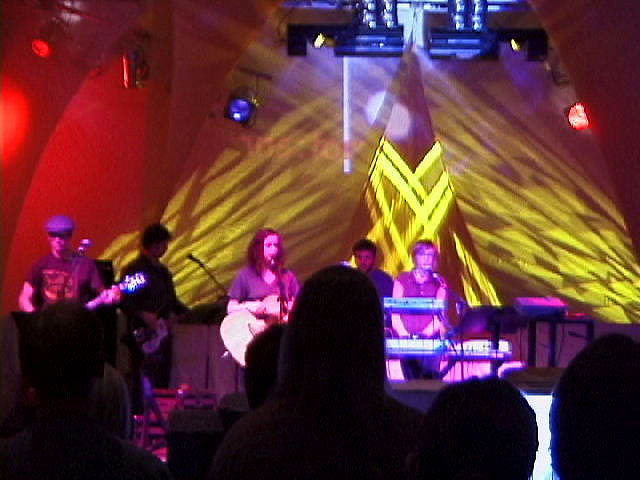
Communion Service ala Emergent Church Movement
Paradoxology reports on Emergent '05:
Tonight's General Session was excellent. It all began with the worship team from Church of the Apostles leading us in an amazing Eucharistic service that focused on the Transfiguration. The liturgy they crafted included ancient elements re-cast in song and prayer and testimony, and climaxed with everyone partaking of Holy Communion together.
I'm not making any kind of judgment or statement, other than I think that all Christians should learn about the postmodern church movement.
Early Church Fathers on Infant Baptism
Hat tip to U.T. Brito of Ad Majorem Dei Gloriam blog for a link to this piece at Reformation Today entitled Patristic Testimony to the Scriptural Doctrine and Practice of Baptizing Infants into the Christian Faith and Church.
CrossWise: Quote Box
Thanks to Glen at Territorial Bloggings for his post on CrossWise Magazine's Quote Box. Here's two excerpts:
From 2-4-05
Some Christian teachers among us unwittingly encourage us to read our Bibles apart from Christ. They look to the Bible primarily as a source of advice for practical living. They may tell members to open the Bible randomly, and to "let God speak" through the words on that page. But while God does speak to all people through Holy Scripture, it is important to remember what He is saying. Jesus told us Himself: the Holy Scriptures "testify about me." (John 5:39)
When we open our Bibles, may God show us Christ at the center. When we read or hear Christian teaching -- in books or even from our own church's pulpit -- may God give us the wisdom to discern whether Christ is front and center. And if Christ is not at the center, may God give us the courage to speak the truth in love, gently pointing our brothers and sisters back to the True Foundation of the faith: Christ Jesus and His work on the cross.
From 2-3-05
No matter how ridiculous it sometimes seems, the Word of God accomplishes what God wants. When Simeon saw Jesus, he spoke words that were ridicuous on their face. Simeon called Jesus his "salvation"--a light for the Gentiles and the glory of Israel. To those without faith, it must have seemed insane.
But Martin Luther points out that God's Word is not effective merely when it seems reasonable. Whether we think God's Word makes sense or not, it is still powerful to do what God desires--'the Word of God must produce results,' Luther says. In this case, Luther points out that Mary and Joseph did believe, though most in the temple scoffed.
Our sinfulness naturally inclines us to doubt the power of God's Word. We sometimes wonder whether proclaiming God's Law and Gospel are enough--especially in today's world. In fact, many churches, with the best of intentions, have taken steps to water down God's Word in an effort to reach out to unbelievers. There is a movement among many of America's largest churches -- even some Lutheran ones -- to move or remove crosses, out of fear that the bloody message of Christ's crucifixion will be too harsh for modern, unbelieving ears. Sermons speak less and less of Christ's actions, and more and more of Christians' actions. The powerful Word of God is set aside for the practical word of man.
From 2-4-05
Some Christian teachers among us unwittingly encourage us to read our Bibles apart from Christ. They look to the Bible primarily as a source of advice for practical living. They may tell members to open the Bible randomly, and to "let God speak" through the words on that page. But while God does speak to all people through Holy Scripture, it is important to remember what He is saying. Jesus told us Himself: the Holy Scriptures "testify about me." (John 5:39)
When we open our Bibles, may God show us Christ at the center. When we read or hear Christian teaching -- in books or even from our own church's pulpit -- may God give us the wisdom to discern whether Christ is front and center. And if Christ is not at the center, may God give us the courage to speak the truth in love, gently pointing our brothers and sisters back to the True Foundation of the faith: Christ Jesus and His work on the cross.
From 2-3-05
No matter how ridiculous it sometimes seems, the Word of God accomplishes what God wants. When Simeon saw Jesus, he spoke words that were ridicuous on their face. Simeon called Jesus his "salvation"--a light for the Gentiles and the glory of Israel. To those without faith, it must have seemed insane.
But Martin Luther points out that God's Word is not effective merely when it seems reasonable. Whether we think God's Word makes sense or not, it is still powerful to do what God desires--'the Word of God must produce results,' Luther says. In this case, Luther points out that Mary and Joseph did believe, though most in the temple scoffed.
Our sinfulness naturally inclines us to doubt the power of God's Word. We sometimes wonder whether proclaiming God's Law and Gospel are enough--especially in today's world. In fact, many churches, with the best of intentions, have taken steps to water down God's Word in an effort to reach out to unbelievers. There is a movement among many of America's largest churches -- even some Lutheran ones -- to move or remove crosses, out of fear that the bloody message of Christ's crucifixion will be too harsh for modern, unbelieving ears. Sermons speak less and less of Christ's actions, and more and more of Christians' actions. The powerful Word of God is set aside for the practical word of man.
Thursday, February 03, 2005
My thoughts on Joel Osteen
The current swarm descending on Joel Osteen is not surprising. It is our human nature to attack each other, I think. The criticism headed his way is not surprising; he deserves it. He seems to have removed the gospel from his teachings and people are finally getting up their nerve to call him on it. What I find interesting in the Osteen bashing is that whenever people start to discuss doctrine (the keeping of Jesus' teachings), the accusers say that is not part of the discussion. Start here with iMonk's post. Note the drift into doctrine by several wordy commenters (I think One Salient Oversight has some great points and look forward to his upcoming blog, but then note iMonk's response to the shift to doctrine:
Oversight--- I appreciate the post and the info, but I am not looking to argue with Pelagians or Pentecostals or Arminians. I am not arguing Calvinism with non-Calvinists. I accept the Christian profession of non-Calvinists.
My issue with Osteen is the Gospel itself. Not some version of the Gospel.
He adds later:
I agree with you, but I hope you can see that my appeal to evangelical bloggers is not for the sake of defending reformed creeds vs Pentecostal creeds.
It's simply identifying Osteen as what he is: A non-evangelical with a non-Christian message. In fact, I don't want to discuss that statement of faith, because it implies Osteen is doing theology. He's not. LISTEN TO HIM. There is no Gospel and no theology. He's Oprah. He's Tony Robbins.
Now, on one hand I understand that iMonk is trying to keep the conversation focused on what he wants to discuss - Osteen- but look at what is happening: the pointing out of a false teacher leads automatically to discussion of doctrine. iMonk appears to be hindering a healthy discussion.
Doctrine: Something taught; a teaching. From the Latin word doctrna meaning doctor or teacher. The keeping of Jesus' teachings is doctrine.
Again, this is human nature. Wanting to point out the stick in someone else's eye, but not see the plank in your own eye. Hey, that sounds like something Jesus said! ;)
Oversight--- I appreciate the post and the info, but I am not looking to argue with Pelagians or Pentecostals or Arminians. I am not arguing Calvinism with non-Calvinists. I accept the Christian profession of non-Calvinists.
My issue with Osteen is the Gospel itself. Not some version of the Gospel.
He adds later:
I agree with you, but I hope you can see that my appeal to evangelical bloggers is not for the sake of defending reformed creeds vs Pentecostal creeds.
It's simply identifying Osteen as what he is: A non-evangelical with a non-Christian message. In fact, I don't want to discuss that statement of faith, because it implies Osteen is doing theology. He's not. LISTEN TO HIM. There is no Gospel and no theology. He's Oprah. He's Tony Robbins.
Now, on one hand I understand that iMonk is trying to keep the conversation focused on what he wants to discuss - Osteen- but look at what is happening: the pointing out of a false teacher leads automatically to discussion of doctrine. iMonk appears to be hindering a healthy discussion.
Doctrine: Something taught; a teaching. From the Latin word doctrna meaning doctor or teacher. The keeping of Jesus' teachings is doctrine.
Again, this is human nature. Wanting to point out the stick in someone else's eye, but not see the plank in your own eye. Hey, that sounds like something Jesus said! ;)
The Next Reformation by Carl Raschke
Has anyone read the book, The Next Reformation, by Carl Raschke? The subtitle is Why Evangelicals Must Embrace Postmodernity
My church just finished a Wednesday class series on the seduction of Chrisitianity and we spent one whole evening discussing the postmodern movement in the church. The crux of the discussion was not slamming postmodernism, but recognizing and understanding the movement.
Here is what Discerning Reader has to say about the book:
Postmodernism has become a four-letter word among many evangelicals. It has been blamed for every malaise of contemporary society and vilified as the greatest threat to contemporary Christian faith. In The Next Reformation, Carl Raschke acquaints readers with what postmodernism really is, and more importantly, what it is not. He argues that evangelical Christianity has allied itself with non-Christian philosophies, including rationalism and evidentialism, and suggests that breaking this alliance and embracing postmodernism may allow evangelical Christianity to flourish once again as a progressive rather than reactionary force in the present-day world.
Raschke begins with a detailed analysis of the current state of postmodernism and evangelical thought. He provides a background to the controversy, revealing what the term has meant in different contexts and how it relates to contemporary evangelicalism. He describes the development of postmodernism, explores the writings of early postmodernist thinkers, and examines how postmodernist thought has influenced contemporary theology from Derridian deconstruction to Radical Orthodoxy.
Raschke then reveals the opportunities postmodernism brings to Christian faith. He examines how postmodern perspectives bring new meaning to the doctrines of faith alone and sola scriptura, illustrating how these doctrines can be revived by means of postmodern language and philosophy. Raschke goes on to explore how postmodern views of hierarchy and organization could alter the structure of the church toward the Reformation theme of the priesthood of all believers.
I'm thinking it might be a good book to read, but was wondering if anyone had read it and could recommend it to me.
My church just finished a Wednesday class series on the seduction of Chrisitianity and we spent one whole evening discussing the postmodern movement in the church. The crux of the discussion was not slamming postmodernism, but recognizing and understanding the movement.
Here is what Discerning Reader has to say about the book:
Postmodernism has become a four-letter word among many evangelicals. It has been blamed for every malaise of contemporary society and vilified as the greatest threat to contemporary Christian faith. In The Next Reformation, Carl Raschke acquaints readers with what postmodernism really is, and more importantly, what it is not. He argues that evangelical Christianity has allied itself with non-Christian philosophies, including rationalism and evidentialism, and suggests that breaking this alliance and embracing postmodernism may allow evangelical Christianity to flourish once again as a progressive rather than reactionary force in the present-day world.
Raschke begins with a detailed analysis of the current state of postmodernism and evangelical thought. He provides a background to the controversy, revealing what the term has meant in different contexts and how it relates to contemporary evangelicalism. He describes the development of postmodernism, explores the writings of early postmodernist thinkers, and examines how postmodernist thought has influenced contemporary theology from Derridian deconstruction to Radical Orthodoxy.
Raschke then reveals the opportunities postmodernism brings to Christian faith. He examines how postmodern perspectives bring new meaning to the doctrines of faith alone and sola scriptura, illustrating how these doctrines can be revived by means of postmodern language and philosophy. Raschke goes on to explore how postmodern views of hierarchy and organization could alter the structure of the church toward the Reformation theme of the priesthood of all believers.
I'm thinking it might be a good book to read, but was wondering if anyone had read it and could recommend it to me.
Wednesday, February 02, 2005
More reasons to keep Jesus teachings...
But there were also false prophets among the people, just as there will be false teachers among you. They will secretly introduce destructive heresies, even denying the sovereign Lord who bought them-bringing swift destruction upon themselves. many will follow their shameful ways and will bring the way of truth into disrepute. In their greed these teachers will exploit you with stories they have made up. Their condemnation has long been hanging over them and their destruction has not been sleeping....These men are springs without water and mists driven by a storm...For they mouth empty, boastful words and by appealing to the lustful desires of sinful human nature they entice people who are just escaping from those who live in error.
2Peter2
Keep this verse handy if you like to watching television preachers.
2Peter2
Keep this verse handy if you like to watching television preachers.
Victory in Jesus?
Lately, the hymn with the refrain, "Victory in Jesus, my Savior for ever" has been going through my head. I have been thinking that the words are not very scriptural or at least not very balanced. I have sung this song so many times!
I heard an old, old story,
Chorus
The chorus is etched in my mind, unfortunately. I say unfortunately, because I associate the song with the emphasis on the one-time and your done style of conversion and the resulting emphasis on holy living going forward. If you haven't been in a church like that (there are many) you'll have to trust me when I tell you the setting this song is sung. It is sung as if to build up our strength to continue to try and live a Christian life. It fails in that your spirit is deflating the second you commit another sin - probably before you get to the parking lot for most humans. In this song is missing a verse about how we remain sinners our whole lives and can't possible attain holiness on this earth. The fact that we are so totally dependant on Christ for our salvation is where true encouragement, peace and hope comes from.
For indeed He was crucified because of weakness,
JS writes...
I’ve heard a lot of people talk about identity in Christ, and usually this is couple with the idea that we are “more than conquerors through Christ". The victorious life that we are supposed to live through Christ is one of strength, confidence, joy, etc. For some people this teaching might be a source of encouragement, but for me the effect is the exact opposite–it depresses me and makes me angry. Why? Keep reading...
Words and Music by E.M. Bartlett© 1939
Based on 1 Corinthians 15:57
"But thanks be to God,
which giveth us the victory
through our Lord Jesus Christ."
I heard an old, old story,
How a Savior came from glory,
How He gave His life on Calvary
To save a wretch like me;
I heard about His groaning,
Of His precious blood's atoning,
Then I repented of my sins
And won the victory.
Chorus
O victory in Jesus,My Savior, forever.
He sought me and bought meWith His redeeming blood;
He loved me ere I knew Him
And all my love is due Him,
He plunged me to victory,
Beneath the cleansing flood.
The chorus is etched in my mind, unfortunately. I say unfortunately, because I associate the song with the emphasis on the one-time and your done style of conversion and the resulting emphasis on holy living going forward. If you haven't been in a church like that (there are many) you'll have to trust me when I tell you the setting this song is sung. It is sung as if to build up our strength to continue to try and live a Christian life. It fails in that your spirit is deflating the second you commit another sin - probably before you get to the parking lot for most humans. In this song is missing a verse about how we remain sinners our whole lives and can't possible attain holiness on this earth. The fact that we are so totally dependant on Christ for our salvation is where true encouragement, peace and hope comes from.
Today, Hapax Legomena posts encouragingly on what victory in Christ truly is and what it is not.
For indeed He was crucified because of weakness,
yet He lives because of the power of God.
For we also are weak in Him,
yet we shall live with Him
because of the power of God
directed toward you.
2 Cor 13:4
JS writes...
I’ve heard a lot of people talk about identity in Christ, and usually this is couple with the idea that we are “more than conquerors through Christ". The victorious life that we are supposed to live through Christ is one of strength, confidence, joy, etc. For some people this teaching might be a source of encouragement, but for me the effect is the exact opposite–it depresses me and makes me angry. Why? Keep reading...
Monday, January 31, 2005
Thoughts on pietism from Eric Phillips
Since Eric Phillips doesn't appear to have a blog, I am posting an interesting set of comments he made over at Bunnie Diehl's blog on the topic of pietism. Check the thread out here.
I'm glad to see my post was useful to people. Writing it was useful to me, actually. It's nice when that happens.
In answer to your questions, Bugs, you aren't automatically a Pietist just because you're Baptist; Pietism infects Christians of every denomination. In fact, the formal "Pietist" movement, historically speaking, was a sect that grew out of the Lutheran Church--which is one big reason Lutherans talk about it so much, and are so wary of it.
However, there are some formal errors in Baptist (and broadly "Evangelical") theology that encourage Pietism, and there are worship practices common in many Baptistic/Evangelical churches that do the same thing. The amount will vary from church to church, and the degree to which it affects someone's understanding of the faith will vary from believer to believer, but Pietism is "in the water" in standard Baptistic/Evangelical theology and practice.
I'll offer one example of a theological error that encourages Pietism, and one example of a worship practice that does.
Baptistic theology denies that Baptism is a saving washing that cleanses us from sin by implanting us into Christ. It says instead that Baptism is an outward sign, a symbolic drama, that testifies to the invisible washing and saving Christ has already done as soon as the believer accepted Him. This makes the believer look for assurance of salvation not to the visible, objective moment when God accepted him (his Baptism), but rather to the invisible, subjective moment when he accepted God--or did he? The Lutheran can say, "Yes, I know I am Christ's. He baptized me." The Baptist or contemporary Evangelical generally says, "Yes, I know I am Christ's. I believe." Or "Yes, I know; I asked Him into my heart." The Lutheran's surety comes from outside himself, from an objective fact. The Baptist's surety comes from something he himself is doing in the present or has done in the past. This leaves the Baptist open to doubts that he doesn't REALLY believe, or doesn't believe ENOUGH, or didn't REALLY understand it, or REALLY mean it, when he asked Jesus into his heart. He is left with the feeling that his degree of surety depends on the quality of his faith--i.e., on how much, how deeply, how sincerely he loves and accepts God, rather than on the objectively verifiable, simple fact that God loves and accepts him. See how that plugs into the definition of Pietism.
And here's an example of a contemporary Evangelical worship practice that plays into the hands of Pietism: the "Once more, with feelin'!" school of praise-song singing. Some Evanglical churches handle this much better than others do, but before I became Lutheran, it was a very common experience for me to find myself singing the same short praise chorus 4 or 5 times in a row. What is the purpose of this? It's so you can really get into it, really feel it, really emote it. The idea is that the emotions have to be engaged, and you have to be focused like a laser, for it really to count as worship. Hence the admonitions I used to hate from worship leaders: "Sing it like you mean it!" "Smile!" And the perplexing worship-leader statement after a praise time, "The Lord was pleased with your worship today." Why didn't he say that last week? Was the Lord not pleased last week? What evidence does he have that the Lord was more pleased this week? Did we sing louder? Did he pick up a more enraptured vibe from us as we launched into "Lord I Lift Your Name on High" for the fourth time? Is God really more pleased with energetic, impassioned, emotion-laden singing than he is with plain old singing? If so, I'm never going to please him as much as so-and-so, who gets excited about everything so easily.
I remember a campfire with Bible College kids that got hijacked by a group of students who started the group singing praise songs, and then lectured the rest of us about not being excited enough while singing. "You can jump up and down at a basketball game, but you can't get excited about the Lord of the Universe?!" At the time, my retort was, "Some people show awe and devotion differently than other people." And that's true, but it didn't contest the Pietistic assumptions of those particular Worship-Nazis--namely that God is more pleased with us the more we strain to feel excited, awe-struck love for Him, and that He might not accept our worship if we aren't really exerting ourselves when we offer it.
Lutheran theology gives such a good answer to this. It says that worship is actually a passive activity: that we can't please God by any straining of our own will or lungs, or any depth of our own emotion, but only by receiving His forgiveness and His holiness in simple faith. When He tells us He forgives us, and we believe He does, that is worship. When He offers His body and blood to us for the strengthening of our souls, and we receive it, that is worship. When we sing about His goodness to us, what makes it worship is that we are recalling and believing--and hence receiving--all His goodness to us, not that we are gratifying Him with our excitement or thanks or devotion. We feel gratitude, sure, and that's a wonderful and holy experience, but we don't pay Him back with the coin of gratitude. We don't pay Him back at all. The only thing in us that pleases Him is Christ's own righteousness, so the only way we can please Him is to receive that righteousness into ourselves. And even our receiving is actually a gift from Him, not a contribution of our own.
The important thing here is to focus all our attention on God's love for us, and resist the temptation to focus on our love for God, which is always a poor, tawdry thing and not worthy of our attention. That part will take care of itself. "We love Him because He first loved us." "He who has been forgiven much, loves much." We just need to realize how much we have been forgiven... over and over again. When we focus on our love for God, whether in a search for assurance of salvation, or in an attempt to project a vibrant pro-God emotion in worship, we're facing the wrong direction spiritually.
I'm glad to see my post was useful to people. Writing it was useful to me, actually. It's nice when that happens.
In answer to your questions, Bugs, you aren't automatically a Pietist just because you're Baptist; Pietism infects Christians of every denomination. In fact, the formal "Pietist" movement, historically speaking, was a sect that grew out of the Lutheran Church--which is one big reason Lutherans talk about it so much, and are so wary of it.
However, there are some formal errors in Baptist (and broadly "Evangelical") theology that encourage Pietism, and there are worship practices common in many Baptistic/Evangelical churches that do the same thing. The amount will vary from church to church, and the degree to which it affects someone's understanding of the faith will vary from believer to believer, but Pietism is "in the water" in standard Baptistic/Evangelical theology and practice.
I'll offer one example of a theological error that encourages Pietism, and one example of a worship practice that does.
Baptistic theology denies that Baptism is a saving washing that cleanses us from sin by implanting us into Christ. It says instead that Baptism is an outward sign, a symbolic drama, that testifies to the invisible washing and saving Christ has already done as soon as the believer accepted Him. This makes the believer look for assurance of salvation not to the visible, objective moment when God accepted him (his Baptism), but rather to the invisible, subjective moment when he accepted God--or did he? The Lutheran can say, "Yes, I know I am Christ's. He baptized me." The Baptist or contemporary Evangelical generally says, "Yes, I know I am Christ's. I believe." Or "Yes, I know; I asked Him into my heart." The Lutheran's surety comes from outside himself, from an objective fact. The Baptist's surety comes from something he himself is doing in the present or has done in the past. This leaves the Baptist open to doubts that he doesn't REALLY believe, or doesn't believe ENOUGH, or didn't REALLY understand it, or REALLY mean it, when he asked Jesus into his heart. He is left with the feeling that his degree of surety depends on the quality of his faith--i.e., on how much, how deeply, how sincerely he loves and accepts God, rather than on the objectively verifiable, simple fact that God loves and accepts him. See how that plugs into the definition of Pietism.
And here's an example of a contemporary Evangelical worship practice that plays into the hands of Pietism: the "Once more, with feelin'!" school of praise-song singing. Some Evanglical churches handle this much better than others do, but before I became Lutheran, it was a very common experience for me to find myself singing the same short praise chorus 4 or 5 times in a row. What is the purpose of this? It's so you can really get into it, really feel it, really emote it. The idea is that the emotions have to be engaged, and you have to be focused like a laser, for it really to count as worship. Hence the admonitions I used to hate from worship leaders: "Sing it like you mean it!" "Smile!" And the perplexing worship-leader statement after a praise time, "The Lord was pleased with your worship today." Why didn't he say that last week? Was the Lord not pleased last week? What evidence does he have that the Lord was more pleased this week? Did we sing louder? Did he pick up a more enraptured vibe from us as we launched into "Lord I Lift Your Name on High" for the fourth time? Is God really more pleased with energetic, impassioned, emotion-laden singing than he is with plain old singing? If so, I'm never going to please him as much as so-and-so, who gets excited about everything so easily.
I remember a campfire with Bible College kids that got hijacked by a group of students who started the group singing praise songs, and then lectured the rest of us about not being excited enough while singing. "You can jump up and down at a basketball game, but you can't get excited about the Lord of the Universe?!" At the time, my retort was, "Some people show awe and devotion differently than other people." And that's true, but it didn't contest the Pietistic assumptions of those particular Worship-Nazis--namely that God is more pleased with us the more we strain to feel excited, awe-struck love for Him, and that He might not accept our worship if we aren't really exerting ourselves when we offer it.
Lutheran theology gives such a good answer to this. It says that worship is actually a passive activity: that we can't please God by any straining of our own will or lungs, or any depth of our own emotion, but only by receiving His forgiveness and His holiness in simple faith. When He tells us He forgives us, and we believe He does, that is worship. When He offers His body and blood to us for the strengthening of our souls, and we receive it, that is worship. When we sing about His goodness to us, what makes it worship is that we are recalling and believing--and hence receiving--all His goodness to us, not that we are gratifying Him with our excitement or thanks or devotion. We feel gratitude, sure, and that's a wonderful and holy experience, but we don't pay Him back with the coin of gratitude. We don't pay Him back at all. The only thing in us that pleases Him is Christ's own righteousness, so the only way we can please Him is to receive that righteousness into ourselves. And even our receiving is actually a gift from Him, not a contribution of our own.
The important thing here is to focus all our attention on God's love for us, and resist the temptation to focus on our love for God, which is always a poor, tawdry thing and not worthy of our attention. That part will take care of itself. "We love Him because He first loved us." "He who has been forgiven much, loves much." We just need to realize how much we have been forgiven... over and over again. When we focus on our love for God, whether in a search for assurance of salvation, or in an attempt to project a vibrant pro-God emotion in worship, we're facing the wrong direction spiritually.
Thanks to Bugs for leading me to this very interesting site: MereComments. It is a feature of Touchstone Magazine online. Bugs, back on Bunnie's blog, had mentioned this site as a place where evangelicals critique themselves. On this site, I found the following very interesting and encouraging post, "Younger worshipper drawn to traditional service." That 17 year old's journey sure sounded familiar to me. Victor Li writes:
I find that the service: the hymns and anthems sung, do provide a lot more depth for reflection and meditation. I enjoy the music, and I enjoy the theology. I enjoy being able to hear myself sing, and not being subject to worship leaders who take themselves too seriously, and imagine themselves as pop stars.
While there, check out "Boomers, Not Their Kids, Driving “Contemporary” Worship Trends", too.
What a find! Thanks, Bugs. As I keep finding more and more and more people like Victor who have traveled the same path as I, it just encourages be to speak up.
I find that the service: the hymns and anthems sung, do provide a lot more depth for reflection and meditation. I enjoy the music, and I enjoy the theology. I enjoy being able to hear myself sing, and not being subject to worship leaders who take themselves too seriously, and imagine themselves as pop stars.
While there, check out "Boomers, Not Their Kids, Driving “Contemporary” Worship Trends", too.
What a find! Thanks, Bugs. As I keep finding more and more and more people like Victor who have traveled the same path as I, it just encourages be to speak up.
My Bloggy Blog: Bill Gothard and moving on...
I was really influenced by Bill Gothard as a college student and that, perhaps, explains why I drifted toward the churches and pastors that I did during that time. Shortly before turning to a confessional Lutheran pastor for help in my jumbled faithwalk, I nearly signed my family up for another Gothard seminar at a local Baptist church. So it is that I read with laughter someone else's experience with Gothard.
Steve, of My Bloggy Blog, writes:
While I did buy into most of what Gothard said; I always found his lectures about Christian Rock unconvincing, but not enough that for one small, but regretful time in my life I gave up the very music that I loved and was a bedrock for my teenage Christian faith. I loved Larry Norman (read my recent blog about Larry here), Randy Stonehill, Keith Green, ect ..but I let Gothard's arguments convince me they where evil, sinful, and not of God. So I exchanged my Christian rock tapes and made a tape of his "10,000 voices singing the hymns" album. But, boy did I go up on the spiritual barometer! Or so I thought. Nineteen years old and driving around listening to "How Great Thou Art" a cappella 24/7. I gave up a Larry Norman/Randy Stonehill together in concert with a full band, because I had "made a commitment" not to listen to CHRISTIAN ROCK!!. Yes Christian Rock...songs about Jesus that have beats and tempos not approved of by Sir Gothard. Aaaahhhhh, my friends thought I had lost it. Like a lemming to the sea I was!
Steve, of My Bloggy Blog, writes:
While I did buy into most of what Gothard said; I always found his lectures about Christian Rock unconvincing, but not enough that for one small, but regretful time in my life I gave up the very music that I loved and was a bedrock for my teenage Christian faith. I loved Larry Norman (read my recent blog about Larry here), Randy Stonehill, Keith Green, ect ..but I let Gothard's arguments convince me they where evil, sinful, and not of God. So I exchanged my Christian rock tapes and made a tape of his "10,000 voices singing the hymns" album. But, boy did I go up on the spiritual barometer! Or so I thought. Nineteen years old and driving around listening to "How Great Thou Art" a cappella 24/7. I gave up a Larry Norman/Randy Stonehill together in concert with a full band, because I had "made a commitment" not to listen to CHRISTIAN ROCK!!. Yes Christian Rock...songs about Jesus that have beats and tempos not approved of by Sir Gothard. Aaaahhhhh, my friends thought I had lost it. Like a lemming to the sea I was!
Sunday, January 30, 2005
Watersblogged on continuing in His Word
I am so thankful to have Bob Waters input on the topic of doctrine. Excellent post on the importance of keeping Jesus' teachings.
Friday, January 28, 2005
Are there dangers in doctrinal purity?
Hapax Legomena posts thoughts on doctrinal purity. He makes a popular argument for ecumenism. Here We Stand is singled out as a blog that takes it to the extreme. I would have to agree with him, however I would argue whether exhuberance about seeking doctrinal purity is a always a bad thing. Also, I would add that many Christians, including confessional Lutherans, believe that any false doctrine corrupts the Gospel. We believe this is the basis for the many warnings in scripture against false teachings. I personally believe that the reason for so many denominations is NOT because of the failings of man but because brave souls stood up to false teachers and broke away.
I’m not actually against doctrinal purity. I am against making it the supreme concern of the Church to the exclusion of all other aspects of the Church’s life and to the detriment of the church’s unity. I bring this up in reaction to several posts I’ve read lately around the blogosphere that have advocated, directly or indirectly, a kind of theological absolutism. It goes something like this...
I did remind Hapax that Here We Stand is Keep is written and frequented by confessional Lutheran thelogians or would-be theologians and they often discuss things that are above many people’s head. I do read it as it updates, ponder their discussions and comment when I feel I can. I would probably recommend Confessing Evangelical as a good alternative. It's written with great forethought, but in a more gentle way. Hapax Legomena ends his post with an admonition:
I am called to live with sinners around me, and to love them while recognizing their sin. In the same way I have to live with the theological sinners around me, not supporting sin or false doctrine, but recognizing that the grace of God covers even this. And above all else, I have to recognize that I am a sinner, that my own theology isn’t perfect, and that I must come humbly and boldly to Jesus for grace.
I don't like how he started out his conclusion, separating Christians from sinners and I was going to remind him that we are all sinners in God's eyes and we remain sinners the rest of our lives. But he ended well with a statement we should all make. Amen to that, Hapax Legomena. You don't even have to come to Jesus; He already came to us. That is the gospel. The Good News!
I’m not actually against doctrinal purity. I am against making it the supreme concern of the Church to the exclusion of all other aspects of the Church’s life and to the detriment of the church’s unity. I bring this up in reaction to several posts I’ve read lately around the blogosphere that have advocated, directly or indirectly, a kind of theological absolutism. It goes something like this...
I did remind Hapax that Here We Stand is Keep is written and frequented by confessional Lutheran thelogians or would-be theologians and they often discuss things that are above many people’s head. I do read it as it updates, ponder their discussions and comment when I feel I can. I would probably recommend Confessing Evangelical as a good alternative. It's written with great forethought, but in a more gentle way. Hapax Legomena ends his post with an admonition:
I am called to live with sinners around me, and to love them while recognizing their sin. In the same way I have to live with the theological sinners around me, not supporting sin or false doctrine, but recognizing that the grace of God covers even this. And above all else, I have to recognize that I am a sinner, that my own theology isn’t perfect, and that I must come humbly and boldly to Jesus for grace.
I don't like how he started out his conclusion, separating Christians from sinners and I was going to remind him that we are all sinners in God's eyes and we remain sinners the rest of our lives. But he ended well with a statement we should all make. Amen to that, Hapax Legomena. You don't even have to come to Jesus; He already came to us. That is the gospel. The Good News!
Monday, January 24, 2005
Hapax Legomena - in need of encouragement
I've been visiting Hapax Legomena. Can't remember how I found the blog, but I did. I found this post and thought I should post it here, too. Most of us have had these thoughts, I'm guessing. This sounds like me about two years ago, except for the blogging comments. I've offered my encouragement.
The Futility of Theology
There’s a long personal story behind this post, but I’m not going to tell it.
I write about Christianity a lot here. And I often sound very sure and confident, but that’s because I’m a good liar, at least in print. The reality is that I have no idea which way I’m really supposed to be going, and I’m sure that I’m screwing it up royally pretty consistently. All of my sound and fury here on the blog is just the frantic scribblings of someone desperately trying to find out Who is this Jesus and how on earth can I get to him? I don’t even know what’s wrong with me half of the time, but I’m hoping somehow that this man can fix me and make sense of this mess I live in. And so I chase him across commentary, blog, and footnote, thinking that if I trace his steps well enough, I’ll find out where he went to.
And that’s why theology is futile. When I’ve done everything I can and still screwed myself over, I realize that everything I’m doing here is pointless. I’m not going to save myself by studying and reading and arguing until I know the way. The only way I can be saved is if Jesus, this same man that I spend so much of my time discussing and dissecting, gets down off the cross that I’ve put him on and comes and picks me up. I can’t save myself through my belief, through my theology. I can only hope that Jesus comes and saves me.
My answer is the Bible answer: Jesus already did come to earth and save you. It's done. Finished. Now be thankful.
The Futility of Theology
There’s a long personal story behind this post, but I’m not going to tell it.
I write about Christianity a lot here. And I often sound very sure and confident, but that’s because I’m a good liar, at least in print. The reality is that I have no idea which way I’m really supposed to be going, and I’m sure that I’m screwing it up royally pretty consistently. All of my sound and fury here on the blog is just the frantic scribblings of someone desperately trying to find out Who is this Jesus and how on earth can I get to him? I don’t even know what’s wrong with me half of the time, but I’m hoping somehow that this man can fix me and make sense of this mess I live in. And so I chase him across commentary, blog, and footnote, thinking that if I trace his steps well enough, I’ll find out where he went to.
And that’s why theology is futile. When I’ve done everything I can and still screwed myself over, I realize that everything I’m doing here is pointless. I’m not going to save myself by studying and reading and arguing until I know the way. The only way I can be saved is if Jesus, this same man that I spend so much of my time discussing and dissecting, gets down off the cross that I’ve put him on and comes and picks me up. I can’t save myself through my belief, through my theology. I can only hope that Jesus comes and saves me.
My answer is the Bible answer: Jesus already did come to earth and save you. It's done. Finished. Now be thankful.
Friday, January 21, 2005
Brutally Honest: What Am I?
Through Intolerant Elle and the Christian Carnival, I found a blog called Brutally Honest. I was very intrigued by his post, What Am I?. In this post, Rick considers whether to let others place the label of evangelical on him. Here is half the post, as a teaser:
Joe Carter has started a "church directory" of sorts. A list of bloggers who consider themselves evangelicals and want that information out in the 'sphere."
" ?sphere.
I graduated from obnoxious evangelicalism nearly 15 years ago to something somewhat less so as I "matured in the faith" and my obnoxiousness whittled away at my... "effectiveness".
I'm a different person today. I've not "evangelized" anyone in the more traditional sense in... well... let's say a very long time...
When I saw Joe's post, I considered adding Brutally Honest to the list. I mean, it'd be another way to publicize the blog and perhaps get more traffic this way.
But the more I thought about it, the more I thought it might be dishonest of me. I'm no longer sure that I can claim to be an evangelical. Oh, I'm certainly a believer in Christ, and I think more people ought to be believers, but I can't say that I'm as... enamored... with pursuing others, with "getting them saved", with "bringing people to Christ".
I'm now more and more convinced that this notion is... I dunno... for me, a bit silly. It may not be for others. I'm open to that. But for me, it seems to be something I will no longer do.Yes, to my evangelical friends, this is... heretical to some I'm sure.
Sounds like another evangelical refugee to me. I am am posting this here in hopes that he will find it and find our group of evangelical refugees. He can start with What Is An Evangelical? and Beggars All. Hope he finds that there are many others out there like himself.
Joe Carter has started a "church directory" of sorts. A list of bloggers who consider themselves evangelicals and want that information out in the 'sphere."
" ?sphere.
I graduated from obnoxious evangelicalism nearly 15 years ago to something somewhat less so as I "matured in the faith" and my obnoxiousness whittled away at my... "effectiveness".
I'm a different person today. I've not "evangelized" anyone in the more traditional sense in... well... let's say a very long time...
When I saw Joe's post, I considered adding Brutally Honest to the list. I mean, it'd be another way to publicize the blog and perhaps get more traffic this way.
But the more I thought about it, the more I thought it might be dishonest of me. I'm no longer sure that I can claim to be an evangelical. Oh, I'm certainly a believer in Christ, and I think more people ought to be believers, but I can't say that I'm as... enamored... with pursuing others, with "getting them saved", with "bringing people to Christ".
I'm now more and more convinced that this notion is... I dunno... for me, a bit silly. It may not be for others. I'm open to that. But for me, it seems to be something I will no longer do.Yes, to my evangelical friends, this is... heretical to some I'm sure.
Sounds like another evangelical refugee to me. I am am posting this here in hopes that he will find it and find our group of evangelical refugees. He can start with What Is An Evangelical? and Beggars All. Hope he finds that there are many others out there like himself.
Wednesday, January 19, 2005
What difference does it make if Jonah was swallowed by a fish?
From our topical study tonight on the Seduction of Christianity: The Inerrancy of Scripture
1. The Bible in its entirety is the inspired, inerrant Word of God. The Scriptures are to be used to interpret Scripture. The Holy Spirit is the true interpreter of the Bible. The Holy Scriptures are profitable "for teaching, for refutation, for correction adn for training in righteousness." The Bible is the supreme and final authority in all theological matters.
2. The entire Bible is Christ centric. The Old Testament is fulfilled in the New Testament. Christ is the center of the Bible and of all interpretation. The centrality of justification by faith is the chief article of biblical revelation. In the Holy Scriptures, God speaks a word of Law and a word of Gospel.
3. The Bible comes to us in human speech, so the laws of human speech (grammar, syntax) are to be observed. (This point stresses the important of knowing Hebrew and Greek.)
4. All doctrines must be based on clear passages. Obscure, figurative, and symbolic passages are to be understood in the light of clear passages.
5. Scripture is to be interpreted by the Analogy of Faith (the sum total of all clear passages).
6. No passage is to be taken out of its context.
7. Each passage has one spirit-intended meaning.
8. The literal meaning is the usual and normal one.
Some lessons learned from the struggle for inerrancy in American Lutheranism
What can we learn from the battle over inerrancy in American Lutheranism to avoid suffering the same losses which have occurred elsewhere? Additional recommended reading: What's Going On Among the Lutherans?
2. Official statements proclaiming belief in the inerrancy of Scripture are of no value if theologians are allowed to ignore them and to teach that the Bible is full of errors.
3. If theologians and pastors are allowed to reject the inerrancy of Scripture, very soon every other doctrine is under attack, including even the doctrine of justification and the reality of Jesus' resurrection.
4. Devout Lutherans who believe in the inerrancy of Scripture cannot preserve the true teachings of the Bible for themselves, for their children, and for future generations unless they separate themselves from false teachers who deny these truths.
5. Loyalty to Lutheran Confessions is an important mark of true Lutheranism, but it is not a substitute for a clear stand on the inspiration and inerrancy of Scripture nor for a consistent practice based on the Scripture alone.
6. The crucial first step for any group of Lutherans trying to restore and maintain sound confessional Lutheranism, which holds to all of the teachings of the Bible, is to be sure that they share a common understanding of the inerrancy of Scripture. This understanding must be based on Scripture's own statements about its origin and character, not on human opinions.
Scripture is our only source of faith and life - the truth.
A summary of principles of biblical interpretation
1. The Bible in its entirety is the inspired, inerrant Word of God. The Scriptures are to be used to interpret Scripture. The Holy Spirit is the true interpreter of the Bible. The Holy Scriptures are profitable "for teaching, for refutation, for correction adn for training in righteousness." The Bible is the supreme and final authority in all theological matters.
2. The entire Bible is Christ centric. The Old Testament is fulfilled in the New Testament. Christ is the center of the Bible and of all interpretation. The centrality of justification by faith is the chief article of biblical revelation. In the Holy Scriptures, God speaks a word of Law and a word of Gospel.
3. The Bible comes to us in human speech, so the laws of human speech (grammar, syntax) are to be observed. (This point stresses the important of knowing Hebrew and Greek.)
4. All doctrines must be based on clear passages. Obscure, figurative, and symbolic passages are to be understood in the light of clear passages.
5. Scripture is to be interpreted by the Analogy of Faith (the sum total of all clear passages).
6. No passage is to be taken out of its context.
7. Each passage has one spirit-intended meaning.
8. The literal meaning is the usual and normal one.
Some lessons learned from the struggle for inerrancy in American Lutheranism
What can we learn from the battle over inerrancy in American Lutheranism to avoid suffering the same losses which have occurred elsewhere? Additional recommended reading: What's Going On Among the Lutherans?
1. Theologians who reject the inerrancy of Scripture usually try to hide their unbelief from devout pastors and lay people by using language which makes it sound as if they believe in inspiration even though they believe the Bible is full of errors.
2. Official statements proclaiming belief in the inerrancy of Scripture are of no value if theologians are allowed to ignore them and to teach that the Bible is full of errors.
3. If theologians and pastors are allowed to reject the inerrancy of Scripture, very soon every other doctrine is under attack, including even the doctrine of justification and the reality of Jesus' resurrection.
4. Devout Lutherans who believe in the inerrancy of Scripture cannot preserve the true teachings of the Bible for themselves, for their children, and for future generations unless they separate themselves from false teachers who deny these truths.
5. Loyalty to Lutheran Confessions is an important mark of true Lutheranism, but it is not a substitute for a clear stand on the inspiration and inerrancy of Scripture nor for a consistent practice based on the Scripture alone.
6. The crucial first step for any group of Lutherans trying to restore and maintain sound confessional Lutheranism, which holds to all of the teachings of the Bible, is to be sure that they share a common understanding of the inerrancy of Scripture. This understanding must be based on Scripture's own statements about its origin and character, not on human opinions.
What Can We Do?
This is my favorite part. It well describes the activities of confessional Lutherans and bloggers in particular, in my opinion. I think it provides the justification for much of what we try to do in our blogs. It is also a good checklist for our daily lives.
1. Teach the doctrine. The doctrine of inspiration and inerrancy can't be tucked away in old dogmatic books. It belongs in our sermons, in our Bible classes, in our catechism classes and in our popular publications. Teaching the whole truth includes testifying against error and exposing the deceptive language of false teachers.
2. Stress the importance of doctrine. I am sure most of you have been asked, "What difference does it make if Jonah was swallowed by a fish?" We must make it clear that God's Word hangs together as a whole. If we dismiss the historicity of such accounts as the story of Jonah, there is no reason not to apply the same canons of judgment to the words and works of Christ, as the Jesus Seminar has demonstrated.
3. Be on guard against heterodox influences. Preach the whole counsel of God. The doctrine of the Word does not stand alone. If one teaching falls, the wave of error spreads out over others. When any teaching of Scripture is denied, the clarity and authority of Scripture are undermined.
4. Continue to testify to the whole church. Because of our love for their souls we should continue to sound the warning against the deadly results of the historical-critical method and also to the victims of heterodox churches.
5. Pray. Finally, we must realize that though we are to work energetically and faithfully, the victory does not depend on us, but on the power of the Spirit.
6. Use the Word devotionally. Our confidence in the clarity and power of the Word grows as we use it devotionally.
The above has been transcribed from the handout for this week's class ( 1/18/05). Feel free to comment, but if you have any problems with what is written here, I will have to refer you to my pastor.
Tuesday, January 18, 2005
Word of the Day: vitiate
vi·ti·ate
Pronunciation: 'vi-shE-"At
Function: transitive verb
Inflected Forms: -at·ed; -at·ing: to make ineffective
Example: Any false doctrine vitiates the Gospel.
Meaning:
To reduce the value or impair the quality of.
To corrupt morally; debase.
To make ineffective; invalidate.
See Synonyms at corrupt.
[Latin vitire, vitit-, from vitium, fault.]
viti·a·ble (vsh--bl) adj. viti·ation n. viti·ator n.
Pronunciation: 'vi-shE-"At
Function: transitive verb
Inflected Forms: -at·ed; -at·ing: to make ineffective
Example: Any false doctrine vitiates the Gospel.
Meaning:
To reduce the value or impair the quality of.
To corrupt morally; debase.
To make ineffective; invalidate.
See Synonyms at corrupt.
[Latin vitire, vitit-, from vitium, fault.]
viti·a·ble (vsh--bl) adj. viti·ation n. viti·ator n.
Why does McChurch bother me?
There is a very interesting debate and much commentary to the God(Trademark) article from the Chicago Tribune this past Sunday. Are we accusing Willow Creek of false teaching? Because if we are, then we are justified in criticizing and shouldn't try to excuse it as a poor, but genuine, proclamation of the gospel. If the cross is being removed and if sinners aren't being confronted with their sinful condition (as has been mentioned by others), then I think it meets the criteria. If we are not, then we should treat them as partners in the gospel. I am only asking questions here, not condemning. I need to learn more about this.
Visit and join in!
Bunnie Diehl
Territorial Bloggings
My earlier post
Bob Waters
Beggars All
Visit and join in!
Bunnie Diehl
Territorial Bloggings
My earlier post
Bob Waters
Beggars All
Monday, January 17, 2005
God (Trade Mark)
Bunnie Diehl posts on the article, GOD (Trade Mark): It worked for burgers, now churches try franchising, written by by Patrick Kampert, Chicago Tribune staff reporter and published January 16, 2005. She wrote a good commentary on her blog.
McChurch!
The Chicago Tribune had a fascinating article today about how "non-denominational" evangelical churches have begun franchising in the Chicago area. The article, which I couldn't find online, began: "Scott and Michelle Knollenberg of Plainfield can spend their Sundays letting national chains cater to their every need -- physical, material and now, spiritual." The Knollenbergs are members of the non-denominational denomination Community Christian Church. Other non-denominational denominations include Willow Creek, New Life and Harvest Bible Chapel. The Knollenbergs say that their non-denominational denomination is not backward, like other Christian churches. Indeed, their non-denominational denomination's church features a (YAWN) coffee shop in the foyer. The Chicago Tribune says the Knollenbergs don't fit the "judgemental fundamentalist" stereotype because they would turn the TV station if a televangelist was on. Their church -- along with Willow Creek non-denominational denomination churches -- "put a priority on delivering a highly professional presentation to audiences that have grown up with 16-screen cineplexes, big-budget musicals and elaborate concerts." Christology abounds! I mean, Pop-culturology abounds!
I was intriged by the "backwards" comment. When did American evangelicals ever appear backward, unless a "progressive" was doing the judging? Unless the American evangelical is the "progressive" doing the judging: "Jim Hilmer, a Florida marketing consultant and a former executive for Blockbuster and the Leo Burnett ad agency, is impressed by the trend. 'I think it's very inventive for the church world,' he said. 'Most churches are pretty staid and tradition-bound.' I found his comments ironic, because after 20 years of American-evangelical style contemporary worship, scripturally-based tradition was what I was craving. I think this comments reveals the elitist attitude I came to find in among some in the American evangelical movement. Thanks to the blogosphere I have learned of so many others who came to despise the movement and seek truly "authentic" worship in the church.
McChurch!
The Chicago Tribune had a fascinating article today about how "non-denominational" evangelical churches have begun franchising in the Chicago area. The article, which I couldn't find online, began: "Scott and Michelle Knollenberg of Plainfield can spend their Sundays letting national chains cater to their every need -- physical, material and now, spiritual." The Knollenbergs are members of the non-denominational denomination Community Christian Church. Other non-denominational denominations include Willow Creek, New Life and Harvest Bible Chapel. The Knollenbergs say that their non-denominational denomination is not backward, like other Christian churches. Indeed, their non-denominational denomination's church features a (YAWN) coffee shop in the foyer. The Chicago Tribune says the Knollenbergs don't fit the "judgemental fundamentalist" stereotype because they would turn the TV station if a televangelist was on. Their church -- along with Willow Creek non-denominational denomination churches -- "put a priority on delivering a highly professional presentation to audiences that have grown up with 16-screen cineplexes, big-budget musicals and elaborate concerts." Christology abounds! I mean, Pop-culturology abounds!
I was intriged by the "backwards" comment. When did American evangelicals ever appear backward, unless a "progressive" was doing the judging? Unless the American evangelical is the "progressive" doing the judging: "Jim Hilmer, a Florida marketing consultant and a former executive for Blockbuster and the Leo Burnett ad agency, is impressed by the trend. 'I think it's very inventive for the church world,' he said. 'Most churches are pretty staid and tradition-bound.' I found his comments ironic, because after 20 years of American-evangelical style contemporary worship, scripturally-based tradition was what I was craving. I think this comments reveals the elitist attitude I came to find in among some in the American evangelical movement. Thanks to the blogosphere I have learned of so many others who came to despise the movement and seek truly "authentic" worship in the church.
Thursday, January 13, 2005
Brian Braatz offers law and gospel for us today - read it!
I definitely needed to hear Brian's words of law and gospel today.
This is the sad reality of our lives: "Despite all that God has done for us, and continues to do for us, and has yet to do for us but will, we stick it in his face. We don't need him. We don't want him."
And yet the law's harsh words are comforting because when I am faced with my unchangeable state here on earth, I am also immediately pointed to the cross. There I meet a God who loves me so much and provided the atonement for my condition. That good old law and gospel works very time, doesn't it.
This is the sad reality of our lives: "Despite all that God has done for us, and continues to do for us, and has yet to do for us but will, we stick it in his face. We don't need him. We don't want him."
And yet the law's harsh words are comforting because when I am faced with my unchangeable state here on earth, I am also immediately pointed to the cross. There I meet a God who loves me so much and provided the atonement for my condition. That good old law and gospel works very time, doesn't it.
Wednesday, January 12, 2005
Theology of the Cross versus theology of glory related to Unitarianism
My church's Wednesday study group focused tonight on the theology of the cross compared to the theology of glory. I took lots of notes and am working on a good post. The chart used by John H. of Confessing Evangelical was featured in the pastor's handout! It originally came from Don Matzat, I believe.
Anyway, as I was scribbling notes and looking at the descriptions in the bible of people practicing the theology of glory, I started to wonder about Unitarians and their rejection of Jesus as God because God would just never lower himself to come to earth, become a lowly human and die for our sins. I need to re-read my grandfather's book, "Why I am a Unitarian". In that sad book, my grandfather (not the one who just died in the Lord, but my other one who died in 1988) had penciled in numerous comments about how God would never lower himself to come to earth as a human and die for us. I've kept that book turned around in my bookshelf for years. I have difficulty reading my beloved grandfather's writings; they make me shudder and feel physically ill to my stomach. I really don't want my kids to find the book, but I just can't throw it out. I don't want to hide it, either; it stands as a testament to someone who, while baptized and raised as a Christian, came to doubt God's love. He died an awful, painful cancerous death as an old man and no one knows if he ever repented on his death bed. He was not at peace at all. He fought it to the bitter end, my father told me. He said it was one of the most awful things he has seen. That, ultimately, is where the theology of glory leads. Please don't post my comments about my grandfather on your blog...just let this stay here. It's too sad and personal, but definitely worth sharing.
Anyway, as I was scribbling notes and looking at the descriptions in the bible of people practicing the theology of glory, I started to wonder about Unitarians and their rejection of Jesus as God because God would just never lower himself to come to earth, become a lowly human and die for our sins. I need to re-read my grandfather's book, "Why I am a Unitarian". In that sad book, my grandfather (not the one who just died in the Lord, but my other one who died in 1988) had penciled in numerous comments about how God would never lower himself to come to earth as a human and die for us. I've kept that book turned around in my bookshelf for years. I have difficulty reading my beloved grandfather's writings; they make me shudder and feel physically ill to my stomach. I really don't want my kids to find the book, but I just can't throw it out. I don't want to hide it, either; it stands as a testament to someone who, while baptized and raised as a Christian, came to doubt God's love. He died an awful, painful cancerous death as an old man and no one knows if he ever repented on his death bed. He was not at peace at all. He fought it to the bitter end, my father told me. He said it was one of the most awful things he has seen. That, ultimately, is where the theology of glory leads. Please don't post my comments about my grandfather on your blog...just let this stay here. It's too sad and personal, but definitely worth sharing.
Tuesday, January 11, 2005
Cleaning up theological litter project #1
Glen Piper posts on those annoying, yet compelling little prayer chain-emails we ALL receive.
I found this post funny because I was doing that today. Someone sent me a nice and sweet, but flawed prayer and I started to edit it. However, I was at work and after a couple of minutes I gave up and got back to work. Here it is:
Pick 4 & Send Back to Me!
God still sits on the throne. Each and everyone one of us are going through tough times right now but God is getting ready to bless you in a way that only He can. Keep the faith.
My instructions were to pick four people that wanted God to bless, and I picked you.
Please pass this to at least four people you want to be blessed and a copy back to me. This prayer is powerful, and prayer is one of the best gifts we receive. There is no cost, but a lot of rewards. Let's continue to pray for one another.
The prayer:
Father, I ask You to bless my friends, relatives and those I care deeply for, who are reading this right now. Show them a new revelation of Your love and power. Holy Spirit, I ask You to minister to their spirit at this very moment. Where there is pain, give them Your peace and mercy. Where there is self-doubt, release a renewed confidence through Your grace. Where there is need, I ask you to fulfill their needs. Bless their homes, families, finances, their goings and their comings.
In Jesus' precious name.
Amen.
Can you pick out the flawed parts? I really only found two, but they are biggies.
I found this post funny because I was doing that today. Someone sent me a nice and sweet, but flawed prayer and I started to edit it. However, I was at work and after a couple of minutes I gave up and got back to work. Here it is:
Pick 4 & Send Back to Me!
God still sits on the throne. Each and everyone one of us are going through tough times right now but God is getting ready to bless you in a way that only He can. Keep the faith.
My instructions were to pick four people that wanted God to bless, and I picked you.
Please pass this to at least four people you want to be blessed and a copy back to me. This prayer is powerful, and prayer is one of the best gifts we receive. There is no cost, but a lot of rewards. Let's continue to pray for one another.
The prayer:
Father, I ask You to bless my friends, relatives and those I care deeply for, who are reading this right now. Show them a new revelation of Your love and power. Holy Spirit, I ask You to minister to their spirit at this very moment. Where there is pain, give them Your peace and mercy. Where there is self-doubt, release a renewed confidence through Your grace. Where there is need, I ask you to fulfill their needs. Bless their homes, families, finances, their goings and their comings.
In Jesus' precious name.
Amen.
Can you pick out the flawed parts? I really only found two, but they are biggies.
Mattworks on the gospel, sin and baptism
Good post from Mattworks after a hiatus...
It's been awhile since I've last posted...last year in fact, but I wanted to wait until the comments worked again. I just returned from the WELS Campus Ministry TCW (Travel/Canvass/Witness) rally in Houston, TX. It was attended by about 70 college students from all over the United States. We had the opportunity to meet eachother, worship with eachother, and tell other people the Gospel together. It was a great time and I met some great people. You can find a super fun photo album of the trip here:http://photos.yahoo.com/mattreichardt@sbcglobal.net/
While it was great, I couldn't help but feel some guilt. The guilt being that it always seems to take something like this to get me back to where I need to be. I hate it that God always needs to kick me in the face. Paul shares my struggle in Romans where he writes, "I do not understand what I do. For what I want to do I do not do, but what I hate I do. And if I do what I do not want to do, I agree that the law is good...For I have the desire to do what is good, but I cannot carry it out. For what I do is not the good I want to do; no, the evil I do not want to do - this I keep on doing."
Answer: Gospel
Keep reading...
Good quote:
Mattworks on baptism: Baptism is a daily thing, not just a one time thing. It's quite the dichotomy. Water saves and drowns.
It's been awhile since I've last posted...last year in fact, but I wanted to wait until the comments worked again. I just returned from the WELS Campus Ministry TCW (Travel/Canvass/Witness) rally in Houston, TX. It was attended by about 70 college students from all over the United States. We had the opportunity to meet eachother, worship with eachother, and tell other people the Gospel together. It was a great time and I met some great people. You can find a super fun photo album of the trip here:http://photos.yahoo.com/mattreichardt@sbcglobal.net/
While it was great, I couldn't help but feel some guilt. The guilt being that it always seems to take something like this to get me back to where I need to be. I hate it that God always needs to kick me in the face. Paul shares my struggle in Romans where he writes, "I do not understand what I do. For what I want to do I do not do, but what I hate I do. And if I do what I do not want to do, I agree that the law is good...For I have the desire to do what is good, but I cannot carry it out. For what I do is not the good I want to do; no, the evil I do not want to do - this I keep on doing."
Answer: Gospel
Keep reading...
Good quote:
Mattworks on baptism: Baptism is a daily thing, not just a one time thing. It's quite the dichotomy. Water saves and drowns.
Sunday, January 09, 2005
Required Reading: Glen Piper on being a father
Glen Piper writes:
I’m afraid that the reason for the decline in the depth & quality of what we teach our children is due, not because of the kids, but rather due to our shortcomings & unwillingness to do the hard work of ensuring that our children are equipped with a proper catechetical foundation.
I must admit that I struggle with this every day, as I try to faithfully fulfill my duties as a Christian father & head of the household. I fail more often than not, but I will keep trying. I desperately want my children to know & understand the rich promises that God has made them, and the wonderous gifts He has given them, beginning with their Baptism. The Spirit can use someone even as flawed & sinful as me as an instrument of His will – and for that I am thankful.
The Piper household is blessed to have a good spiritual leader in Glen!
I’m afraid that the reason for the decline in the depth & quality of what we teach our children is due, not because of the kids, but rather due to our shortcomings & unwillingness to do the hard work of ensuring that our children are equipped with a proper catechetical foundation.
I must admit that I struggle with this every day, as I try to faithfully fulfill my duties as a Christian father & head of the household. I fail more often than not, but I will keep trying. I desperately want my children to know & understand the rich promises that God has made them, and the wonderous gifts He has given them, beginning with their Baptism. The Spirit can use someone even as flawed & sinful as me as an instrument of His will – and for that I am thankful.
The Piper household is blessed to have a good spiritual leader in Glen!
Why I don't think I'm a Theologian
Glen,
You make a good point. I should probably explain that, since my conversion to Confessional Lutheran practice, I have gained an understanding of what it means to be a Christian: to love and worship God, to share my beliefs with others, to defend the gospel and to preach and teach the gospel. I think that I am qualified and compelled to do the first three, but I am not qualified to do the last one outside of children and other women. Does that sound strange to you? I realize that I do end up appearing to teach at times, but I am actually defending or sharing the gospel. Why am I concerned about not appearing to give men spiritual instruction? Well, there is the biblical mandate, of course, but I am aided in accepting that mandate by the numerous abuses of men or women teaching and preaching when they had no business doing so. I am not against women teaching, particularly in educational settings. It's just that at age 44, I am sometimes overwhelmed by how much I do not know about God and God's Holy Word.
I think the Lutheran church does an outstanding job of teaching and training their pastors. My pastors can read Hebrew, Greek and who knows what else. They know that Bible inside and outside, as much as a mere man can, and they know in their hearts. I think that men have a God-given gift in this area, whether they are a pastor or not. God designed men and women so beautifully and complimentarily, giving each of us important gifts to sustain us here on earth. All of my pastors have read my blogs and have encouraged me to continue. They remind me that we all have a duty, male or female, to defend the gospel and share it with others. Confessional Lutheran pastors do such a great job of teaching and preaching - they don't need my help, except to bring others in need to them. So...that's why I like to say "I'm not a theologian." What I really should say, I suppose, is "I'm not a pastor."
The passage below comes from WELS.net.
It should come as no surprise that when Christians leave their homes and gather for worship, fellowship, and instruction in God's house, God doesn't abandon or reverse the order he has established for the home but prescribes it also for the church (I Corinthians 14:33-35). Those who have been given headship and responsibilities in the home have that same position in the church -- under Christ, of course.
Christian men consider their church to be their spiritual family. They regard the female members of their congregation as their sisters in Christ. If there is a considerable age difference, they will even treat them with the love and respect which a Christian son ought to show his mother (I Timothy 5:2).
In that loving spirit, they will assume their God-given responsibility in the church for the good of all the members. They will cheerfully, even sacrificially, give of their time and energy to oversee the business of God's house, to see to it that God's Word is taught in truth and that programs of Bible study and instruction in sound doctrine are made available to all members of their spiritual family. They will foster good stewardship and fellowship, promote and participate in energetic programs of outreach and evangelism, and show loving concern for the physical and spiritual welfare of every member. They will strive to be men full of the Spirit and wisdom (Acts 6:3) and will seek that Spirit and wisdom from the Holy Scriptures.
Just as Christian husbands strive to bring joy into the lives of their God-given wives, so Christian men in the congregation will consider the spiritual needs of their sisters in Christ and will strive to do all in their power to make their worship and fellowship edifying and delightful. They will also do all they can to recognize the gifts of their spiritual sisters, seek their input, develop programs in which those gifts can be used in a God-pleasing way in the service of the Lord and of his church, and encourage them to joyfully participate in such service.
Just as in the Christian home so also in the Christian church, Christian women will recognize the headship of their brothers in Christ. They will cheerfully help and serve in any way they can and, in loving obedience to Christ the true head of the church, accept the Scriptural restriction that they are not permitted to teach or have authority over the man (I Timothy 2:11-12). For the strength to do this they too will turn to Christ, to the Word and to the Spirit.
As Christian men and women worship and serve together in this way in the church they will experience what Paul speaks of in Ephesians 4:16: "From him the whole body, joined and held together by every supporting ligament grows and builds itself up in love, as each part does his work."
I'm open to comments here. I am new to Confessional Lutheranism and am definitely NOT new to overreacting. ha! BTW, I do not consider blogs to be teaching; they are for sharing and defending the gospel or any other things you want. Women are a great part of the Confessional Lutheran blogosphere!
You make a good point. I should probably explain that, since my conversion to Confessional Lutheran practice, I have gained an understanding of what it means to be a Christian: to love and worship God, to share my beliefs with others, to defend the gospel and to preach and teach the gospel. I think that I am qualified and compelled to do the first three, but I am not qualified to do the last one outside of children and other women. Does that sound strange to you? I realize that I do end up appearing to teach at times, but I am actually defending or sharing the gospel. Why am I concerned about not appearing to give men spiritual instruction? Well, there is the biblical mandate, of course, but I am aided in accepting that mandate by the numerous abuses of men or women teaching and preaching when they had no business doing so. I am not against women teaching, particularly in educational settings. It's just that at age 44, I am sometimes overwhelmed by how much I do not know about God and God's Holy Word.
I think the Lutheran church does an outstanding job of teaching and training their pastors. My pastors can read Hebrew, Greek and who knows what else. They know that Bible inside and outside, as much as a mere man can, and they know in their hearts. I think that men have a God-given gift in this area, whether they are a pastor or not. God designed men and women so beautifully and complimentarily, giving each of us important gifts to sustain us here on earth. All of my pastors have read my blogs and have encouraged me to continue. They remind me that we all have a duty, male or female, to defend the gospel and share it with others. Confessional Lutheran pastors do such a great job of teaching and preaching - they don't need my help, except to bring others in need to them. So...that's why I like to say "I'm not a theologian." What I really should say, I suppose, is "I'm not a pastor."
The passage below comes from WELS.net.
It should come as no surprise that when Christians leave their homes and gather for worship, fellowship, and instruction in God's house, God doesn't abandon or reverse the order he has established for the home but prescribes it also for the church (I Corinthians 14:33-35). Those who have been given headship and responsibilities in the home have that same position in the church -- under Christ, of course.
Christian men consider their church to be their spiritual family. They regard the female members of their congregation as their sisters in Christ. If there is a considerable age difference, they will even treat them with the love and respect which a Christian son ought to show his mother (I Timothy 5:2).
In that loving spirit, they will assume their God-given responsibility in the church for the good of all the members. They will cheerfully, even sacrificially, give of their time and energy to oversee the business of God's house, to see to it that God's Word is taught in truth and that programs of Bible study and instruction in sound doctrine are made available to all members of their spiritual family. They will foster good stewardship and fellowship, promote and participate in energetic programs of outreach and evangelism, and show loving concern for the physical and spiritual welfare of every member. They will strive to be men full of the Spirit and wisdom (Acts 6:3) and will seek that Spirit and wisdom from the Holy Scriptures.
Just as Christian husbands strive to bring joy into the lives of their God-given wives, so Christian men in the congregation will consider the spiritual needs of their sisters in Christ and will strive to do all in their power to make their worship and fellowship edifying and delightful. They will also do all they can to recognize the gifts of their spiritual sisters, seek their input, develop programs in which those gifts can be used in a God-pleasing way in the service of the Lord and of his church, and encourage them to joyfully participate in such service.
Just as in the Christian home so also in the Christian church, Christian women will recognize the headship of their brothers in Christ. They will cheerfully help and serve in any way they can and, in loving obedience to Christ the true head of the church, accept the Scriptural restriction that they are not permitted to teach or have authority over the man (I Timothy 2:11-12). For the strength to do this they too will turn to Christ, to the Word and to the Spirit.
As Christian men and women worship and serve together in this way in the church they will experience what Paul speaks of in Ephesians 4:16: "From him the whole body, joined and held together by every supporting ligament grows and builds itself up in love, as each part does his work."
I'm open to comments here. I am new to Confessional Lutheranism and am definitely NOT new to overreacting. ha! BTW, I do not consider blogs to be teaching; they are for sharing and defending the gospel or any other things you want. Women are a great part of the Confessional Lutheran blogosphere!
Wednesday, January 05, 2005
All Theology isn't Christology!
Chris Williams does a stunningly poignant job of linking back to the very words of Christ. This post caught my eye because I am starting a new Bible study tonight on The Seduction of Christianity. We are using a resource book by the same title by Dave Hunt. I have not enjoyed previewing this book; it is so filled with milleniallist propaganda, that I quit reading it. I do trust my pastor to lead us through the topics from a Confessional Christian Worldview. The Bible will be our guide.
John 5:39 -47
39You diligently study[a] the Scriptures because you think that by them you possess eternal life. These are the Scriptures that testify about me, 40yet you refuse to come to me to have life.
41“I do not accept praise from men, 42but I know you. I know that you do not have the love of God in your hearts. 43I have come in my Father's name, and you do not accept me; but if someone else comes in his own name, you will accept him. 44How can you believe if you accept praise from one another, yet make no effort to obtain the praise that comes from the only God[b]?
45“But do not think I will accuse you before the Father. Your accuser is Moses, on whom your hopes are set. 46If you believed Moses, you would believe me, for he wrote about me. 47But since you do not believe what he wrote, how are you going to believe what I say?”
John 5:39 -47
39You diligently study[a] the Scriptures because you think that by them you possess eternal life. These are the Scriptures that testify about me, 40yet you refuse to come to me to have life.
41“I do not accept praise from men, 42but I know you. I know that you do not have the love of God in your hearts. 43I have come in my Father's name, and you do not accept me; but if someone else comes in his own name, you will accept him. 44How can you believe if you accept praise from one another, yet make no effort to obtain the praise that comes from the only God[b]?
45“But do not think I will accuse you before the Father. Your accuser is Moses, on whom your hopes are set. 46If you believed Moses, you would believe me, for he wrote about me. 47But since you do not believe what he wrote, how are you going to believe what I say?”
Tuesday, January 04, 2005
How to teach our children
In response to a post by Bunnie Diehl on the capability of young children to learn deep scriptural truths, I am featuring an article that I have long linked to: Reforming Youth Ministry, written David Fields featured on Modern Reformation. My favorite quote from this article:
"Don't be afraid to teach the doctrines of the faith. Our students are capable of handling more than we give them credit for. They are at a point in their life where they want to "question" life. Let's give them biblical truths to deal with. Let them wrestle and search the scriptures for answers to their questions. We must all be sure we are properly equipping those in our ministry. Our young believers crave the nourishment of God's Word so they may grow (1 Pt 2:2). Give it to them! Paul says "Woe is me if I do not preach the Gospel!" (1 Cor 9:16)"
Thankfully, this is the approach of my kids' schools (Lutheran) and our church confirmation program. It's tough learning and all the kids meet the challenge! Besides, most of us adults can use the refresher as we help our kids with the work. I am so thankful, also, for Luther's Small Catechism. It has been a valuable teaching tool for us as parents.
"Don't be afraid to teach the doctrines of the faith. Our students are capable of handling more than we give them credit for. They are at a point in their life where they want to "question" life. Let's give them biblical truths to deal with. Let them wrestle and search the scriptures for answers to their questions. We must all be sure we are properly equipping those in our ministry. Our young believers crave the nourishment of God's Word so they may grow (1 Pt 2:2). Give it to them! Paul says "Woe is me if I do not preach the Gospel!" (1 Cor 9:16)"
Thankfully, this is the approach of my kids' schools (Lutheran) and our church confirmation program. It's tough learning and all the kids meet the challenge! Besides, most of us adults can use the refresher as we help our kids with the work. I am so thankful, also, for Luther's Small Catechism. It has been a valuable teaching tool for us as parents.
Sunday, January 02, 2005
Bloggers' exchange on Romans 10:9
Recently, I was discussing Romans 10:9 with a reader of Bunnie Diehl's blog. The discussion followed a post from a Beggars All post on the apparently volatile, but very intriguing subject of Lutheranism versus Pietism. The original piece was written by Chaplain Dean Kavouras who serves Cleveland's Fire Division, Police Division, and the Federal Bureau of Investigation. He is also assitant pastor at Christ Lutheran Church in Cleveland. Pietism has been a pet subject of mine for a few months now, so I read the article, post and comments with interest. The author of the article on pietism seemed to question the salvation of pietists. I, personally, wouldn't have taken the article that far, but he did. He wrote,
Will Pietists be saved? Will they go to heaven? If they are baptized (which they may not be) and if they don’t believe what their churches teach them, they will be saved (Mark 16:15). Lutheran theologians have noted that there is often a ‘happy inconsistency’ in that men don’t always believe what their churches teach, and that having been exposed to the Word of God they somehow manage to find Christ (Christ finds them). Does this justify the false doctrine and practice which Pietists teach? Does this ‘happy inconsistency’ justify the robbing souls of comfort that takes place in Pietistic circles? No. Does this ‘happy inconsistency’ mean that Lutherans should be indifferent to doctrine and preach a ‘sub’, Pietistic, Gospel? Not at all. Rather we should, and by God’s grace do, continue in our Lord’s Word because we have been made His disciples, indeed.
Will Pietists be saved? Will they go to heaven? If they are baptized (which they may not be) and if they don’t believe what their churches teach them, they will be saved (Mark 16:15). Lutheran theologians have noted that there is often a ‘happy inconsistency’ in that men don’t always believe what their churches teach, and that having been exposed to the Word of God they somehow manage to find Christ (Christ finds them). Does this justify the false doctrine and practice which Pietists teach? Does this ‘happy inconsistency’ justify the robbing souls of comfort that takes place in Pietistic circles? No. Does this ‘happy inconsistency’ mean that Lutherans should be indifferent to doctrine and preach a ‘sub’, Pietistic, Gospel? Not at all. Rather we should, and by God’s grace do, continue in our Lord’s Word because we have been made His disciples, indeed.
Before you react to the chaplain's statement, consider the comment made by a reader on Bunnie's blog:
Bunnie,
...The fellow who wrote the article questions whether these Pietists will be saved. If they have met the requirements of Romans 10:9, I believe they will be saved. Don't you?
Bugs
That is the point of the discussion that I chose to join in. I try not to judge the salvation of other Christians because 1. I can't possibly do so and 2. I hate to do the very thing I was taught as a generic evangelical: to judge another's Christian's salvation by subjecting their faith to the "decision" test. I wrote a response to Bugs,
Bugs,
I re-read the whole chapter of Romans 10 and I don't think it is accurate to summarize Romans 10:9 by saying it is a requirement to be met. I believe it says the opposite: You can only profess with your mouth and believe with your heart if you have faith. And since the bible also makes it clear that faith is a gift from God that we cannot possible give or attain for ourselves, then it wouldn't be accurate to say that Romans 10:9 is a requirement to be met.
Romans 10: 5-13 Moses describes in this way the righteousness that is by the law: “The man who does these things will live by them.” But the righteousness that is by faith says: “Do not say in your heart, ‘Who will ascend into heaven?’” (that is, to bring Christ down) “or ‘Who will descend into the deep?’” (that is, to bring Christ up from the dead). But what does it say? “The word is near you; it is in your mouth and in your heart,”that is, the word of faith we are proclaiming: That if you confess with your mouth, “Jesus is Lord,” and believe in your heart that God raised him from the dead, you will be saved. For it is with your heart that you believe and are justified, and it is with your mouth that you confess and are saved. As the Scripture says, “Anyone who trusts in him will never be put to shame.”For there is no difference between Jew and Gentile–the same Lord is Lord of all and richly blesses all who call on him, for, “Everyone who calls on the name of the Lord will be saved.”
Theresa
Bugs, as all good bloggers do, had a reply:
Theresa,
You're probably right, "requirement" may be the wrong word. I agree with your statement, that you must have (God given) faith before you can sincerely "profess with your mouth and believe with your heart", but it says if you do those things you will be saved. It does not say, be baptised, take sacraments, go to church, etc. I expect those things will follow if you are saved.
I can understand that Lutherans and others may differ with that viewpoint. That's fine. I certainly don't question their salvation because of it. But the chaplain in this article questions the salvation of those who don't see this his way. I think he's out of line to do so. Do you see my point?
Bugs
So, my reply to Bugs is that I wouldn't do what the chaplain has done in questioning the salvation of pietists, although I see the point he is making. I do believe that pietism has the potential to destroy or harm one's faith, as much as other false teachings. I also was reminded again that it is often very inaccurate to quote one verse out of God's Word and try to make doctrine out of it. That is one of the best lessons I've learned since joining a confessional Lutheran church - to let scripture interpret scripture and don't just single out a verse and apply your own logic to it. My exchange with Bugs did cause me to further study Romans 10 to firm up my position on it. It is a great chapter and I'm glad Bugs' comments chased me to God Word. Here are some comments by Confessional Lutheran theologians on Romans 10:9, in the format of question and answer:
Question A: This morning, I was speaking with a person who is a member of a Christian church. I was sharing with him that Scripture teaches that God works faith into the heart of the believer and, therefore, God is completely responsible for our salvation. I then told him that, because of this fundamental teaching, we regard "decision theology" or the call to "accept Jesus into your heart" as flawed ways of communicating the Scriptural truth of how sinners are saved. My friend then asked how Lutherans would interpret Romans 10:9-13. This passage, taken on its own, seems to support my friends view. What would be a proper response to his question?
Answer: There are probably two things that you might share with your friend. One is to point out that the context of Ro10:9-13 shows that this passage is not talking about how a person comes to faith. Instead, it is emphasizing over and over again that we are not saved by what we do (v2, v3b, v5, v6b, v7), but by putting our whole trust in what God did for us in Christ (v3a, v4, v6a, v8, vv10-13). The other thing to share would be those passages that tell us that faith is not a decision we make, but a miracle worked in us by the Holy Spirit whom God gives to us as a gift of his grace: 1 Co 2:14, Ro 5:5, 1 Co 12:3, Eph 2:8.
Question B: HELP! I am very distressed. I have been raised in the WELS, however my boyfriend comes from basically a non-denominational background. We're trying to find agreement on Baptism. ( and it just so happens that my pastor is out of town) I am all for infant baptism, but he has several issues with it: His arguments are: Don't you have to repent before you can be forgiven, and how do you receive forgiveness you aren't asking for? And how can we receive gifts if we don't know what they are? He is constantly referring to Romans 10:9 that you must confess Christ to receive salvation. We also differ in our views of how we come to faith. He tells me we have to "ask" or "accept" Christ. I know that just because I decide I am forgiven that doesn't make it true (its been true since Easter). I know that my only power is to reject God. Is it accurate to say, then, that you come to faith when you stop rejecting God? and that to stop rejecting isn't the same as accepting (as in just because I stop walking forwards it doesn't mean I'm walking backwards?)
Answer: It would be good for you to talk with your pastor about this because in a face-to-face conversation there can be more give and take so that all of your questions can be answered.Your question is not answered in a scriptural way by any statement that says or implies that we have some personal worth or responsibility for salvation. It is not that believing or accepting Jesus is not rejecting him.It is rather that Jesus is the one who has done it all. You refer to that in your statement about the resurrection. God gets all the glory and responsibility and praise for our salvation. There are no conditions that we must fulfill for God to convert us or to save us. Conditions would mean that we have done something to save ourselves -- like repenting or believing or not rejecting or not as strongly as we used to.Please consider: I Cor. 12:3 "no one can say, 'Jesus is Lord,' except by the Holy Spirit." Whether it is repentance or believing or accepting or whatever, the Lord works through his word to accomplish his ends. That is the message of Romans 10. It is the power of the word of God to work salvation. (10:17) The word of God is the Holy Spirit's tool -- we call it a means of grace.The Bible also refers to Baptism as a means of grace -- a means by which or through which God the Holy Spirit gives us grace. Infant Baptism is a pure gift of God's grace -- the child does not even ask for it. God simply gives it.It is always a miracle that God brings any of us sinners to faith in Jesus and to salvation. It is a miracle of God's grace. Repentance is a part of that miracle. Faith is a part of that miracle. When adults are baptized they can confess their sins and their faith and even request baptism for themselves. Children cannot speak to confess sins or faith or request baptism. Yet we have the words of God in Acts 2:38-39. "Repent and be baptized, every one of you, in the name of Jesus Christ so that your sins may be forgiven. And you will receive the gift of the Holy Spirit. The promise is for you and your children and for all who are far off -- for all whom the Lord our God will call." Therefore, we baptize little children. They are a part of the everyone -- "you and your children and for all who are far off." We trust that God will work his miracle of repentance and faith in the "everyone", which includes infants, as he has promised. "The promise is for you and your children."
This last question and answer is my favorite.
Question C: Please explain Romans 10:9 to me. It has been used to support decision theology and a better understanding of it will help me greatly.
Romans 10 begins with Paul's heartfelt prayer that his fellow Israelites might be saved (v1). However, since they reject the free gift of salvation that God provides them and want to earn their own salvation by what they do, they lose salvation (vv2-3). In v4, Paul summarizes the only way of salvation: Christ gives us righteousness (God's acquittal of our sins) and everyone who accepts this free gift by faith is saved. In vv5-8, Paul emphasizes that salvation is not ours by some heroic deeds we must perform like ascending to heaven. Instead, it is the simple message of forgiveness that is accepted by faith. Then verses 9 and 10 remind the Romans and us that faith is confessing Jesus with our mouths and believing on him with our hearts, not deeds we perform to earn God's forgiveness.
Subscribe to:
Posts (Atom)